Editor’s summary:Vanadium flow batteries are a type of large rechargeable battery used to store energy from solar panels or wind turbines. Instead of solid components like in a phone battery, they use a liquid — a special solution containing a metal called vanadium — that flows through the battery.These batteries don’t like heat. If the liquid inside gets above about 40°C, a harmful solid crust forms when the vanadium clumps together and falls out of the liquid. This damages the battery. In hot countries or warm summers, this is a real practical concern. This article explains what researchers in Denmark have now discovered by testing how hot you can let the battery liquid get before this damaging clumping happens. When tested inside a real working battery, the liquid could actually handle temperatures 10–20°C higher before clumping occurred. In other words, the batteries are more heat-tolerant in real life than the standard lab test suggested. Their research suggests vanadium flow batteries could potentially operate in warmer conditions than previously thought — good news for using them in hot climates for large-scale energy storage.
VisBlue is often described as a Danish university spinout, but that description is too small for what makes the company interesting. The more revealing story is about engineering scale-up: how research from Aarhus University moved into a vanadium redox-flow battery company, how that company tried to turn a particular battery chemistry into manufacturable hardware, and how Danish public funding was used not simply to support invention, but to build a domestic supply chain around a strategic storage technology.
The resulting case is useful far beyond Denmark. It speaks to a European problem hiding in plain sight: how to move from laboratory promise and pilot rhetoric to durable industrial capability in long-duration energy storage.
Europe’s power system is becoming more dependent on flexibility as variable renewable generation rises, and the European Commission has been explicit that energy storage is now central to a decarbonised, resilient system. At the same time, Europe’s storage market is expanding quickly, with Energy Storage Europe reporting 89 GW of installed storage capacity across technologies by the end of 2024 and strong growth ahead. The strategic question is no longer whether storage matters. It is which storage technologies fit which jobs, and which European firms can build them at useful scale.
VisBlue matters because it is not a generic battery startup. It is a test case for vanadium redox-flow batteries, or VRFBs, in a European setting. It shows what happens when a chemistry with strong theoretical advantages meets the less glamorous realities of manifolds, pumps, membranes, control systems, customers, safety claims, and mineral supply chains. It also shows something more politically salient: that Europe’s battery future is not just about competing with Asian and American lithium-ion factories. It may also depend on whether smaller, specialised firms can carve out real niches in storage segments where lithium-ion is not always the obvious winner.
Not just a spinout
Aarhus University states that VisBlue was spun out in 2014 to commercialise a scalable flow-battery solution for storing sustainable energy. The company’s own history adds a more detailed, if naturally self-flattering, origin story: a Danish-Portuguese spinout involving Aarhus University and the University of Porto, founded by Anders Bentien, Adelio Mendes, Morten Madsen and Søren Bødker, based on a patented invention and early support from Borean Innovation.
That much is conventional. Universities generate intellectual property, founders form a company, and public or seed finance helps the idea out of the laboratory. What is less conventional is the way the story then pivots away from novelty and towards scale. Aarhus University’s RED-BATS project page does not read like a celebration of a clever invention. It reads like an industrialisation brief. The project aimed to scale vanadium redox-flow battery stacks from 5 kW to 25 kW, demonstrate a 25 kW / 100 kWh-class system, and, crucially, help establish Danish production of stacks and systems at VisBlue in Aarhus while expanding “a competitive Danish supply-chain for VFB key components”. That is not the language of pure research. It is the language of manufacturing ambition.
This distinction matters. Europe has no shortage of battery announcements, pilot plants, and strategic documents. What it often lacks is the slow, costly, failure-prone middle ground between research and commodity production. VisBlue is useful precisely because it inhabits that middle ground. It is neither a laboratory curiosity nor a gigafactory titan. It is a company trying to make a complex electrochemical system boring enough for customers to trust, regulators to accept, and suppliers to serve.
What VisBlue makes
VisBlue commercialises vanadium redox-flow batteries for renewable-energy storage, load balancing, time-shifting, and forms of local grid support. The company’s product pages describe a modular platform, marketed as VisFlow, with scalable power and energy capacity, spot-price optimisation through a control layer it calls SMARTflow, and an emphasis on institutional, municipal, housing-association and industrial customers rather than households. One standard module listed by the company, the VisFlow10, is rated at 10 kW and 40 kWh. The company also says, quite tellingly, that it does not currently make batteries for private households or smaller installations “due to size and price”.
That last admission is more important than it looks. It cuts through a great deal of green-tech mythology. Many battery companies like to imply universal applicability. VisBlue’s own materials suggest something narrower and more plausible. Flow batteries are not trying to beat lithium-ion in phones, cars, or compact domestic systems. They are trying to be useful where footprint matters less, repeated cycling matters more, long service life is valuable, and safety or discharge duration can outweigh compactness.
VisBlue’s current market positioning reflects that. Its commercial case studies include municipal buildings and off-grid or semi-islanded applications rather than high-density urban consumer storage. One installation cited by the company is a 40 kW / 200 kWh battery at Værløse Aquatic Center in Furesø Municipality, intended to shift power use against variable electricity prices and to work alongside solar panels. Another is Livø, described as the first Danish island to install a VisBlue battery solution, where the battery helps integrate solar and wind in an off-grid setting that previously depended on diesel.
Why vanadium redox-flow batteries are different
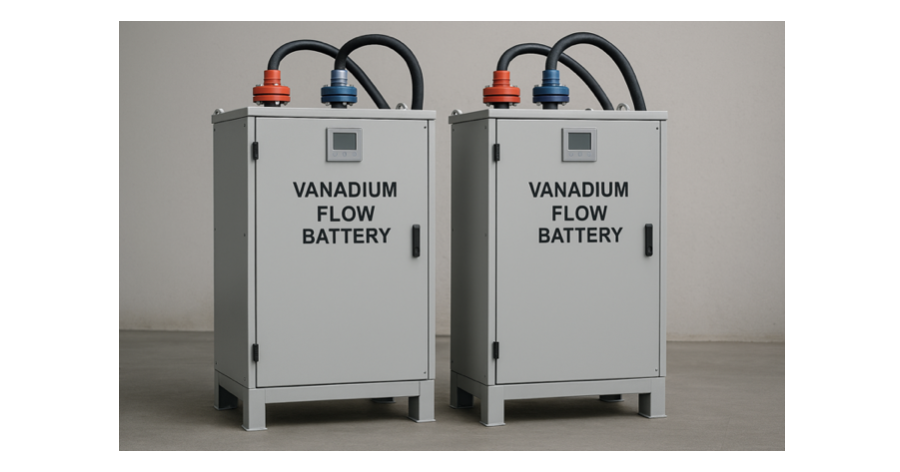
A vanadium redox-flow battery stores energy not in solid electrodes, as lithium-ion does, but in liquid electrolytes held in external tanks and circulated through a cell stack. In the Aarhus/VisBlue 2021 paper on temperature-induced precipitation, the authors describe typical electrolytes as vanadium dissolved in sulphuric and phosphoric acid, with energy conversion taking place in a stack containing electrochemical cells, electrodes and an ion-exchange membrane. VisBlue’s own technical pages describe the same basic architecture in more commercially digestible language: two tanks, pumps, a stack of cells, and vanadium in different oxidation states moving through charge and discharge cycles
This architecture has one decisive system advantage. In a VRFB, power and energy can be scaled independently. If you want more power, you change the stack. If you want more energy duration, you enlarge the tanks and electrolyte volume. For large stationary storage, that decoupling is not a decorative feature. It is the whole proposition. The 2025 RSC review on redox-flow batteries identifies modularity, scalability, and decoupled energy and power as among the core reasons flow batteries remain attractive for grid-scale renewable integration. The U.S. Department of Energy’s flow-battery assessment places the technology squarely within its long-duration storage strategy for systems providing 10 hours or longer.
Vanadium itself also solves a classic flow-battery problem. Because the same element is used on both sides of the system, cross-contamination through the membrane is less destructive than in mixed-chemistry systems. VisBlue states explicitly that this is one reason it favours vanadium over other flow chemistries, since it helps “alleviate cross-contamination” and avoids electrolyte degradation pathways associated with using different redox species. The Aarhus-linked literature on vanadium systems makes essentially the same point from a more scientific angle: using vanadium ions in both half-cells reduces the permanent capacity loss that can arise when species cross the membrane.
The RED-BATS wager
RED-BATS was the central wager on whether this chemistry could be pushed into more industrially meaningful form. Aarhus University’s project page set out a clear trajectory: take a technology then operating around 5 kW stack scale, move to 25 kW, demonstrate a 100 kWh-class system, improve efficiency and cost of ownership, and seed Danish production at VisBlue. The project budget was listed at €2.4 million, funded through Denmark’s Energy Technology Development and Demonstration Programme, EUDP.
The EUDP final report, submitted in February 2025, describes the ambition in unusually plain terms. It says redox-flow batteries, and especially vanadium-flow batteries, are “commercial and market-ready” technologies for energy storage and balancing over time, but also ones that “can still be optimized and matured”. That sentence captures the real status of the field rather neatly. The chemistry is not science fiction. Yet the business of making it work at lower cost, with better efficiency, higher reliability and supply-chain depth, is still very much an engineering and manufacturing challenge.
It is also notable that RED-BATS was not just VisBlue and Aarhus. The final report lists Blue World Technologies as project managing institution and includes Aarhus University, DTU, VisBlue, Dano-tek and SP Moulding as partners. Even in miniature, it looks like the sort of consortium Europe keeps saying it wants: research, components, controls, moulding, manufacturing, and system integration inside one programme. That is one reason the project is interesting as industrial policy, not just as battery development.
What RED-BATS says it achieved
The project did not merely repeat its original targets. It appears to have exceeded them, at least in headline system size. The final report says that a 60 kW / 360 kWh VRFB system was “developed and demonstrated”, and that it is “highly suitable for operation in connection with a wind turbine”. It also says the system would be brought to market by VisBlue, “who already has the first customer”. In addition, the project reports a new “OCV cell and manifold” with significantly lower parasitic losses, along with an integrated electronic and control system for VRFB operation.
Those details matter because they shift the story away from megawatt-hour boasting and back to system engineering. In flow batteries, balance-of-plant losses can be ruinous if pumps, piping, manifolds and controls are not carefully engineered. The project’s focus on lowering parasitic losses suggests that RED-BATS was dealing with one of the technology’s most persistent real-world problems, namely that the apparent elegance of independent energy and power scaling can be undermined by hydraulic and system inefficiencies. A recent system-level analysis in Energies likewise emphasises manifold design, shunt-current losses and pumping losses as critical determinants of overall round-trip efficiency in redox-flow systems.
The same is true of controls. Lithium-ion batteries have benefited from years of refinement in battery management systems, electronics, packaging and supply chains. Flow batteries still need equal seriousness on those supposedly peripheral elements. RED-BATS’ reference to an integrated electronic and control system is therefore not marginal. It signals a recognition that electrochemistry alone does not make a commercial stationary battery. Reliable operation, state-of-charge estimation, thermal management, hydraulic efficiency and user-facing system intelligence are part of the product.
The underlying research chain
One reason this case is more credible than many startup stories is that the research chain is visible. It is possible to see the movement from university project page, to peer-reviewed paper, to final demonstration report, to marketed systems and case studies. The 2021 paper by Emil Holm Kirk, Filippo Fenini, Sara Noriega Oreiro and Anders Bentien is especially useful because it deals not with slogans but with failure modes. Their subject was temperature-induced precipitation of V2O5 in vanadium-flow batteries, a major operational concern because the positive electrolyte is often considered temperature-limited, typically around 40°C, to prevent damaging precipitation.
More importantly, the paper warns against an overly casual reading of degradation data. The authors found that capacity fade, often used in the literature as a proxy for precipitation, can be significantly distorted by external oxidation and cycling parameters, potentially producing incorrect interpretations. Their “in operando” experiments suggested precipitation temperatures 10 to 20°C higher than batch tests under certain conditions. In other words, they were probing not whether vanadium-flow batteries are good in theory, but how one actually interprets system behaviour under operating conditions.
That is precisely the kind of work an industrially serious battery company needs around it. The difference between a chemistry that looks robust in a paper and one that survives years in a municipal building or wind-coupled installation often lies in how well its awkward edge cases are understood. High ambient temperatures, precipitation thresholds, state-of-charge measurement, membrane crossover, shunt currents and parasitic losses are not side issues. They are the technology.
Why VRFBs can beat lithium-ion, sometimes
The strongest argument for vanadium redox-flow batteries is not that they are universally better than lithium-ion. They are not. The stronger claim is narrower: that for certain stationary, long-duration and safety-sensitive applications they may offer a superior bundle of attributes. Reviews of the field repeatedly point to long cycle life, modularity, fast response, high reliability, and a lower fire risk because the electrolyte is aqueous rather than flammable organic solvent. The 2024 membrane review in Inorganic Chemistry Frontiers notes that lithium-ion batteries retain advantages in specific energy and compactness, but also highlights thermal-runaway risks for large-scale applications as a reason redox-flow batteries have drawn increasing attention.
VisBlue leans hard into exactly these points. Its product pages and FAQ emphasise 20-plus-year system life, non-flammability, high recyclability, and the fact that vanadium electrolyte does not wear out in the way solid electrode materials do. Those are company claims and should be treated as such, but they are broadly aligned with why the chemistry has long appealed to grid-storage researchers and project developers. In particular, the ability to retain the value of the electrolyte beyond the life of other components changes the economics and circularity story in ways lithium-ion cannot easily replicate.
That makes the technology especially attractive where long life and cycling endurance matter more than compact footprint. A municipal swimming pool, an islanded microgrid, a housing association with solar and variable tariffs, or a wind-linked balancing application do not care about battery gravimetric energy density in the way an electric vehicle does. They care more about safety case, operating life, schedule of replacement, fire protection requirements, and whether capacity and power can be tailored to the site’s load profile.
Why lithium-ion still wins most of the market
Yet the counter-case is also strong, and any serious analysis has to start there. Lithium-ion dominates for reasons that are not merely historical inertia. It has higher energy density, more mature manufacturing, deeper supply chains, more bankable integrators, faster learning curves, and much greater deployment scale. The DOE’s Storage Innovations reports assessed both lithium-ion and flow batteries as long-duration candidates, but that in itself reflects a reality: lithium-ion starts from commercial dominance, while flow batteries are trying to prove where that dominance should stop.
Flow batteries also have stubborn weaknesses. Their energy density is low. Their systems are mechanically more complex because they need tanks, pumps and fluid handling. Membranes remain expensive. Parasitic pumping losses are real. Space requirements are larger. And unlike lithium-ion, they have not yet benefited from the same extraordinary global scale-up in manufacturing and finance. The 2025 RSC review lists limited energy density, high overall cost, electrolyte instability issues in some chemistries, and engineering hurdles around membranes and electrodes as material constraints on wider deployment.
VisBlue’s own market stance quietly acknowledges this. The company does not currently target households with small batteries because of “size and price”. That is a remarkably honest statement, and it tells us where the chemistry sits today. Vanadium flow batteries are not for everything. Their future depends on becoming convincingly better for certain things.
The Danish and European policy angle
This is where the Danish and European policy angle becomes important. The European Commission’s 2023 Recommendation on Energy Storage argues that a renewable-heavy energy system requires more flexibility across timescales, and that storage can provide not only balancing but reliability, security of supply and lower peak-time prices. The Commission’s energy storage page now frames storage as central to decarbonisation, electrification and energy security, while the newer Batteries Regulation seeks a lifecycle framework around sustainability, safety, performance and recyclability for batteries placed on the EU market.
Denmark’s EUDP sits neatly within that logic. It is a national programme under the Danish Energy Agency designed to support energy technology development and demonstration. RED-BATS therefore exemplifies a particular Scandinavian policy style: support collaborative demonstration, force interaction between universities and firms, and tie the project to a domestic industrial ambition rather than to research publication alone. Aarhus University’s project page is explicit about that ambition. The battery itself matters, but so too does the attempt to establish Danish stack and system production and a competitive domestic supply chain.
From a policy perspective, that is the most interesting feature of the whole story. Europe talks constantly about strategic autonomy in batteries, but most of that discussion defaults to lithium-ion gigafactories. VisBlue suggests another path: highly specialised, regionally embedded manufacturers building technologies that may never be universal, but could become indispensable in niches created by grid flexibility, safety regulation, circularity and long-duration storage needs.
Scale problem and sceptical view
There is, however, a reason to be cautious. RED-BATS’ 60 kW / 360 kWh demonstration is meaningful for a Danish company and a university-linked scale-up. It is not meaningful in the way utility-scale battery markets usually measure significance. China’s Dalian project, based on vanadium-flow technology developed at the Dalian Institute of Chemical Physics, connected a 100 MW / 400 MWh first phase in 2022 and is intended eventually to reach 200 MW / 800 MWh. By 2024, Chinese developers had already moved beyond that scale in other VRFB installations. Against that backdrop, VisBlue’s progress looks serious, but small.
That comparison is not unfair. It is the right one. Europe’s challenge in long-duration storage is not whether it can produce elegant demonstrations. It is whether it can translate them into repeated deployment, financing models, supply contracts, and customer confidence quickly enough to matter. A 40 kW / 200 kWh installation at a municipal swimming pool is real, and useful, but it is not yet the sort of deployment that changes system planning assumptions across the continent.
It is also worth interrogating the phrase “market-ready”, used in the EUDP report. Chemistry can be market-ready while companies are not. A technology family can be technically viable while its economics, bankability, service ecosystem and mineral supply are still fragile. In that sense, VisBlue is more convincingly a demonstration of engineering competence than of commercial inevitability. The article’s real lesson is not that vanadium flow batteries have won. It is that they have made a case strong enough to deserve industrial scrutiny.
The supply-chain question
There is one further complication. Even if Europe wants more vanadium-flow batteries, that does not automatically confer strategic autonomy. Vanadium supply is concentrated, price-volatile, and still overwhelmingly tied to steel rather than batteries. A 2025 academic analysis of the vanadium market for EU green energy argues that supply is highly concentrated, demand remains dominated by steel, and cost, especially electrolyte cost, remains a major barrier to VRFB uptake. The paper also points to European weaknesses in primary mining and refining, even as it highlights circularity options such as electrolyte reuse and recovery from slags and catalysts.
That means the dream of a “Danish supply chain” around VisBlue always had limits. RED-BATS could help develop domestic components, controls and stack manufacturing, and the report suggests it did begin that process. But no Danish or even purely European flow-battery industry can wish away the raw-material geography of vanadium. The best-case strategy is therefore not autarky. It is de-risking through recycling, electrolyte value retention, long-life system design, selective partnerships, and perhaps business models such as electrolyte leasing that separate the hardware sale from the chemistry inventory.
This is also where VisBlue’s claims about recyclability and long life become more than marketing. If the electrolyte retains value and can be reused across component replacements or even systems, then vanadium’s supply-chain problem is not eliminated, but it is reframed. You are no longer buying a fuel that disappears. You are buying a material stock that may remain valuable long after pumps and electronics have been refreshed.
What the VisBlue case shows
So, what does this Danish case reveal? First, that vanadium redox-flow batteries have moved beyond academic possibility. Aarhus University and EUDP documentation, together with the underlying temperature-stability paper and subsequent commercial installations, show a real line from research to demonstration to market entry. Second, that the decisive work in this field is not confined to electrochemistry. It lies in manifold design, parasitic-loss reduction, system controls, site optimisation, customer fit and component sourcing.
Third, the case suggests that Europe’s battery future may become more technologically plural than many industrial-policy debates assume. Lithium-ion will dominate huge swathes of storage for the foreseeable future. But the more the grid values duration, safety, repeat cycling, and flexible sizing, the more room there may be for technologies like VRFBs. The European Commission’s energy-storage agenda already points in that direction, even if the market has not fully caught up.
Finally, VisBlue shows both the promise and the fragility of Europe’s innovation model. Public funding can help turn research into a product. University-industry collaboration can generate tangible hardware. Demonstration can seed domestic capability. Yet none of this guarantee’s scale, and scale is where battery industries become strategic rather than symbolic. On that measure, VisBlue is best understood not as proof of arrival, but as proof of possibility.
A restrained conclusion would therefore be this. VisBlue is one of the more credible European examples of how a flow-battery company can emerge from university research and push into engineering demonstration with public backing. It has done enough to merit attention from policymakers, grid planners and industrial analysts.
But its deeper significance lies not in what has already been won. It lies in the question it puts to Europe: whether the continent can turn these medium-scale, chemistry-specific, industrially grounded experiments into a storage ecosystem large enough to matter.
Timeline
- 2014: VisBlue is spun out from Aarhus University. The company’s own history says it emerged as a Danish-Portuguese spinout linking Aarhus University and the University of Porto.
- 2018: VisBlue records its first commercial sale, according to the company’s history, and Livø becomes the first Danish island with a VisBlue VRFB system in operation.
- 2021: Aarhus and VisBlue-linked researchers publish a peer-reviewed paper on temperature-induced precipitation in vanadium-flow batteries, addressing a key operational challenge.
- 2021 to 2023: RED-BATS runs as an EUDP-funded scale-up and demonstration project aiming to move stack size from 5 kW to 25 kW and demonstrate a 100 kWh-class system, with Danish production ambitions at VisBlue.
- February 2025: The RED-BATS final report states that a 60 kW / 360 kWh system was developed and demonstrated, together with lower-loss cell and manifold design and integrated control advances.
- 2020s commercial phase: VisBlue markets modular VisFlow products and highlights installations such as Værløse Aquatic Center, where a 40 kW / 200 kWh battery is used for municipal energy optimisation.
Glossary
- Vanadium redox-flow battery, VRFB: A rechargeable battery that stores energy in liquid electrolytes containing vanadium ions in different oxidation states, circulated through an electrochemical cell stack.
- Stack: The electrochemical core of the system, containing multiple cells where charging and discharging reactions occur. In flow batteries, stack size largely determines power output.
- Electrolyte: The vanadium-containing liquid that stores the battery’s energy chemically and is pumped through the stack during operation.
- Membrane: A polymer separator inside the cell that allows ion transport while limiting crossover between the two half-cells. Membrane price and performance remain major constraints for VRFB deployment.
- Parasitic losses: Energy losses caused by ancillary parts of the system, including pumps, manifolds, shunt currents and other balance-of-plant effects.
- Thermal runaway: A dangerous self-accelerating failure mode associated especially with lithium-ion systems, and one reason aqueous flow batteries have a different safety profile.
- Long-duration energy storage: Storage designed to discharge over many hours rather than only short peak periods. Flow batteries are often discussed as candidates for 10-hour-plus applications.
Endnotes
- European Commission, “Energy storage”, Directorate-General for Energy.
- European Commission, “Commission Recommendation of 14 March 2023 on Energy Storage”.
- Energy Storage Europe and LCP Delta, “EMMES 9.0”, March 2025.
- Regulation (EU) 2023/1542 concerning batteries and waste batteries.
- Aarhus University, “Scaleup of redox flow batteries”, RED-BATS project page.
- EUDP, RED-BATS final report, submitted 28 February 2025.
- Aarhus University, “Visblue”, spinout profile.
- VisBlue, “The story of VisBlue”, company history.
- VisBlue, “Product” and “VisFlow10” pages.
- Walid Sharmoukh, “Redox flow batteries as energy storage systems: materials, viability, and industrial applications”, RSC Advances, 2025.
- VisBlue, Værløse Aquatic Center case study.
- VisBlue, Livø off-grid case study.
- Emil Holm Kirk, Filippo Fenini, Sara Noriega Oreiro and Anders Bentien, “Temperature-Induced Precipitation of V2O5 in Vanadium Flow Batteries Revisited”, Batteries, 2021.
- Yang Yang, Quge Wang, Shizhao Xiong and Zhongxiao Song, “Research progress on optimized membranes for vanadium redox flow batteries”, Inorganic Chemistry Frontiers, 2024.
- U.S. Department of Energy, “Technology Strategy Assessment: Flow Batteries”, 2023.
- U.S. Department of Energy, “Technology Strategy Assessment: Lithium-ion Batteries”, 2023.
- Chinese Academy of Sciences, reporting on the Dalian flow battery energy storage station, 2022.
- Iván Jares Salguero, Guillermo Laine-Cuervo and Efrén García-Ordiales, “Strategic Analysis of the Vanadium Market: A Critical Element for EU Green Energy”, Energies, 2025.
- VisBlue, FAQ and materials pages.
- System-level engineering literature on energy losses in redox-flow batteries, including manifold, shunt-current and pumping-loss effects.
Source list
Primary sources:
- Aarhus University project page for RED-BATS
- EUDP final report for RED-BATS
- Aarhus-linked and VisBlue-linked 2021 paper on vanadium precipitation behaviour
Company and deployment sources:
- VisBlue company history
- VisBlue product and FAQ pages
- VisBlue municipal and off-grid case studies
Context and comparison sources:
- European Commission energy storage recommendation and storage policy pages
- EU Batteries Regulation
- U.S. Department of Energy Storage Innovations 2030 assessments for flow batteries and lithium-ion batteries
- Peer-reviewed reviews on flow batteries, membranes, and battery safety
- Chinese Academy of Sciences reporting on large-scale vanadium-flow deployment in Dalian
- Academic analysis of vanadium supply-chain concentration and volatility in Europe