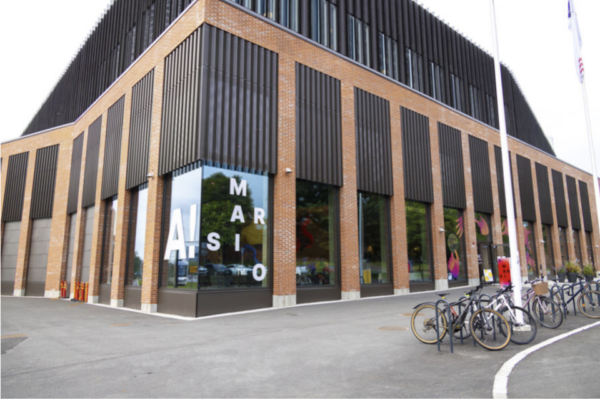
On 1 September 2026, Aalto University’s Designs for a Cooler Planet returns to the Marsio building in Otaniemi (Finland), promising more than 20 research-driven proposals on sustainable architecture, energy, circular materials and bio-based alternatives. The exhibition is framed as Aalto’s largest annual showcase, a place where research becomes visible as “practical solutions, experiments and ideas”, including bio-based material experiments and seaweed-based alternatives to plastic.
That public stage is a fitting place to begin any investigation of Laureen Mahler’s work. Mahler, a doctoral researcher in Aalto’s Department of Art and Media, sits precisely where exhibitions like Designs for a Cooler Planet become more than university outreach. Her field is the liminal zone between craft, mathematics, materials science and ecological design, and her research asks a deceptively simple question: what if the future of packaging is not merely a new material, but a new way of making form?
Aalto’s research portal lists Mahler’s Everyday Materials / Designs for a Cooler Planet as a peer-reviewed artistic and non-textual research output published in connection with Helsinki Design Week in 2025. Its keywords are telling: origami, bio-based materials and packaging design. The exhibition text asks how scaling and industrialisation of bio-based materials can be accelerated, how their life cycles can meet the demands of a circular economy, and whether mid-scale production processes might have a role to play.
This is not simply another “plastic substitute” story. It is a story about geometry, material agency and the change in thinking required when designers stop treating matter as passive. Mahler’s research profile says her work focuses on the designer-maker, knowledge cultivated through the physical act of making, spatial engagement through craft-driven practices, and the combination of field, laboratory, workshop, digital tools and material-driven exploration.
The public-facing hook is irresistible: nettles could replace bubble wrap. In a post from Aalto University Bioinnovation Center, Mahler’s work is described as using bast fibres such as nettle, “long, soft, cellulose-rich fibres”, and transforming them into strong origami structures for sustainable packaging. But nettle is best understood as one strand in a wider research programme, not the whole fabric. The deeper work concerns cellulose sources, mycelium, hemp, paper, folding, moulds, space, and the design of dynamic structures that may one day protect goods without relying so heavily on fossil plastic.
From showcase to method
Designs for a Cooler Planet matters because it places Mahler’s work within a broader institutional argument: that materials research must be translated into social, industrial and policy-facing forms. The 2026 exhibition is explicitly presented as a venue for sustainable futures, with projects ranging from new textiles and agricultural-waste colour to bio-based materials and plastic replacement.
Mahler’s 2025 Everyday Materials contribution took that question into the realm of everyday life. The Aalto research portal describes a landscape in which consumers and industry increasingly demand more sustainable alternatives, while society still needs clothes, homes and built environments “within the limits of what our planet can sustain”. The exhibition’s stated aim, via Professor Pirjo Kääriäinen, was to push material development forward while encouraging visitors to make sustainability shifts in everyday life.
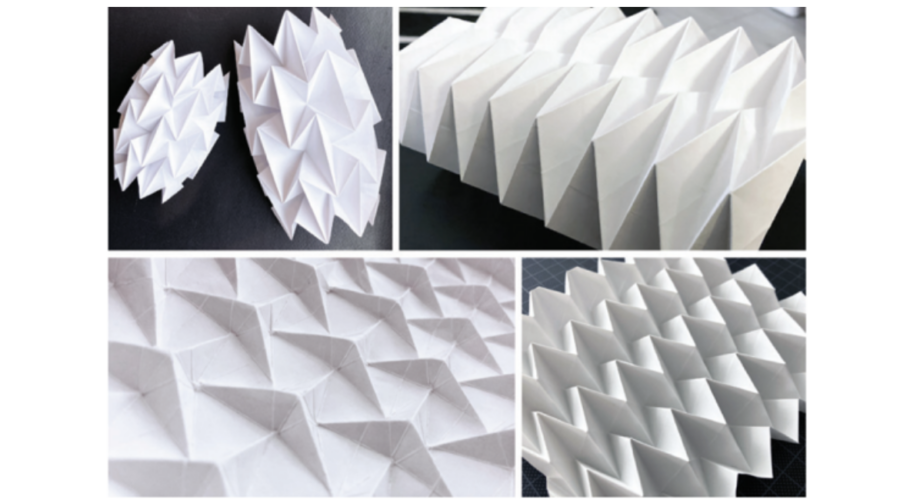
This is where Mahler’s practice becomes policy-relevant. A new material is not automatically a new material system. Packaging needs performance, price, supply chains, standards, disposal routes and public trust. Mahler’s work approaches that system from an unexpected entry point: origami tessellations, repeated folded geometries that can give flat materials strength, cushioning, motion and dimensionality.
The scientific significance lies in the move from material substitution to structural intelligence. Plastic packaging often performs well because it is light, cheap, resilient and geometrically versatile. A bio-based alternative must therefore compete not only chemically, but mechanically and spatially. Mahler’s research suggests that geometry can become part of the sustainability equation: fold the material differently, and the material may do more with less.
The fold as a research instrument
In Shaping Space and Forming Dimensionality through Origami Practice, Mahler begins not with a market claim but with an ontological one. Space, she writes, “surrounds and enfolds the breadth of our doings”. In design research terms, space is not empty background, but something “participatory and dynamic”, physically made alongside the artefact.
The paper, published in the Proceedings of Nordes 2025: Relational Design, uses origami practice to explore how making produces knowledge. Its case is origami tessellation, especially corrugations: periodic folded patterns that can collapse into three-dimensional structures. These structures are not just decorative. They offer a way to observe how materials, force, motion and space become entangled.
For a scientific audience, the paper’s importance is methodological. Mahler treats folding as a way of seeing relations that are otherwise difficult to document. The fold is a line, a force, a memory in the material and a change in the surrounding space. In her analysis, a single crease is not isolated. It is part of an “ecology of the fold”, involving paper, force, direction, time and the space around the structure.
This matters for bio-based packaging because material performance is often relational. A sheet of cellulose, hemp fibre or mycelium composite may be weak in one configuration and surprisingly capable in another. Origami tessellations exploit geometry: unit cells, repeated creases, mountain and valley folds, collapsible forms and dynamic structures. Mahler’s research places these features within design practice, but the implications extend into engineering, packaging and circular materials development.
In the Nordes paper, Mahler uses photographs, video frames, diagrams, CAD mappings and photogrammetry to document folding as a temporal process. The result is a research method for making visible what might otherwise remain tacit: how the material moves, how the structure emerges, and how space is shaped as part of making.
For policymakers, this may sound abstract, but it has practical relevance. Many sustainability failures happen at interfaces: between laboratory sample and factory line, between recyclable claim and waste infrastructure, between consumer behaviour and material design. Mahler’s work insists on studying the process, not merely the finished object. That is exactly what innovation policy often neglects.
Growing rather than folding
The more applied breakthrough comes in Growing Tessellations: Negotiation and Wayfinding in Interdisciplinary Design Practice, co-authored by Mahler and Bahareh Barati and published in the International Journal of Design. The paper explores whether tessellated structures could be grown rather than folded by combining craft, biofabrication and digital fabrication.
The project brought together two research traditions: Mahler’s work on bio-based materials and origami tessellations, and Barati’s expertise in smart and biological materials from a Material Driven Design perspective. Their shared objective was to test whether dynamic three-dimensional structures could emerge through living materials, digital tools and craft techniques rather than through conventional folding alone.
The authors call this approach “growing tessellations”. The phrase is more than poetic. It describes a process in which mycelium, plant fibres, moulds, paper-making and digital fabrication are treated as active contributors. The project does not see the designer as a lone author imposing form on passive material. Instead, it treats design as negotiation among human and more-than-human actors.
The living material in the study is mycelium, the network of fungal hyphae often described as the root-like structure of fungi. Mahler and Barati selected Reishi, Ganoderma lucidum, because it grows reliably in the laboratory, bonds with cellulosic substrates and can be structurally manipulated. They explored two routes: papermaking with mycelium and moulding natural cellulose fibres into tessellated forms.
Crucially, this is where nettles should be placed in the larger story. The public Aalto Bioinnovation Center communication highlights nettle as an example of a cellulose-rich bast fibre that can be transformed into origami structures for packaging. The peer-reviewed Growing Tessellations paper focuses on industrial hemp as the bast fibre substrate, along with pine, bamboo, flax and other cellulose-related material combinations in testing. Nettles are therefore part of the broader bast-fibre and cellulose logic, rather than the central experimental substrate in the supplied academic article.
That distinction is journalistically important. The strongest peer-reviewed evidence available here concerns mycelium composites, hemp fibres, cellulose pulp, papermaking and tessellated structures. The nettle claim is credible as Aalto Bioinnovation Center communication, but it should be reported as one example of the bast-fibre pathway rather than as the core of the published Growing Tessellations experiment.
What the experiments actually did
Mahler and Barati’s project was not a simple materials test. It was an interdisciplinary design investigation. They documented laboratory notes, project diaries, sample catalogues, videos, photographs and workflow instructions. Weekly meetings were used to review artefacts and decide how the project should adapt.
One key experiment was papermaking with mycelium. Standard papermaking is wet, expansive and workshop-based. Mycelium cultivation, by contrast, needs controlled sterility, appropriate moisture and protection from contamination. The researchers had to rethink both practices. They developed a liquid inoculant using Reishi culture, bamboo fibres and xanthan gum, resulting in a medium fluid enough to mix with cellulose pulp while stable enough to support mycelial growth.
The paper reports a promising finding: mechanical testing of mycelium-paper tessellations showed heightened elasticity and fracture toughness compared with non-inoculated sheets made under the same laboratory conditions. This does not yet prove commercial viability, but it is exactly the sort of early result that should attract packaging researchers and industry partners.
A second experiment involved preparing bast fibre substrates. The researchers selected industrial hemp, noting that bast fibres are long and resilient, suitable for durable textiles and stronger paper, and that hemp is a favourable substrate for mycelium. Early attempts produced uneven growth and contamination, so the process was modified through carding, autoclaving and manually massaging the inoculant into the fibres.
A third strand concerned moulds. To grow Miura tessellations, the researchers needed moulds that could hold geometry while allowing mycelium to breathe, grow and respond to moisture. Early 3D-printed PLA moulds were too light, while thicker laser-cut Vivak could suffocate growth. The successful direction involved ultra-light Vivak, vector-marked with crease patterns and manually pre-creased so that the mould could expand or compress in response to the living material.
The point is not that the final object is ready to replace plastic packaging tomorrow. The point is that each failure produced a new design event. The researchers describe these events as “knots” in a meshwork of processes. Craft, biofabrication and digital fabrication each brought constraints and possibilities, and innovation occurred where the processes had to negotiate.
For innovation policy, this is a valuable insight. Bio-based materials often fail because they are asked to enter industrial systems designed for plastics. Mahler and Barati’s work suggests another route: redesign the tools, geometries and processes around the needs of the biological material.
Why origami matters for packaging
Packaging is a geometry problem as much as a chemistry problem. Bubble wrap works because trapped air, flexible polymer films and repeated units absorb shock. Foam works because structure, not just substance, distributes force. Corrugated cardboard works because folds turn a flat sheet into a load-bearing form. Mahler’s origami research belongs in this lineage, but with a bio-based twist.
Origami tessellations such as Miura, waterbomb, Kresling and Resch patterns are dynamic structures. They can fold flat, expand, compress and distribute forces through repeated geometries. In Growing Tessellations, Mahler and Barati note that origami tessellations already appear in research on packaging, auxetic textiles, soft robotics, deployable technologies, metamaterials and shape-changing interfaces.
This breadth matters. It means the research is not trapped in the craft studio. The same forms that interest artists and designers also interest engineers. In packaging, the potential lies in creating cushioning, impact absorption, adjustability and aesthetic value from renewable or regenerative materials.
The Aalto Bioinnovation Center post makes the packaging proposition explicit: bast fibres such as nettle can be transformed into strong origami structures that may serve as protective and aesthetically striking alternatives to plastics. The phrase “replace bubble wrap” is catchy, but the deeper claim is that cellulose structure plus origami geometry could produce a new category of protective packaging.
A material culture shift
Mahler’s work is optimistic, but not simplistic. The centre of gravity is not only performance, but culture. The two supplied papers return again and again to making, attention, negotiation and the role of non-human actors. In Growing Tessellations, the authors argue for “making-with”, a mode of interdisciplinary practice where designers work with materials, tools, organisms and machines rather than merely on them.
This is where the work becomes especially relevant for a magazine audience. The future without too much plastic will not be beige, joyless or purely technical. Mahler’s research suggests that sustainable materials can be beautiful, dynamic and tactile. The Aalto Bioinnovation Center post describes the structures as both protective and aesthetically striking, while Everyday Materials asks how bio-based materials might enter ordinary homes and lives.
That aesthetic dimension should not be dismissed. One reason plastic became ubiquitous is that it was cheap, colourful, mouldable and emotionally legible as modern. If bio-based alternatives are to win public adoption, they need not only low emissions or biodegradability, but also desirable material cultures. They must feel like progress, not austerity.
Mahler’s origami structures offer a possible answer. They replace the smooth anonymity of plastic with visible intelligence: folds, fibres, surfaces and forms that reveal how they work. In that sense, they could help change what consumers expect protective packaging to look and feel like.
The limits of the evidence
A strongly optimistic reading still needs to be honest about what is not yet known. Growing Tessellations is explicitly exploratory. The authors state that their aim was not comprehensive characterisation of the tessellated artefacts or full experiential and qualitative testing, but the development of methodological tools for interdisciplinary designing, event analysis and reflection on practice.
Commercial packaging would require further testing: compression behaviour, drop performance, humidity resistance, shelf life, microbial safety, scaling, cost, end-of-life behaviour, compatibility with recycling or composting systems, and supply-chain availability. For nettle specifically, more source-specific data would be needed on fibre processing, cultivation, yields, regional supply and performance in folded structures.
There is also a larger systems question. Bio-based is not automatically sustainable. A material can be renewable but land-intensive, compostable but not collected, biodegradable but unsuitable for real disposal conditions, or circular in theory but linear in practice. Aalto’s Everyday Materials framing acknowledges precisely this challenge by asking how life cycle and reuse can be designed to meet circular-economy demands.
The promise of Mahler’s research is that it does not treat these questions as afterthoughts. By foregrounding process, documentation and negotiation, it gives industry and policy a way to catch problems early, while the material system is still being shaped.
Why this research is strategically important
Europe’s plastics challenge is not a single-material problem. It is a design, infrastructure and procurement problem. Lightweight fossil plastics dominate because they are embedded in machines, standards, retail expectations and logistics. A replacement material must therefore enter a full ecosystem of performance and policy.
Mahler’s work is strategically valuable because it sits before the point of lock-in. It asks how materials, structures, tools and practices can be designed together. The Growing Tessellations project even produced a visualisation tool for mapping interdisciplinary design events, treating documentation as an intermediary artefact that helps teams identify where affordances emerge.
That matters for innovation agencies. Too often, funding separates material science, design, manufacturing and user research into distinct work packages that meet late in the process. Mahler’s research shows why early entanglement matters. The mould, the fibre, the fungus, the fold and the fabrication method all have to be negotiated together.
In policy language, this is a call for mission-oriented material innovation. The mission is not simply to invent a biodegradable film. It is to reduce unnecessary plastic through new material systems, new geometries, new production processes and new cultural expectations.
A roadmap for a future without too much plastic
The optimistic conclusion is not that plastic disappears. Some medical, safety and technical applications will continue to need high-performance polymers. The realistic goal is a future without too much plastic: fewer single-use fossil materials, fewer unnecessary layers, fewer petrochemical cushioning systems, and more packaging designed around renewable fibres, structural geometry and circular end-of-life routes.
Mahler’s research points towards a concrete policy roadmap:
First, fund geometry-led bio-based materials research. Public research funding should not separate “material” from “form”. Programmes should explicitly support projects that combine cellulose, bast fibres such as hemp and nettle, mycelium composites, origami tessellations, mechanical testing and packaging design. Mahler’s work shows that the fold is not decorative, but functional and epistemic.
Second, build mid-scale pilot facilities. Aalto’s Everyday Materials text asks whether mid-scale production processes could accelerate bio-based materials. This is the missing layer between laboratory sample and industrial conversion. Finland and the wider Nordic region should fund shared pilot lines where researchers, fibre processors, packaging companies and retailers can test folded bio-based structures in realistic batch sizes.
Third, create packaging trial sandboxes. Public agencies and large retailers should run controlled procurement trials for non-food e-commerce cushioning, cosmetics, electronics, books, ceramics and spare parts. These are promising early markets because they require protection and presentation, but not always the strict barrier properties of food packaging. Mahler’s origami-inspired structures could be tested first where cushioning, aesthetics and renewability matter most.
Fourth, require comparative life-cycle assessment from the beginning. Bio-based packaging should be assessed for carbon, water, land, chemical inputs, transport, reusability, recyclability and compostability. The work should include end-of-life modelling for real municipal systems, not idealised disposal. Aalto’s exhibition framing already recognises the life-cycle question as central to circular material development.
Fifth, develop standards for bio-based structural cushioning. Current packaging standards often assume established materials. New standards are needed for fibre-based origami structures, including compression recovery, humidity behaviour, contamination safety, biodegradation claims, fibre sourcing and compatibility with paper recycling streams. This would help prevent greenwashing while giving serious innovators a route to market.
Sixth, support regional fibre economies. Bast fibres such as hemp and nettle should be investigated not as novelty plants, but as part of local bioeconomy strategies. That means agronomy, harvesting, retting, fibre processing, pulp integration and design applications need to be studied together. The Aalto Bioinnovation Center’s nettle communication is a useful public signal, but the next step is peer-reviewed, fibre-specific performance and supply-chain evidence.
Seventh, use public procurement to create first demand. Universities, municipalities, museums and state agencies can specify reduced-plastic packaging in tenders and require suppliers to test renewable protective systems where technically feasible. This would create a market signal without waiting for perfect cost parity.
Eighth, treat design exhibitions as innovation infrastructure. Designs for a Cooler Planet is not merely communication. It is a translation device, where scientists, designers, policymakers, companies and citizens can encounter early-stage material futures. Mahler’s work benefits from precisely this kind of setting because it needs not only laboratory validation, but cultural imagination and industrial conversation.
The fold after plastic
The promise of Laureen Mahler’s research is quiet but radical. It does not ask us to wait for one miracle molecule. It asks us to reconsider the relationship between material, form and making. In her work, paper is not flat, cellulose is not simple, mycelium is not inert, and space is not empty. A fold becomes a laboratory. A fibre becomes a structure. A fungus becomes a collaborator.
That is why her research deserves attention beyond design circles. For scientists, it offers a process-rich approach to material discovery. For policymakers, it suggests how public funding, standards and procurement could accelerate alternatives to unnecessary fossil plastic. For readers, it offers a tangible image of the future: a parcel arriving not wrapped in petrochemical bubbles, but cushioned by fibrous, folded, bio-based structures whose strength comes from geometry and whose beauty comes from being visibly made.
The future without too much plastic will not arrive through substitution alone. It will arrive through redesign: of materials, of systems, of expectations and of the humble protective forms that sit between the things we make and the world they travel through. Mahler’s work suggests that one path to that future may begin with a sheet, a fibre, a living material and a fold.
Source notes
- The nettle-specific claim is drawn from Aalto University Bioinnovation Center’s public LinkedIn communication. It describes Mahler’s work with bast fibres such as nettle for cellulose-rich origami structures that may serve as sustainable packaging alternatives. [linkedin.com]
- The peer-reviewed Growing Tessellations article focuses on mycelium composites, hemp bast fibre substrates, cellulose pulps, papermaking, digital fabrication and Miura tessellations. Nettles should therefore be treated as one example within a broader bast-fibre and cellulose research direction. Growing Tessellations: Negotiation and Wayfinding in Interdisciplinary Design Practice
- The Shaping Space paper provides the theoretical and methodological basis for understanding origami practice, dimensionality, spatial engagement and relational making. Shaping Space and Forming Dimensionality through Origami Practice
- The Designs for a Cooler Planet framing is taken from Aalto University’s 2026 exhibition page and news article, plus Mahler’s 2025 Everyday Materials exhibition record in the Aalto research portal. [aalto.fi], [aalto.fi], [research.aalto.fi]
References
- Aalto University. (2026). Designs for a Cooler Planet 2026 exhibition. https://www.aalto.fi/en/events/designs-for-a-cooler-planet-2026-exhibition
- Aalto University. (2026). Research becomes real-world solutions in autumn exhibition; Designs for a Cooler Planet showcases work by researchers and students. https://www.aalto.fi/en/news/research-becomes-real-world-solutions-in-autumn-exhibition-designs-for-a-cooler-planet-showcases
- Aalto University. (2026). Laureen Mahler at AeRaTe. https://www.aalto.fi/en/school-of-arts-design-and-architecture/laureen-mahler-at-aerate
- Aalto University Bioinnovation Center. (2026). Who knew nettles could replace bubble wrap? LinkedIn post. https://www.linkedin.com/posts/aalto-university-bioinnovation-center_nettle-cellulose-sustainablepackaging-activity-7393892991435784192-Hpqh
- Aalto University Research Portal. (2026). Laureen Mahler. https://research.aalto.fi/en/persons/laureen-mahler/
- Mahler, L. (2025). Everyday Materials / Designs for a Cooler Planet. Exhibition, Aalto University & Helsinki Design Week. https://research.aalto.fi/en/publications/everyday-materials-designs-for-a-cooler-planet/
- Mahler, L. (2025). Shaping space and forming dimensionality through origami practice. In A. Morrison, A. Culén, & L. Habib (Eds.), Proceedings of Nordes 2025: Relational Design, 6 to 8 August, Oslo, Norway (pp. 675 to 682). Design Research Society. https://doi.org/10.21606/nordes.2025.60
- Mahler, L., & Barati, B. (2025). Growing tessellations: Negotiation and wayfinding in interdisciplinary design practice. International Journal of Design, 19(3), 31 to 61. https://doi.org/10.57698/v19i3.02