ForumNordic Analysis by Nicholas Anderson, Editor in Chief, and leading expert for international infrastructure funding solutions for critical long term investments.
Russia’s war in Ukraine has settled one argument in European capitals: defence spending is going up, permanently. It has opened a much messier one: how, exactly, is anyone supposed to pay for it? NATO’s push toward 5% of GDP on defence and defence-adjacent spending is arriving faster than national treasuries can absorb it. No single government budget, however disciplined, can carry that load alone — and that arithmetic is what has pushed the Nordic and Baltic region into the middle of a genuinely new experiment in collective financing.
Over the past year, a cluster of new mechanisms has emerged, each trying to solve the same underlying problem from a different angle: how to unlock long-term, patient capital for weapons production, munitions stockpiles and dual-use technology, at a scale and speed that annual parliamentary budget cycles were never designed for.
A familiar template, borrowed for a new purpose
The instinct behind most of these proposals is not new. Europe already runs on a model of state-backed, regionally owned development banks — the European Investment Bank (EIB), the European Bank for Reconstruction and Development (EBRD) and the Nordic Investment Bank (NIB) among them — that have spent decades financing infrastructure with exactly the profile defence now needs: enormous upfront capital, long payback horizons, and a premium on stable, investment-grade credit. State and regional ownership is what gives these institutions their strong ratings in the first place.
The logic now being applied to defence is the same one: pool sovereign credit, spread the risk, and use that combined strength to borrow more cheaply than any single mid-sized economy could manage on its own. Where it gets complicated is that none of the existing development banks are considered a clean fit — most were built with governance structures, sectoral mandates or big-member-state politics that make it awkward to simply redirect them toward weapons and ammunition. So rather than one obvious answer, the Nordics are watching several new vehicles take shape in parallel.
The UK-led track: MDM
The most advanced of these, from Finland’s vantage point, is the Multilateral Defence Mechanism (MDM), which began life as a trilateral effort between the United Kingdom, the Netherlands and Finland in March 2026. Its goal is explicitly to speed up joint procurement and aggregate demand for critical defence capabilities, rather than to build a bank in the traditional sense.
The mechanism has been gathering momentum. Ahead of the NATO summit in Ankara, Finland, the UK, the Netherlands and Poland issued a joint statement on 6 July confirming they will expand MDM into a broader coalition and move into the next phase of design work this autumn. Poland is the newest addition — notably, none of the other Nordic countries have joined MDM to date. Sweden, Norway and Denmark have made no public move to sign on, at least not yet.
The Canadian-led track: DSRB
That absence looks less like disengagement and more like a bet on a different table. Sweden, Norway and Denmark all appear as prospective anchor nations in the Defence, Security and Resilience Bank (DSRB), a proposed multilateral development bank that would be headquartered in Canada and designed to mobilise private capital — with six of Canada’s largest banks already signed on as partners — to work alongside, rather than replace, national defence budgets.
The DSRB’s anchor-nation list draws heavily on the Joint Expeditionary Force (JEF): Denmark, Estonia, Finland, Iceland, Latvia, Lithuania, the Netherlands, Norway, Sweden and the UK, plus the United States and Japan. Credit quality is doing a lot of the selection work here — the only NATO members currently holding a AAA rating are Canada, Denmark, Germany, Luxembourg, the Netherlands, Norway and Sweden, which is precisely why Stockholm, Oslo and Copenhagen carry outsized weight in the bank’s proposed capital structure. An earlier, related proposal from the Atlantic Council envisaged a similar institution acting as a depository for annual allied financing commitments, centrally managing funds for stockpiling and R&D.
Commentary out of London has begun framing MDM and the DSRB as competing rather than complementary options, with the UK Treasury reportedly weighing one against the other. For the Nordics, though, there is no requirement to pick a side yet — Finland is active in MDM while remaining a JEF anchor nation eligible for DSRB, and Sweden, Norway and Denmark can watch both tracks mature before committing serious capital to either.
Brussels’ own toolkit: SAFE, the EIB and defence bonds
Running alongside both bank proposals is a purely EU-level track. The Security Action for Europe (SAFE) programme uses Union-level loans to help member states accelerate defence investment and close procurement gaps in line with NATO commitments. The EIB has separately widened its own risk appetite for defence — expanding loans, guarantees, equity investment and advisory support, and updating its eligibility rules so that SMEs and start-ups can tap dedicated credit lines through financial intermediaries. The European Investment Fund has begun seeding specialist defence venture capital, including a €50 million commitment to Join Capital, in an attempt to build a European defence and dual-use investment ecosystem that barely exists today compared with the United States. Jointly issued EU defence bonds — collective debt to fund procurement without loading it entirely onto national budgets — have also been floated repeatedly by EU leadership, though not yet formalised.
Unlocking capital that has been sitting on the sidelines
A quieter but equally important strand of this story is about reworking the private capital rules that have kept institutional money out of defence altogether. Many defence SMEs still struggle to get bank or institutional financing because of ESG screening; the UK’s Defence Secretary and Chancellor have set up a task force pushing ten-year investment strategies and disclosure rules specifically to make defence investable again. Insurance regulators including EIOPA and the NAIC are reviewing capital-charge treatment for structured credit, partly to free up insurer balance sheets for long-duration, defence-adjacent lending. Where traditional banks remain slow, fintech and private-credit lenders are increasingly stepping in to provide working capital to smaller suppliers. At national level, some governments are also relaxing fiscal rules to permit defence-specific borrowing outside normal deficit constraints, while NATO itself has launched a €1 billion innovation fund to backstop dual-use and defence-tech start-ups directly.
Where the Nordics actually stand
For Sweden, Norway and Denmark, the clearest concrete commitment so far runs through NORDEFCO rather than any of the new international financing vehicles. Nordic defence ministers signed a revised NORDEFCO memorandum of understanding on 6 May in Rovaniemi — the first update since Finland and Sweden joined NATO — under Norway’s 2026 chairmanship of the group. That gives the five Nordic countries a well-established regional forum for coordinating procurement and standards even as they weigh their positions on MDM, the DSRB and the EU’s SAFE programme.
The pattern that emerges is less about picking a single winner and more about hedging across several bets simultaneously — joining early where the terms suit a country’s interests (as Finland has with MDM), while keeping a seat reserved at the other tables (as Sweden, Norway and Denmark are doing through JEF and prospective DSRB membership). With the next phase of MDM design due this autumn and DSRB’s founding-nation discussions still in progress, the coming months should show which of these mechanisms Nordic finance ministries are prepared to put real money behind — and whether the region ends up backing one model, or, in keeping with its own preference for diversified, competing institutions, several at once.
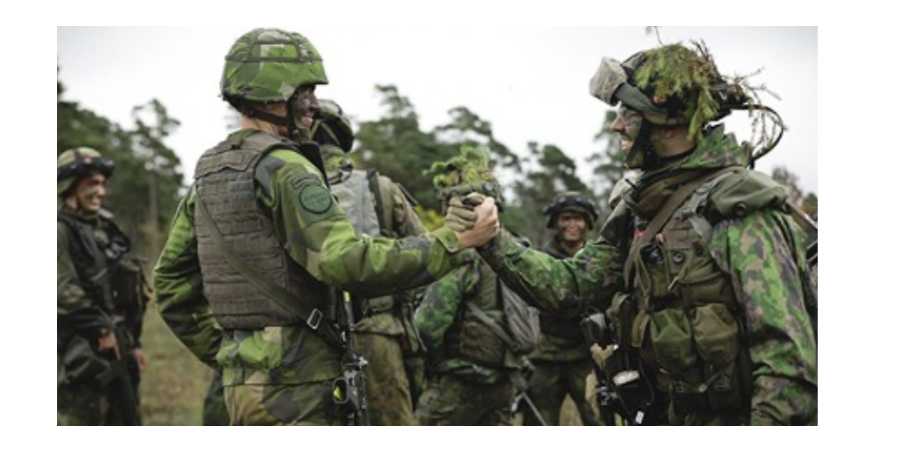
Photo: Finnish Defence Forces.