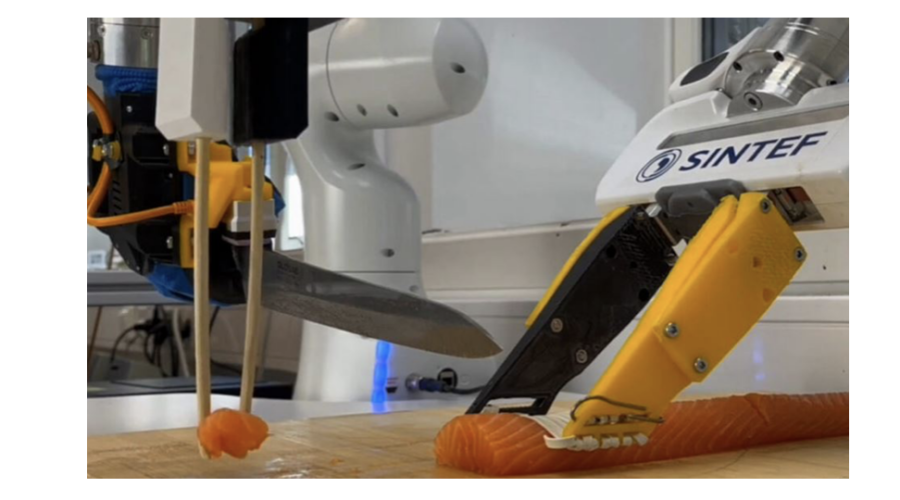
Somewhere in Trondheim, a robot with three arms is doing something no self-respecting machine should be able to do: handling a slippery, wobbly salmon loin without turning it into fish paste. It slices. It plates. It does not, as far as anyone has reported, judge your knife skills. That last part is the only reason it hasn’t taken your job yet.
Sashimi-Bot is the work of SINTEF Ocean, alongside NTNU, QUT, Inria, MIT and NMBU, under the GentleMAN and BIFROST projects, funded by the Research Council of Norway. The results were serious enough to land in both Nature Magazine and the freshly minted journal Nature Robotics — which is either a triumph for autonomous robotics or the most elaborate justification for a sushi dinner ever written into a grant proposal.
Why salmon? Because, according to chief scientist Ekrem Misimi, there is barely anything in nature more annoying for a robot to grip than a soft, slick, shape-shifting fish loin. Salmon doesn’t hold still, doesn’t have a fixed shape, and actively resists being turned into dinner with any dignity. If you’ve ever lost a fight with a fillet at home, you now have a research consortium’s worth of validation.
The robot itself runs three arms in coordination — one straightens the loin, another wields the knife, a third finishes the job with chopsticks, lifting the finished slices onto a platter without them sticking to the blade. Researchers call this “physical intelligence”: the combination of seeing, feeling and adjusting in real time, rather than executing a rigid script. The knife itself carries a sensor that registers resistance as it cuts, roughly mimicking the feedback a human hand gets when a blade hits a cutting board — a fish-based answer to the age-old robotics problem of “how does a machine know it’s about to break something.”
Training happened first in simulation, essentially a virtual sushi dojo, before the robot applied that knowledge directly to real fish with no retraining required — which is more than can be said for most junior line cooks.
The bigger point, buried under the novelty, is that salmon makes an unusually good stand-in for every other frustrating, deformable, irregularly shaped object robots currently can’t handle — meat, fruit, textiles, recycling streams, even underwater maintenance targets. If a robot can manage sashimi without shredding it, the same tactile and visual control techniques start looking plausible for jobs in food processing, agriculture, healthcare and underwater infrastructure repair — areas still leaning heavily on manual labour precisely because the materials involved are too unpredictable for older robotic systems.
Sverre Herland, another SINTEF Ocean researcher on the project, called it the most fun work he’s done — not a sentence usually associated with peer-reviewed robotics papers, but then again, most peer-reviewed robotics papers don’t end with a robot serving you dinner.
Nobody is claiming Sashimi-Bot is coming for the world’s sushi chefs. But somewhere between the lab bench and the platter, it’s quietly solving a problem robotics has struggled with for decades: how to touch the real world without wrecking it.