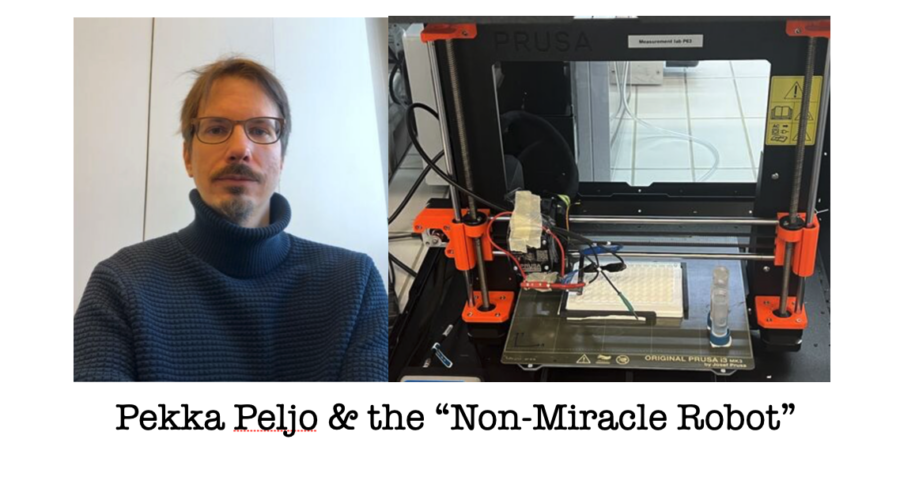
Aalto University’s converted 3D printer could help materials researchers produce better electrochemical data. It has not, however, discovered a superior battery material.
At Aalto University, researchers have combined a liquid-handling machine, a modified consumer 3D printer and electrochemical instrumentation to automate repetitive measurements. The result is an accessible high-throughput platform that can compress weeks of laboratory work into days. Its immediate achievement is not the discovery of a revolutionary battery chemistry, but something less spectacular and potentially more useful: a faster, more standardised way to produce the experimental data on which future discoveries may depend.
In a laboratory at Aalto University in Espoo, Finland, a machine built from familiar components moves a set of electrodes through the wells of a laboratory plate. Solutions have been prepared by a liquid-handling robot. Electrochemical measurements follow automatically, while software organises and partly processes the resulting data.
The apparatus, known as HT-EChem, looks modest beside the enclosed robotic laboratories and articulated arms increasingly associated with artificial intelligence in science. One of its central components began life as a consumer-grade 3D printer. Yet its relative simplicity is part of the point.
Researchers led by electrochemist Pekka Peljo have repurposed the printer’s precise three-axis movement to position a three-electrode assembly in successive wells of a standard 96-well plate. The platform combines this positioning system with automated liquid handling, cyclic-voltammetry instrumentation and a structured data-processing workflow.
The system does not make each individual electrochemical measurement dramatically faster than a trained scientist. Instead, it removes much of the repetitive labour surrounding a large series of measurements. Experiments can be programmed in advance and left to run for extended periods, including overnight. Sample preparation is accelerated, electrodes can be moved systematically between wells, and measurements made under numerous chemical conditions can be collected in a consistent format.
According to doctoral researcher Chuyue Li, a measurement campaign that could occupy a researcher for about two weeks may be completed by the platform in roughly one day. That figure is reported by the research team rather than established through an independent productivity study, but it illustrates the intended advantage: not faster electrochemistry in each well, but greater throughput across the whole experimental campaign.
What the platform actually demonstrated
The strongest evidence for HT-EChem comes not from the university’s news release, published on 14 September 2026, but from the associated open-access research article in Device. The paper, published online on 8 September, describes a standardised, high-throughput electrochemistry platform for investigating redox-active chemical species.
Its principal analytical method is cyclic voltammetry, in which the electrical potential applied to an electrode is swept through a predetermined range while the resulting current is measured. The shape and position of the resulting curves can reveal whether a compound undergoes oxidation or reduction, at what potential the reaction takes place and how reversible the process appears under the tested conditions.
These properties matter in redox-flow batteries. Unlike conventional sealed batteries, a flow battery generally stores its electroactive material in liquid electrolytes held in external tanks and pumped through an electrochemical cell. The power-producing hardware and the quantity of stored electrolyte can therefore, within engineering limits, be scaled separately. This makes flow batteries candidates for stationary applications requiring storage over several hours or longer.
The researchers used HT-EChem to examine iron-aminopolycarboxylate complexes and selected organic redox molecules. They tested how changes in pH affected redox potential, electrochemical reversibility and the accessibility of particular reactions. The high-density measurements allowed the team to construct potential-pH maps and stability-pH profiles.
The experiments also distinguished among the electrochemical behaviour of related iron complexes. Fe-PDTA displayed two reduction features consistent with a reaction followed by structural reorganisation, while Fe-EDTA and Fe-DTPA showed one dominant reduction peak under comparable conditions. This is a meaningful scientific result because it demonstrates that the automated platform can do more than register the presence or absence of a signal. It can generate sufficiently structured measurements to support mechanistic interpretation.
The paper therefore supports several specific conclusions:
- HT-EChem can perform cyclic-voltammetry screening in a 96-well format.
- It can examine large sets of controlled chemical conditions, including systematic pH variation.
- It operates with microlitre-scale samples, reducing the amount of reagent required.
- It can produce comparable, structured electrochemical datasets.
- It can reveal condition-dependent differences among redox-active compounds.
None of this is equivalent to demonstrating a commercially superior energy-storage material.
The discovery claim that the evidence does not support
The distinction is particularly important because phrases such as “robot accelerates the search for energy-storage materials” can easily mutate into the much stronger assertion that a robot has discovered a better battery material.
The available evidence does not support that assertion.
Aalto University itself is unusually explicit on this point. Peljo says that although vanadium works well in many flow-battery systems and can provide a long service life, its cost motivates the search for more affordable materials. He then adds that the researchers do not yet have a genuinely promising alternative for flow batteries. The immediate achievement, the university states, is primarily a new way of performing experimental research.
The research article reports characterisation and mechanistic analysis of model redox systems. It does not report a new electrolyte that outperforms vanadium across the combination of criteria required in a practical flow battery. These include redox potential, solubility, chemical and electrochemical stability, reaction kinetics, membrane compatibility, crossover behaviour, safety, raw-material availability, cost and long-term performance in a functioning cell.
Nor does the evidence presently show:
- an independently replicated discovery of a superior redox material;
- a full battery-cell demonstration based on a newly discovered candidate;
- long-duration cycling sufficient to establish operational stability;
- benchmarked performance against commercial vanadium systems;
- pilot-scale manufacturing or deployment;
- a quantified reduction in the total time required to move from molecular screening to a bankable storage product.
The robot is consequently best described as a high-throughput robotic electrochemistry platform, not as an autonomous inventor or a machine that has independently discovered a better battery.
Automated, but not yet fully self-driving
There is also a technical difference between an automated laboratory and a self-driving laboratory.
A widely used scientific definition describes a self-driving laboratory as a platform in which machine learning selects experiments iteratively in pursuit of an objective, automated equipment performs them, the results are analysed and the next experimental choices are made through a closed feedback loop.
HT-EChem automates substantial parts of the physical and informational workflow. Its published description covers sample handling, electrode positioning, cleaning checks, measurements and structured processing. It also produces the kind of standardised data that could later support machine learning.
What has not been demonstrated in the reported work is a complete autonomous cycle in which an algorithm repeatedly decides which new compound or condition to test, instructs the apparatus, evaluates the outcome and redesigns the next experiment without substantive human intervention.
That makes HT-EChem a potential building block for a self-driving laboratory rather than, on present evidence, a fully realised one. Its intelligence lies mainly in workflow design and data standardisation. The scientific questions, chemical selections and experimental boundaries still originate with researchers.
This is not a trivial limitation, but neither is it a criticism of the platform’s value. Closed-loop autonomy depends on reliable automation. An optimisation algorithm is of little use if the measurements fed back to it are inconsistent, poorly documented or distorted by electrode contamination, sample-handling errors or instrument drift.
Why standardised data may be the real advance
Materials research often faces a circular difficulty. Machine-learning models require large, reliable and sufficiently diverse datasets. Yet generating those datasets experimentally is expensive and time-consuming. Models trained on a narrow chemical domain may appear accurate within that domain but perform badly when asked to predict unfamiliar molecules or conditions.
“Machine learning is only as good as the data it has been trained on,” Peljo told Aalto University. The immediate question, he said, is how experiments can be accelerated sufficiently to produce the data needed for better predictive models.
HT-EChem addresses the experimental half of that problem. Automation makes it easier to vary one or more conditions systematically, while a common plate format and data workflow may improve comparability. Smaller samples also allow researchers to investigate compounds available only in limited quantities and can reduce chemical consumption and waste.
But high throughput is not automatically high quality. An automated system can reproduce an error as efficiently as it reproduces a valid measurement. Electrode fouling, evaporation, cross-contamination, incorrect sample identification, reference-electrode drift and software configuration failures can all generate misleading datasets. An automated platform therefore requires calibration routines, control samples, metadata standards, error detection and continuing human scrutiny.
The published system includes cleaning checks and structured processing, but its wider value will depend on how reliably other laboratories can reproduce its measurements with their own equipment, compounds and operators.
Open hardware lowers one barrier, not all of them
The research team has released raw cyclic-voltammetry data, a design for the 3D-printed electrode holder and the control software. The supporting dataset was made available through Zenodo under a CC BY 4.0 licence, while the software repository describes an MIT-licensed code package.
The repository includes motion and instrument-control logic, data-visualisation and cyclic-voltammetry analysis tools. It also identifies external dependencies, including vendor libraries for PalmSens instrumentation, an optional MySQL database and an optional OctoPrint installation for printer control.
This openness matters. Laboratory automation is often restricted by proprietary hardware, bespoke integration and the cost of engineering a system around equipment that was never designed to communicate with other instruments. Reusing the movement system of a consumer 3D printer offers a comparatively inexpensive route to repeatable electrode positioning.
Nevertheless, “open source” should not be confused with effortless replication. A laboratory would still need compatible electrochemical instruments, liquid-handling equipment, chemically resistant components, software expertise and procedures for validation and safety. The public repository also reports no visible forks or stars at the time captured by the source, so broad adoption and independent reproduction cannot yet be inferred.
Part of a much larger race
HT-EChem sits within an international movement towards automated and autonomous experimentation.
One prominent comparison is A-Lab at Lawrence Berkeley National Laboratory and the University of California, Berkeley. A-Lab combined computational predictions, published knowledge, robotics, machine learning and active learning to plan and interpret solid-state synthesis experiments. During 17 days of operation it synthesised 41 novel compounds from 58 targets. That system demonstrated a more complete form of autonomous materials experimentation than HT-EChem, although it addressed inorganic solid synthesis rather than liquid electrochemical screening.
In battery research, a 2024 system developed by researchers associated with the Helmholtz Institute Ulm, the Karlsruhe Institute of Technology and the Technical University of Munich integrated millimetre-scale battery experiments, electrochemical testing, spectroscopy and data infrastructure. Its authors emphasised reproducibility and the challenge of combining measurements of differing fidelity, illustrating that automation must extend beyond moving samples if it is to guide materials decisions reliably.
Researchers at the University of Washington and Pacific Northwest National Laboratory have also reported autonomous organic synthesis for redox-flow-battery materials using robotic experimentation and Bayesian optimisation. That work closes more of the loop between automated experiments and algorithmic decisions than the present HT-EChem demonstration.
These comparisons establish both the significance and the limits of the Finnish platform. HT-EChem is not the world’s first automated materials laboratory, nor the most autonomous. Its distinctive promise is accessibility: a relatively uncomplicated architecture for turning a routine but labour-intensive electrochemical method into a higher-throughput, standardised process.
From an Aalto apparatus to a European development chain
The platform is connected to PREDICTOR, a European Union-funded doctoral network intended to create high-throughput methods for the screening, synthesis and characterisation of redox-flow-battery materials.
The project runs from 1 September 2024 to 31 August 2028 and has an EU contribution of €3,603,168 under the Marie Skłodowska-Curie Actions. It brings together seven principal partners and 15 associated organisations from 11 countries and is training 17 doctoral researchers.
Its planned development chain extends beyond electrochemical measurement. It includes computational screening, automated synthesis and electrolyte preparation, experimental characterisation, data management and AI-supported self-optimisation. The consortium intends to validate the approach using active materials and electrolytes for redox-flow batteries and ultimately assemble three demonstrator cells at technology-readiness levels 3 to 4.
HT-EChem should therefore be understood as one component in a broader European attempt to connect modelling, preparation, measurement and validation. Whether that chain produces improved battery materials will depend not only on the speed of any single robot but on the compatibility of data and methods across institutions.
Commercial value will depend on the bottleneck
The platform’s clearest near-term value is in research productivity. It can release skilled researchers from repetitive sample preparation and measurement, improve the density of experiments across variables such as pH and reduce the quantity of material consumed.
For universities and smaller research organisations, the use of open designs and a modified consumer machine may lower the entry cost of automation. For companies, however, the commercial calculation is more complicated. An automated screening platform adds value only if electrochemical characterisation is a genuine bottleneck and if the resulting measurements predict performance in a complete cell.
A molecule that looks favourable in cyclic voltammetry may fail because it decomposes over repeated cycling, crosses a membrane, reacts with another electrolyte component, is difficult to synthesise, has insufficient solubility or costs too much. High-throughput screening can eliminate unsuitable candidates earlier, but it cannot remove the need for progressively more realistic testing.
Nor is there evidence yet that HT-EChem has reached industrial readiness. The relevant publication establishes laboratory performance and scientific utility. It does not provide a full cost model, uptime analysis, maintenance requirement, cross-laboratory reproducibility study or comparison with commercial laboratory-automation systems.
A quieter, more credible revolution
The temptation in reporting laboratory automation is to attribute agency to the machine. Robots “discover”, AI “invents” and autonomous laboratories appear to displace the scientist. The reality is more layered.
HT-EChem is valuable because researchers have redesigned an experimental workflow. They have identified where human time is being lost, adapted inexpensive motion hardware, integrated instruments and imposed structure on the resulting data. The robot performs the repetition. Scientists still define what constitutes an interesting molecule, judge whether a voltammogram is chemically meaningful and decide which apparent improvements deserve further investigation.
No superior flow-battery material has yet emerged from the platform. No replacement for vanadium has been announced. No industrial battery has been built around a robotic discovery.
What has been achieved is narrower and more defensible. Aalto University and its collaborators have shown that a common electrochemical experiment can be made more systematic, less labour-intensive and more data-rich using a combination of liquid handling, open software and a repurposed 3D printer.
If the system is reproduced independently, integrated into closed-loop optimisation and connected successfully to synthesis and cell validation, it could help accelerate materials development. For now, its contribution is to make better experiments easier to run. In a field frequently distracted by claims of machine intelligence, that may be precisely the kind of progress worth noticing.
Fact box: HT-EChem
| What is it? | A high-throughput robotic platform for liquid electrochemical measurements, particularly cyclic voltammetry. |
| What does the hardware include? | A liquid-handling robot, a modified consumer 3D printer used for electrode positioning, a three-electrode assembly and electrochemical instrumentation. |
| What format does it use? | Standard 96-well plates and microlitre-scale samples. |
| What has it demonstrated? | Automated screening of redox-active compounds across conditions including pH, with structured analysis of redox potential and reversibility. |
| Has it found a superior battery material? | No. The research team explicitly says that it does not yet have a promising alternative to established flow-battery materials. |
| Is it fully autonomous? | Not on the evidence reported. It automates a workflow but has not demonstrated a complete machine-learning-controlled experimental feedback loop. |
| Are the resources public? | The dataset, raw cyclic-voltammetry files, electrode-holder design and software have been released publicly. |
| What is the wider programme? | PREDICTOR, an EU-funded network developing high-throughput and AI-supported methods for redox-flow-battery materials. |
References
Abolhasani, M., & Kumacheva, E. (2023). The rise of self-driving labs in chemical and materials sciences. Nature Synthesis, 2, 483–492. https://doi.org/10.1038/s44160-022-00231-0
Aalto University. (2026, September 14). Robot accelerates the search for energy-storage materials.
Aalto University. (2026). Electrolytic Processes.
European Commission. (2024). High-throughput screening, synthesis and characterization of active materials for flow batteries: PREDICTOR, Grant Agreement 101168943. CORDIS. [cordis.europa.eu]
Fraunhofer Institute for Chemical Technology. (n.d.). Research project PREDICTOR. [ict.fraunhofer.de]
Li, C., Liu, X., Dey, M., Martínez González, E., Moumaneix, L., Kousar, A., & Peljo, P. (2026). From screening to mechanism-informed analysis: A standardized high-throughput electrochemistry platform for redox species discovery. Device, Article 101282. [cell.com]
Li, C., Liu, X., Dey, M., Martínez González, E., Moumaneix, L., & Peljo, P. (2026). Supporting data for “From screening to mechanism-informed analysis: A standardized high-throughput electrochemistry platform for redox species discovery”. Zenodo. https://doi.org/10.5281/zenodo.19663868 [research.aalto.fi]
Rahmanian, F., Fuchs, S., Zhang, B., Fichtner, M., & Stein, H. S. (2024). Autonomous millimeter scale high throughput battery research system. Digital Discovery, 3(5), 883–893. [pubs.rsc.org]
Szymanski, N. J., Rendy, B., Fei, Y., Kumar, R. E., He, T., Milsted, D., McDermott, M. J., Gallant, M., Cubuk, E. D., Merchant, A., Kim, H., Jain, A., Bartel, C. J., Persson, K., Zeng, Y., & Ceder, G. (2023). An autonomous laboratory for the accelerated synthesis of novel materials. Nature, 624, 86–91. https://doi.org/10.1038/s41586-023-06734-w [nature.com], [pmc.ncbi.nlm.nih.gov]
Tamura, C., Job, H., Chang, H., Wang, W., Liang, Y., & Sun, S. (2025). Autonomous organic synthesis for redox flow batteries via flexible batch Bayesian optimization. Digital Discovery, 4(10), 2737–2751. [pubs.rsc.org]
Photos: Aalto University