After four years and eight million euros, a European research consortium says it has cracked one of the EV industry’s stickiest problems: building a battery that’s both less dependent on scarce raw materials and better at protecting itself from degradation.
The Horizon Europe project IntelLiGent, coordinated by SINTEF Industry in Trondheim, set out to design a next-generation lithium-ion battery — cobalt-free, lighter on critical materials, and smart enough to slow its own decay. Project manager Nils Peter Wagner says the team examined the battery cell down to its smallest components to find the optimal material mix, motivated partly by geopolitics: more than 95 percent of global lithium-ion cell manufacturing currently happens in Asia, and the raw materials batteries depend on are often mined in politically unstable regions.
The headline innovation sits in the cathode, built from a new generation of cobalt-free lithium-nickel-manganese oxide that uses less lithium and nickel than today’s standard chemistries while still delivering high energy density and voltage. The anode pairs graphite with silicon, which stores far more lithium ions than graphite alone, supplied by Norwegian company Vianode using a manufacturing process it says cuts emissions by 90 percent compared to competitors.
Perhaps the cleverest piece is the binder — normally a passive material that just holds electrode structures together. IntelLiGent’s team replaced the usual fluorinated PVDF binder, which requires toxic solvents, with a water-soluble alternative that does double duty: it actively traps manganese and nickel ions released from the cathode before they can migrate to the anode and trigger lithium plating, a major cause of battery aging.
“Our binders can trap the metal ions manganese and nickel when they are released from the cathode, preventing them from reaching the anode, where they can cause lithium plating and reduce the battery’s lifetime,” Wagner explains.
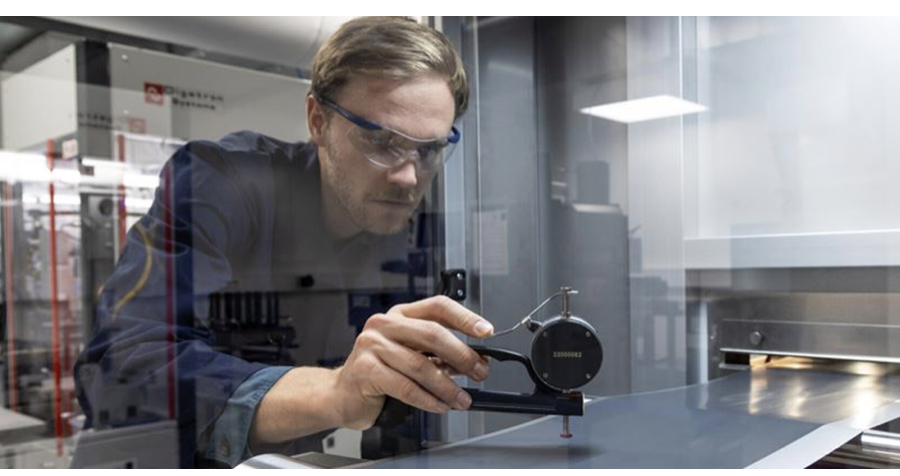
Beyond chemistry, the project cleared an industrial hurdle that has stalled other European battery efforts: at the SINTEF Battery Lab, researchers scaled production of water-based electrode rolls up to 100 metres at high density and uniform quality — among the first European demonstrations of scaling water-based LNMO cathodes for EVs. The team has produced more than 60 test cells, and Spanish manufacturer MILLOR BATTERY has already built a working battery module from them, showing the chemistry can move toward real battery packs.
With the project wrapping up in 2026, the consortium — which also includes the University of Oxford, the Austrian Institute of Technology, Topsoe, Empa, ELyte, and IREC — frames the results as a concrete step toward a European-made, next-generation EV battery supply chain.
Photo: SINTEF