For decades, saving a drifting ship in a storm has meant hauling nearly a tonne of towing gear across the water in a bag slung beneath a helicopter — slow, heavy, and useless once the weather turns nasty. A new system developed by SINTEF and Norwegian partners just made that problem obsolete.
The innovation is disarmingly simple: shrink the equipment enough to fit inside the helicopter cabin instead of dangling below it. The new towline and its purpose-built carrying case, dubbed the “helibag,” weigh just 75 kilos combined — a fraction of the roughly 1,000 kilos legacy systems require. Carrying the load internally rather than externally lets rescue helicopters fly farther and operate in far worse weather, directly expanding Norway’s reach when ships lose power in the North Sea or Norwegian Sea.
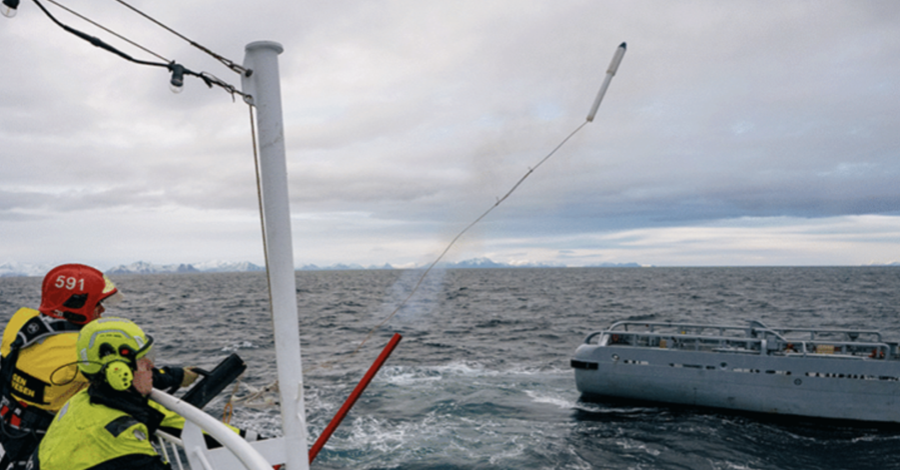
The system got an unplanned real-world validation this year. During a full-scale rescue exercise off Lofoten — involving the cruise ship M/S Spitsbergen, the coast guard vessel KV Barentshav, and the SAR Queen helicopter — a genuine Mayday call interrupted the drill. The bulk carrier LMZ Pluto had lost engine power in the Norwegian Sea en route from Russia to Colombia. Days later, the same crew members who had just trained with the new gear were lowered onto the 190-metre, fertilizer-laden vessel to attach an emergency tow, keeping it clear of offshore installations.
“When the equipment is safely on deck, the crew carries the helibag to the mooring deck and deploys the towline. The whole setup only takes ten minutes,” said Ørjan Selvik, senior adviser at SINTEF Ocean, who led the exercise.
The timing matters. Every year, 140 to 170 ships drift in Norwegian waters awaiting rescue, and from 2028 stricter emergency-towing rules take effect for vessels above 20,000 gross tonnage. Norway currently has no dedicated capability to board an abandoned vessel and rig a tow — a gap the Norwegian Coastal Administration, which oversaw the exercise, says the new equipment and training program are meant to close.
The rope itself was developed by Offshore & Trawl Supply near Ålesund, and can be fired to a stricken ship by air cannon or delivered via sea drone. Nothing in the system is radically new technology on its own; the innovation lies in reassembling known components into something light and fast enough to matter in a real emergency. As Selvik put it: “The best innovations are usually intuitive.”
More training sessions are now planned to roll the equipment out across Norway’s rescue services.
Photo: SINTEF