A reported feature on the Norwegian company trying to turn phase change materials into a commercially credible thermal battery, and why that is important and goes far beyond one start-up.
What follows distinguishes between three kinds of evidence: company claims, research-partner claims, and independently documented evidence in public records and published research. As of 11 June 2026, Cartesian looks genuinely promising, but it is not yet a done deal. The public evidence supports serious technical progress and real installations. It does not yet support every commercial and performance claim often attached to the broader “thermal battery” story.
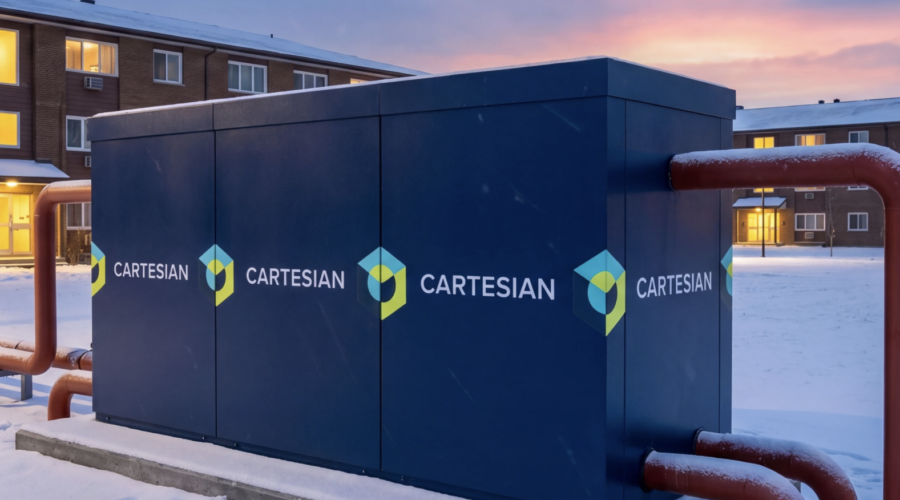
On 21 May 2024, in a REMA 1000 supermarket in Mjøndalen, a small crowd gathered around a piece of equipment that, on first inspection, did not look like the future. It was called a thermal box. Its job was not to electrify transport, dazzle venture capitalists, or fit neatly into the now familiar battery script. It was there to store cold. Electricity would be used when prices were low, the cold would be banked, and the box would discharge later, helping the store ride through hotter, more expensive periods of the day. SINTEF described the system as a “cold battery”, developed originally through the FME HighEFF research centre, while Cartesian’s own case study presented the installation as a 200 kWh cold-storage unit integrated with the site’s CO2 refrigeration system.
That scene captures why Cartesian is one of the more interesting Norwegian energy plays below the headline. The company is not chasing the glamour end of the energy transition. It is working on thermal energy storage, or TES, using phase change materials, or PCMs, to store heat and cold in a compact form. That sounds niche until one remembers the scale of the problem. SINTEF notes that roughly half of global energy demand is thermal, while in industry the share can reach about 80 per cent. The IEA, for its part, continues to show that buildings account for around 30 per cent of global energy demand, with heating, hot water and cooling still doing much of the work. In advanced economies, most residential building energy is still tied up in space and water heating, and cooling remains the fastest-growing building energy use globally.
Once you see that, Cartesian starts to make more sense. This is not a story about replacing lithium-ion cells with something warmer. It is a story about the fact that buildings, supermarkets, district heating systems, industrial processes and data centres do not mostly need electrons in abstract form. They need temperature control, delivered at the right moment, in the right place, at a tolerable cost. By June 2026, Cartesian’s newer public-facing site was no longer describing itself only as a building technology company. It was talking about turning “buildings and factories into flexible energy assets”, with applications spanning commercial buildings, district heating and cooling, and data centres. That widening frame matters because it suggests the company increasingly sees itself not as an equipment vendor for green buildings alone, but as a flexibility company for an electricity system under strain.
The Norwegian angle is crucial here. Norway is often discussed through hydropower, offshore wind, batteries, hydrogen and industrial decarbonisation. But heat is a quieter system bottleneck. A recent SINTEF publication on the future Norwegian building stock found that buildings consume more than 50 per cent of the country’s electricity, and that smarter heating choices can materially reduce both annual electricity use and winter peaks. Another SINTEF-related publication on detached houses reported that buildings accounted for 56 per cent of Norway’s final electricity consumption in 2023. In a 2025 viewpoint, SINTEF argued that smarter use of building electricity could postpone expensive grid investments, while another blog entry in early 2026 framed two-thirds of grid capacity on the coldest days as effectively “reserved” for building heating. In a country electrifying transport and industry while facing grid constraints, thermal flexibility is not a side issue.
Cartesian’s backstory is almost archetypally Norwegian. The company was founded in 2023 and is a spin-out from SINTEF Energy Research, with roots also in NTNU. SINTEF says the technology was partially developed through the research centre HighEFF, while Cartesian itself traces the technology through more than a decade of phase-change-materials work at SINTEF and cites research and demonstration projects including HighEFF, PCM-STORE and PCM-STOVE. According to the company, one founder, Alexis Sevault, had been working on compact heat storage at SINTEF, while another, Håkon Selvnes, focused on compact cold storage during his PhD and related work with NTNU and industry. Their convergence produced the commercial insight that the same essential architecture could handle both heat and cold.
There is, importantly, some independent public evidence beneath that origin story. Well before Cartesian the company existed, researchers tied to SINTEF and NTNU had published on latent heat storage in the ZEB Laboratory in Trondheim. A 2019 SINTEF conference publication described an innovative PCM-based latent heat storage unit integrated into the centralised heating system of the Zero Emission Building living laboratory, with a total designed storage capacity of 0.6 MWh, a maximum combined effect of 26 kW, and bio-based wax as PCM at a melting temperature of 37°C. A 2020 follow-up publication described an active latent heat storage unit using biowax in the ZEB Lab’s central water-based heating system, storing heat from the main heat pump and district heating network, with a storage capacity of 194 kWh and the same 37°C bio-based wax. This is not yet proof that Cartesian’s current product suite is mature at scale, but it is proof that the company’s claims of a long research runway are not invented from thin air.
The ZEB Laboratory itself also matters because it is a real building environment rather than a bench-top fantasy. The lab is a nearly 2,000 m² zero-emission building at NTNU Gløshaugen, with extensive building-integrated photovoltaics, heat pumps, and a PCM bio-wax heat storage battery linked into the energy system. Cartesian’s own reference page says a 200 kWh Thermal Box has been in operation there since mid-2021. The site presents the installation as a way of storing surplus solar energy as heat and using it later to stabilise building temperature and reduce operating costs. Again, the company case study is promotional, but the existence of the ZEB Lab infrastructure and the earlier publications establish that this is a serious demonstration lineage rather than a deck-only company.
So, what is the product, exactly? Cartesian’s original Norwegian site described the Thermal Box as a modular, retrofit-ready thermal energy storage system using phase change materials across a wide temperature range from minus 20°C to 120°C, intended for commercial buildings and district heating and cooling. The newer 2026 site sharpened the commercial language: “5× more compact than water”, scalable from 50 kW to 5 MW thermal, with a “25-year design life”, and marketed as “non-flammable” and “low-maintenance”. The company also points to specific use cases, from avoiding chiller upsizing to reducing grid peak demand, and says the box can be plugged indoors or outdoors. That is the sales pitch. The underlying physics is simple enough: store latent heat or cold through phase changes rather than relying only on sensible heat in large volumes of water. The difficulty is not the idea. The difficulty is making it reliable, controllable, compact, affordable and safe in real systems.
This is where the public evidence becomes especially interesting. SINTEF’s COMPETES project, launched for 2024 to 2026, may be the clearest public sign that Cartesian is moving from promising prototype work toward pre-commercial maturity. SINTEF states that the main objective is to demonstrate Cartesian’s second-generation thermal energy storage system at TRL 6 to 7 and to raise two major innovations from TRL 4 to 6 to 7. One innovation is a design method using extruded aluminium profiles, which SINTEF says should make the system significantly lighter and 30 per cent more cost-effective, with patent pending. The other is a state-of-charge determination method, which is especially important in latent thermal storage because knowing how much usable heat or cold remains in a phase-changing medium is not as straightforward as reading voltage in an electrochemical battery. SINTEF says the project budget is NOK 14.4 million, with NOK 7.2 million from the Research Council of Norway, and that it aims to lay the basis for pre-commercial technology by 2026 and broader adoption by 2027.
The phrase “state of charge” may sound like jargon, but it gets to the heart of whether Cartesian can become more than a clever box. Thermal storage systems live or die by controls and integration. The latent heat stored in a PCM is valuable only if operators can call on it accurately, predictably and at the right thermal power. SINTEF’s separate La-Flex project, running 2024 to 2027, makes explicit that real-time state-of-charge measurement and precise thermal power control are needed if latent thermal energy storage is to participate in flexibility and reserve markets. Cartesian is part of that consortium alongside SINTEF, DTU, THWS, AInergy and KLP Eiendom. In other words, the company’s technical bottlenecks are not hidden. They are being worked on openly in public collaborative research.
That is one reason Cartesian deserves serious attention. Another is that there is already a visible if still early installation base. Patentstyret said in April 2025 that Cartesian had four installations in Norway and France and several more projects scheduled for delivery in 2025. SINTEF’s award note the same month said the company already operated installations in Norway and France and planned further expansion in Europe and the United States. Cartesian’s own case studies list at least three named references: the 200 kWh ZEB Lab installation, a 200 kWh REMA 1000 cold storage project in Mjøndalen operating since Q2 2024, and an 800 kWh heat storage installation using 37°C bio-based wax in KLP Eiendom’s 19,000 m² office building in Trondheim, operating since Q4 2024. A trade newsletter in April 2024 also reported a 400 kWh Thermal Box destined for France for collective residential heating.
Still, this is where a tougher journalistic reading becomes necessary. Public evidence that the systems exist and operate is not the same as independent evidence that they perform as advertised over time. Cartesian says the REMA 1000 project reduces energy consumption and that the system can support stable cooling on hot days. SINTEF’s award article says the broader solution reduces energy consumption by 10 per cent, energy costs by 20 per cent, peak loads by at least 30 per cent, and investments in cooling and heating equipment. The newer company site gives a live-looking number of “−38% peak demand vs. baseline”. Yet none of the material publicly available in June 2026 appears to offer a detailed, third-party measurement and verification report for the current commercial product generation, with methodology, baselines, seasonal data, cycling statistics and uncertainty ranges. That does not make the claims false. It means they remain partly claims.
The same caution applies to compactness. Cartesian’s 2026 site claims “5× the energy density of water”, while a Patentstyret customer story in late 2024 quoted Alexis Sevault saying the solution is “four to eight times more compact than conventional solutions for thermal storage”. These are not necessarily contradictory. Compactness depends on the chosen PCM, the relevant temperature window, heat exchanger design, and how one defines the comparison case. But the shift in public language is a reminder that almost every attractive attribute in thermal storage is conditional. Compactness relative to a big water tank is real. Compactness at acceptable power density, cycling life and installed cost is the commercial test.
That last phrase, power density, points to one of the core technical risks. PCMs have an obvious appeal because latent heat storage packs more energy into less volume. Yet for decades the technology has grappled with a set of stubborn materials and engineering problems. Recent reviews continue to flag low thermal conductivity, containment and leakage as major limitations for broader use. Hydrated salts often suffer from supercooling, phase separation, leakage and poor conductivity. Paraffin-based PCMs, meanwhile, are valued for reliable phase behaviour and low supercooling but are troubled by low conductivity and, in many cases, flammability. None of these issues is fatal in principle. All of them can become commercial killers if not handled elegantly and cheaply in an industrial product.
Cartesian’s own patenting activity suggests it knows exactly where one of its hardest engineering problems lies. A WIPO publication from March 2026 describes a “phase change material thermal storage device with regeneration of the heat exchange surface”. The abstract is blunt: as the PCM solidifies, the design must ensure that the solid phase frees space near the heat exchange surface so that fresh liquid can come into contact and continue latent storage and thermal restitution. In plainer language, one challenge is that ice, wax or salt hydrate wants to create thermal bottlenecks around the exchanger surfaces. If those bottlenecks become severe, a compact storage concept can lose the very performance it needs to justify itself. The patent language on detaching solid PCM from heat exchange surfaces, through active or passive heating, mechanical means or surface treatment, reads like a clue to the company’s real engineering frontier.
There are hints elsewhere that Cartesian’s team has been wrestling with exactly these practicalities for years. In its 2024 article on the Thermal Box, the company said SINTEF had catalogued more than 300 different PCM candidates, tested 50 intensively, and narrowed the field to around ten promising materials. That is not independently verified public science on its own, but it aligns with the broader picture of a technology platform that is less about one magical material than about matching the right PCM to the right temperature band and then creating a package that can exchange heat quickly enough, cheaply enough and safely enough to be worth installing. For cooling applications, the company has repeatedly emphasised water or ice at 0°C because it is cheap and available. For heating applications around buildings, it has used bio-based wax near 37°C.
Safety is another area where public messaging deserves scrutiny. Cartesian’s 2026 site and some application pages now describe the Thermal Box as “non-flammable”, “safe and reliable”, and built from recyclable materials. That may be true for at least some configurations, especially if the PCM mix, enclosure and fire strategy are chosen accordingly. Yet the wider PCM literature remains cautious. Review papers note that the major drawback of many organic PCMs is flammability, particularly in buildings and other safety-critical settings, and that extensive work on flame retardance is still needed. Specific paraffin-based PCMs are explicitly described in the literature as highly flammable unless modified or encapsulated appropriately. Since Cartesian’s published references include bio-based wax as a PCM, the relevant question is not whether “PCM” as a category is safe, but which PCM, in which package, under which standard, in which installation. As of June 2026, the company’s public materials do not seem to provide a clear list of external certifications, fire test standards passed, or product-level safety dossiers in the public domain.
This matters because the sales channels Cartesian appears to be chasing are conservative. HVAC engineers, supermarket refrigeration contractors, district heating operators and eventually insurers do not buy poetic thermodynamics. They buy systems that fit standards, survive procurement, and come with warranties and references they can defend. Cartesian has clearly made progress with references. It showed at ISH 2025 in Frankfurt, where its exhibitor profile described the box as easy to integrate into water- and glycol-based building systems and suitable for indoor or outdoor installation. The company also appears to be building a partner network across Europe and, by 2026, had a North American distribution reference through Siwa HVAC, which presented the Thermal Box as suitable for commercial and institutional buildings in cooling and heating contexts. That kind of channel development is a sign of intent, but channel development is not the same thing as market adoption.
Commercial durability is arguably the second great test, after the engineering. Proff, drawing on official Norwegian company registry data, shows Cartesian AS was established in 2023 and had eight employees, 2024 revenues of NOK 6.86 million, a pre-tax loss of NOK 13.5 million, and equity of roughly NOK 2.0 million at the end of 2024. That is not alarming for a deep-tech spin-out at this stage, but nor is it trivial. The company is still small, cash-burning and in the awkward middle distance between demonstrator and scaled manufacturer. Publicly visible funding rounds help explain how it got this far. Arntzen reported in early 2024 that Cartesian raised NOK 23 million in capital plus about NOK 8 million in R&D funds from the Research Council of Norway and Innovation Norway. Later reports and investor posts pointed to a roughly NOK 30 million financing package in 2025, with support from SINTEF Venture, Kongsberg Innovation, Eviny Ventures and others.
The ownership picture also says something about the company’s current phase. Proff’s shareholder data show SINTEF Venture VI as the largest shareholder at 33.876 per cent, alongside founder-linked entities and investors including Kongsberg Pre-Såkorn Fund 1 and Eviny Ventures. This looks like a spin-out still held relatively close to its originating ecosystem, rather than a company already financed for rapid industrial roll-out. That can be a strength, because it keeps the research-commercialisation bridge intact. It can also be a constraint if scaling requires much larger manufacturing, service and balance-sheet capacity than early investors want to provide.
Then there is the question of manufacturability. SINTEF’s COMPETES project puts unusual emphasis on cheaper design through extruded aluminium profiles, while the company’s environmental claims emphasise recyclable steel, reusable PCMs and low-maintenance design. That pairing is telling. A thermal battery can be technologically elegant and still commercially doomed if the balance of aluminium, steel, enclosure complexity, controls and integration labour pushes the installed cost too high. The life-cycle picture is also not automatically green. A 2025 life-cycle assessment of a commercial PCM-filled compact storage module for building applications, not Cartesian’s product but relevant to the category, found that aluminium production dominated climate impacts in manufacturing. That is a reminder that the carbon story for compact thermal storage depends heavily on material choices, recycled content, and the operational savings actually delivered in service.
And yet, despite all these caveats, Cartesian’s proposition remains unusually credible by the standards of the energy-transition hype cycle. One reason is that it is built on an infrastructural truth rather than a speculative market. Buildings and industry already consume vast amounts of thermal energy. Norway and Europe are already facing electricity grid constraints. Cooling demand is already rising. Data centres are already becoming large, localised heat and cooling loads. SINTEF’s 2025 project on Norwegian participation in the IEA thermal energy storage task explicitly frames TES as strategically relevant for buildings, industry, district energy systems and data centres. The company’s recent shift toward data-centre and urban-project messaging may simply reflect that reality. Thermal storage is becoming easier to understand as a system-enabling tool rather than a building add-on.
A second reason is that Norwegian research institutions are not describing Cartesian in the language usually reserved for speculative curiosities. SINTEF says the company demonstrates what can happen “when research and industry collaborate on concrete challenges”, and the Nordic Innovation Award jury emphasised the company’s “well-thought-out IP strategy” as well as its role in reducing energy consumption, peak loads and CO2 emissions. Patentstyret’s materials make clear that Cartesian has been serious about patents and freedom-to-operate work, while the WIPO publication shows that at least part of that strategy has now entered the international patent system. In other words, the company is behaving like an engineering company trying to build defensible industrial know-how, not merely a climate-tech story machine.
Still, the honest verdict in June 2026 is not that Cartesian has cracked compact thermal storage once and for all. It is that Cartesian has advanced far enough to deserve close attention, and perhaps to unsettle older assumptions about what counts as an energy-storage company in Europe. The public evidence supports a clear chain from multi-year SINTEF and NTNU research, through published demonstrator work in the ZEB Lab, into named installations in Norway and France, backed by public R&D funding, industrial partners, and patent activity. The evidence also supports the claim that second-generation product work is underway with explicit targets for lower cost, better control and higher readiness.
What the evidence does not yet fully provide, at least in public, is the independent operational granularity that would turn promise into bankability. There is no obvious public trove of third-party long-duration cycling data for current product variants, no clear public schedule of certifications and fire-test disclosures, no disclosed standardised capex figures per usable kWh thermal, and no broad set of customer-side M&V reports showing performance across seasons and use cases. Those gaps are normal for a young industrial company. They are also precisely what separates a compelling Norwegian research spin-out from a durable European infrastructure supplier.
If Cartesian clears that bar, the implications extend well beyond one company. It would suggest that one of the most underappreciated fronts in the energy transition is not glamorous long-duration electricity storage alone, but the quiet, local, temperature-based reshaping of demand in buildings and heat systems. It would suggest that Norway’s research-commercialisation machine can produce not only dramatic frontier technologies, but also tools for reducing very ordinary, very expensive thermal peaks. And it would strengthen the case that the next stage of European electrification depends as much on managing heat and cold cleverly as on adding more generation and wires.
The right way to see Cartesian, for now, is as a serious contender rather than a coronated winner. It is promising because the public record shows real science, real engineering, real pilots, real partners and a coherent policy fit. It is still only promising because the hardest questions remain the oldest ones in industrial technology: can it be manufactured cheaply, integrated simply, financed patiently, certified convincingly, and proven repeatedly in the field? By the end of 2026, the most important signals to watch will be the outcome of COMPETES, any public disclosure around second-generation product performance, clearer evidence on safety certification, and whether the company can convert research-backed credibility into repeatable sales beyond the friendly orbit of Norwegian demonstrators.
In that sense, Cartesian is not a headline-grabbing moonshot. It is something more Norwegian, and perhaps more useful: a disciplined attempt to commercialise the mundane fact that heat matters, that timing matters, and that a lot of the energy transition will be won not in spectacular moments, but in quiet machine rooms where peaks are shaved, chillers downsized, boilers deferred and thermal loads moved out of the way.
If the company succeeds, the real story will not be that it invented an exotic new battery.
It will be that it helped make heat legible to an electricity system
that can no longer afford to ignore it.
Reference list:
- Arntzen de Besche. (n.d.). Cartesian successfully raises capital. https://www.arntzen.no/en/post/cartesian-successfully-raises-capital [arntzen.no]
- Cartesian. (n.d.). About us. https://cartesian.no/about-cartesian/ [cartesian.no]
- Cartesian. (n.d.). KLP Eiendom: In search of efficient energy storage and reduced consumption. https://cartesian.no/case-study/klp-eiendom/ [cartesian.no]
- Cartesian. (n.d.). REMA 1000: Advanced storage reduces energy consumption. https://cartesian.no/case-study/enhancing-supermarket-energy-efficiency/ [cartesian.no]
- Cartesian. (n.d.). Technology overview. https://cartesian.no/technology/ [cartesian.no]
- Cartesian. (n.d.). The Zero Emission Building: A testing ground for thermal energy storage and energy efficiency. https://cartesian.no/case-study/zero-emission-building/ [cartesian.no]
- Cartesian. (2024, August 5). Newly developed Thermal Box aims to solve the energy crisis. https://cartesian.no/thermal-box-aims-to-solve-the-energy-crisis/ [cartesian.no]
- Cartesian. (2026). Cartesian: Turning buildings into flexible energy assets. https://www.cartesian.energy/ [cartesian.energy]
- International Energy Agency. (2025). Buildings. In Energy efficiency 2025. https://www.iea.org/reports/energy-efficiency-2025/buildings [iea.org]
- International Energy Agency. (n.d.). Cooling. https://www.iea.org/energy-system/buildings/space-cooling [iea.org]
- Patentstyret. (2024, November 20). Cartesian uses rights to gain an edge over competitors. https://www.patentstyret.no/en/customer-stories/cartesian-uses-rights-to-gain-an-edge-over-competitors[patentstyret.no]
- Patentstyret. (2025, April 10). Norwegian Cartesian wins Nordic Innovation Award. https://www.patentstyret.no/en/news-updates/norwegian-cartesian-wins-nordic-innovation-award [patentstyret.no]
- PCM-ral. (2024, April). Phase change matters newsletter. https://pcm-ral.org/phase-change-matters-newsletter-april-2024/ [pcm-ral.org]
- Proff. (n.d.). Cartesian AS – Org.nr. 830 975 012 – Trondheim. Retrieved June 11, 2026, from https://www.proff.no/selskap/cartesian-as/trondheim/designere/IDQQOF8009Y [proff.no]
- Proff. (n.d.). Cartesian AS – Aksjonærer i Norge. Retrieved June 11, 2026, from https://www.proff.no/aksjon%C3%A6rer/bedrift/cartesian-as/830975012 [proff.no]
- Sevault, A., Bøhmer, F., Næss, E., & Wang, L. (2019). Latent heat storage for centralized heating system in a ZEB living laboratory: Integration and design. In 1st Nordic Conference on Zero Emission and Plus Energy Buildings. SINTEF. https://www.sintef.no/en/publications/publication/0198cc4ea473-48d1e27a-47f5-47fc-822a-881c61f30699/ [sintef.no]
- Sevault, A., & Næss, E. (2020). Active latent heat storage using biowax in a central heating system of a ZEB living lab. In Proceedings of the 14th IIR-Gustav Lorentzen Conference on Natural Refrigerants (pp. 493–498). International Institute of Refrigeration. https://doi.org/10.18462/iir.gl.2020.1146 [sintef.no]
- SINTEF. (2024). IPN COMPETES: Competitive & environment-friendly thermal energy storage technology. https://www.sintef.no/en/projects/2024/ipn-competes/ [sintef.no]
- SINTEF. (2024). La-Flex: Flexible latent thermal storage for reserve markets access of heating and cooling systems. https://www.sintef.no/en/projects/2024/la-flex/ [sintef.no]
- SINTEF. (2025, April 10). Norwegian company Cartesian wins Nordic Innovation Award. https://www.sintef.no/en/latest-news/2025/norwegian-company-cartesian-wins-nordic-innovation-award/[sintef.no]
- SINTEF. (2025). Norwegian participation in IEA SHC Task 74 / ES Task 47 – Thermal energy storage applications and systems integration. https://www.sintef.no/en/projects/2025/norwegian-participation-in-iea-shc-task-74-es-task-47-thermal-energy-storage-applications-and-systems-integration/ [sintef.no]
- SINTEF. (n.d.). Thermal energy storage. https://www.sintef.no/en/expert-list/sintef-energy-research/thermal-energy-storage/ [sintef.no]
- SINTEF Community. (2025). Energy efficiency and district heating to reduce future power shortage: Potential scenarios for Norwegian building mass towards 2050. https://www.sintef.no/en/publications/publication/0198cc729b04-359053cd-e448-4b44-a15b-705f3a3dc1d3/[sintef.no]
- World Intellectual Property Organization. (2026, March 12). WO/2026/052440: Phase change material (PCM) thermal storage device with regeneration of the heat exchange surface. PATENTSCOPE. https://patentscope.wipo.int/search/en/WO2026052440 [patentscope.wipo.int]
- ZEB Laboratory. (n.d.). Energy solutions. https://zeblab.sintef.no/wiki/Energy_Solutions [zeblab.sintef.no]
- ZEB Laboratory. (n.d.). Main page. https://zeblab.sintef.no/index.php/Main_Page [zeblab.sintef.no]