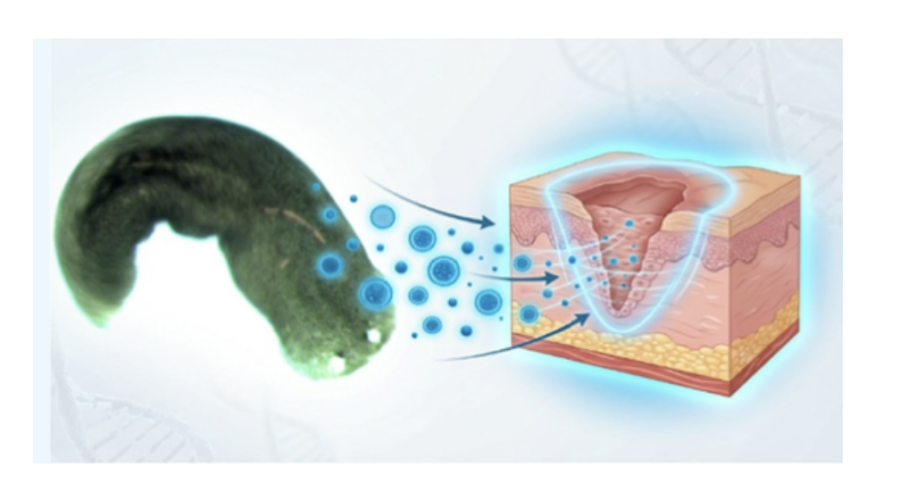
In a quiet urban park in Malmö, a modest experiment has set in motion a line of inquiry that could reshape wound care, cosmetic science, and even notions of biological boundaries. Beneath the surface of Pildammsparken’s ponds, five‑millimetre planarian flatworms were collected, dissected, and reduced to something far smaller than tissue or organ: nanoscale packages of biological information. The claim now emerging from Lund University is striking. These packages, known as extracellular vesicles, appear capable of accelerating wound healing in human skin models.
Yet beneath this elegant narrative lies a set of deeper questions. What exactly has been demonstrated, what remains speculative, and what happens when curiosity‑driven biology becomes entangled with commercial ambition?
The science of borrowing regeneration
Planarians have long occupied a near‑mythical status in biology. Slice one apart and each fragment can reorganise itself into a complete organism. A single worm can effectively generate up to 200 individuals from fragments; an ability rooted in pluripotent stem cells called neoblasts.
The Lund study moves beyond regeneration as spectacle and into mechanism. Instead of transplanting cells or tissues, the researchers isolate extracellular vesicles, lipid‑bound particles roughly 50–200 nanometres in diameter that carry proteins, RNAs, and signalling molecules. These vesicles act as intercellular messengers, orchestrating processes such as proliferation, immune signalling, and tissue repair.
From the attached study, the experimental approach is methodologically rigorous in its context. Vesicles were extracted following enzymatic dissociation and centrifugation, characterised through cryo‑electron microscopy and dynamic light scattering, and applied in two distinct systems: a vascularised chicken membrane model for burn injuries, and a human three‑dimensional skin equivalent. The findings are consistent across systems. Vesicles accelerated wound closure, enhanced re‑epithelialisation, and increased fibroblast proliferation in the dermal layer. There was also evidence of improved barrier integrity and faster vascular recovery in burn conditions.
Notably, topical application appeared more effective than systemic exposure in some cases. This suggests a highly localised signalling mechanism, possibly mediated by concentration gradients or uptake pathways in damaged tissue.
At face value, this is an elegant demonstration of cross‑species signalling. Biological instructions generated in an invertebrate can modulate repair processes in mammalian tissue. For the first time, the regenerative “language” of planarians appears partially intelligible to human cells.
A scientific first, but not yet a therapy
The step from laboratory observation to therapeutic reality is vast. The Lund team themselves emphasise that this is foundational work, conducted entirely in vitro.
What is compelling about the study is not that it produces a finished treatment, but that it opens a conceptual possibility. If extracellular vesicles can transfer functional biological signals across species, they might be used as cell‑free therapeutics. This would circumvent many limitations of stem cell therapies, including immune rejection and tumourigenic risk.
Yet the limitations are equally clear. The immune compatibility of xenogeneic vesicles remains largely untested. The study’s preliminary assays on human immune cells showed no overt short‑term toxicity or immune activation, but this is a narrow and simplified model.
The molecular content of the vesicles also remains only partially characterised. While cryo‑electron microscopy reveals encapsulated material, the specific RNA or protein signals responsible for the observed effects are undefined. Without this mechanistic clarity, reproducibility, scaling, and regulatory approval become uncertain prospects.
The commercial origin of curiosity
Perhaps the most revealing detail of the research lies not in its methodology but in its origin. The project began with an inquiry from a South Korean skincare company interested in whether Scandinavian flatworms might possess exploitable regenerative properties.
This intersection of basic biology and commercial interest is not unusual. Yet it raises important questions about direction and emphasis. The study sits at the boundary between regenerative medicine and cosmetic application. Indeed, one of its key findings is that vesicles increase the thickness of the fibroblast‑rich dermal layer, a potential proxy for reducing age‑related skin thinning.
It is not difficult to imagine how such results might be translated into high‑value skincare products long before they reach clinical wound treatment. The patent disclosure attached to the paper already points towards commercial intent. This trajectory mirrors broader trends in biotechnology, where cosmetic markets often act as an early testing ground for biologically active compounds due to less stringent regulatory pathways.
The ethical tension is subtle but real. Should a discovery with potential implications for treating chronic wounds, a major global health burden, first materialise as an anti‑ageing cream? Or does commercialisation in cosmetics provide the necessary funding and momentum for eventual medical applications?
The problem of scaling nature
Even if the science proves robust, scaling poses a formidable challenge. The experimental protocol relies on harvesting vesicles from planarian tissues through mechanical disruption and biochemical processing. While effective at laboratory scale, this raises questions about industrial feasibility.
Producing consistent, standardised vesicle preparations requires precise control over biological variability. Wild organisms, by definition, introduce environmental heterogeneity. The Lund researchers deliberately chose wild‑type worms to preserve ecological authenticity, but this choice complicates reproducibility.
A more industrial approach would demand either stable laboratory cultures or synthetic replication of the vesicles’ active components. The latter would require identifying the key signalling molecules responsible for the regenerative effect. Until then, the system remains biologically intriguing but technologically immature.
Cross‑species communication and its limits
At a deeper level, the study touches on a profound biological question. To what extent are the mechanisms of regeneration universal?
The success of the vesicles suggests that certain pathways governing cell migration, proliferation, and extracellular matrix formation are conserved across vast evolutionary distances. This aligns with earlier findings that extracellular vesicles are fundamental mediators of intercellular communication across many organisms.
However, conservation does not imply compatibility without risk. Cross‑species signalling introduces uncertainties about unintended effects. Could such vesicles trigger aberrant growth, fibrosis, or immune dysregulation in complex living systems? The controlled environment of artificial skin models cannot fully answer these questions.
The narrative of scientific surprise
There is also a narrative element that deserves scrutiny. The researchers themselves describe the project as emerging from an unexpected question, outside their primary expertise.
This framing is appealing, suggesting serendipity and intellectual openness. But it also reflects a broader shift in science towards opportunistic, interdisciplinary exploration driven by external interest. While this can yield innovation, it can also blur the boundary between curiosity‑driven research and market‑oriented experimentation.
Promise suspended between biology and ambition
The discovery of planarian‑derived extracellular vesicles accelerating wound healing in human skin models is both credible and provocative. It demonstrates that regenerative signals can cross species boundaries and influence mammalian tissue repair, a conceptual breakthrough with genuine implications for future therapies.
Yet it remains, at this stage, a beginning rather than a solution. The mechanisms are incomplete, the safety profile uncertain, and the path to clinical translation long. Meanwhile, commercial interest is already shaping the narrative, potentially steering the research toward cosmetic applications before its medical potential is realised.
The flatworms of Malmö offer a glimpse into a deeper biological language, one written in nanoscale signals rather than genes alone. The question now is not whether that language can be translated, but who will control its meaning, and to what end.
Picture: Lund University