The sound at the surface
In a laboratory in Helsinki, a small and easily overlooked phenomenon unfolds. A shallow pool of polymer solution sits beneath a focused beam of ultrasound. At a precise intensity, the surface trembles and rises into a fountain, a protruding peak of liquid that appears to defy gravity. Apply a strong electric field and, from the tip of that peak, a thread thinner than anything visible to the naked eye shoots into the air, stretches, dries and settles as part of a web so fine that tens of thousands of its strands could fit inside the width of a human hair.
This is ultrasound‑enhanced electrospinning, or USES. It is both deceptively simple and profoundly technical. And it sits at the centre of Acouspin, a Finnish spinout attempting to turn a decade of laboratory physics into something closer to an industrial platform.
The claim is quietly ambitious. To transform nanofiber production from an artisanal, temperamental process into something scalable, programmable and, crucially, economical. To turn a physics experiment into a manufacturing tool. To do so within the ecosystem of the Nordic deep tech economy, where universities, public funding and start‑up culture intersect more seamlessly than in many larger industrial regions.
The question is less whether the underlying science works. The literature suggests that it does. The question is whether acoustic control over matter can cross the boundary that separates scientific novelty from industrial inevitability.
Nanofibers explained
To understand what Acouspin is building, it helps to start with the object itself.
Nanofibers are, in essence, extremely thin threads of material, typically with diameters below one micrometre. They are not rare in nature, but their controlled production is relatively recent. Their defining feature is not simply their size, but what size does to matter.
A fibre at the nanoscale has a vastly increased surface area relative to its volume. This matters because surface interactions dominate many physical and chemical processes. A nanofiber membrane, for instance, can capture particles far smaller than conventional filters. It can also host active molecules, release drugs in controlled ways, or interact with cells in tissue engineering.
In simple terms, nanofibers behave like highly efficient interfaces between materials and their environment. They are not just structures. They are functional surfaces.
This is why they have attracted interest across sectors that often do not speak to each other. Filtration systems aiming to trap microplastics or airborne particles. Medical devices that need to deliver drugs gradually or encourage tissue growth. Battery systems where separator layers must be simultaneously thin, porous and robust.
The challenge has never been conceptual. It has been practical: how to produce these fibres at scale, with consistency, and without prohibitive cost.
Limits of traditional electrospinning
For decades, the dominant method of producing nanofibers has been electrospinning. The principle is well established. A polymer solution is pushed through a small needle. A high-voltage electric field is applied. The liquid forms a structure known as a Taylor cone at the tip of the needle. From that cone, a fine jet emerges, stretches in the electric field and solidifies into a fibre.
The process works. It is versatile and can produce very thin fibres with controlled properties. But it comes with significant drawbacks.
First, the reliance on needles introduces mechanical limitations. Needles clog. They limit throughput. They require careful maintenance.
Second, the process is difficult to scale. Increasing production typically requires arrays of needles, which introduce complexities in maintaining uniform electric fields and consistent fibre quality.
Third, control over fibre properties often depends on changing the chemical composition of the solution, rather than physical parameters. That can add cost and complexity.
Researchers have long sought needleless approaches to overcome these limitations. One family of methods creates multiple jets from open surfaces rather than individual nozzles. Ultrasound‑enhanced electrospinning sits within this category, but adds a distinctive twist.
How sound replaces the needle
The core innovation behind USES is both elegant and slightly counterintuitive.
Instead of forcing a polymer solution through a nozzle, USES uses focused ultrasound to shape the liquid surface itself. High‑intensity sound waves create what researchers describe as an “acoustic fountain” or protrusion on the surface of the fluid.
This protrusion effectively replaces the needle tip. When a high voltage is applied, the electric field pulls a jet from the top of the protrusion in the same way it would from a conventional Taylor cone. The result is a nanofiber.
The implications are significant.
There is no physical nozzle to clog. The spinning site is dynamically created by sound. The system is inherently more flexible, because the location and properties of the jet can be controlled by adjusting ultrasound parameters rather than mechanical components.
In laboratory demonstrations, researchers have shown that by varying ultrasound frequency, intensity and pulse patterns, it is possible to modify fibre diameter and morphology during the process itself. This enables real‑time control over fibre properties without changing the chemistry of the solution.
Put differently, the system allows physical control over material structure at the nanoscale through acoustic energy.
For a non‑specialist reader, it may help to think of it as shaping liquid matter with sound, and then freezing that shape into solid fibres using electricity.
From single jets to scale
A promising laboratory technique is not the same as an industrial process.
One of the central challenges for USES has been throughput. Early demonstrations typically relied on a single ultrasonic transducer generating one spinning site. That limits production rates.
Scaling such a system requires multiple jets operating simultaneously. But this introduces new problems. Jets can interfere with each other through electrostatic interactions. Fibre mats can become uneven. Process stability becomes harder to maintain.
Research at the University of Helsinki has attempted to address this through multi‑jet systems. In one study, a prototype device with multiple controllable jets showed that increasing the number of spinning points led to a roughly linear increase in fibre yield, at least up to six jets.
However, the same work also noted growing non‑uniformity in the resulting fibre mats, indicating that scaling is not simply a matter of replication. Interactions between jets must be carefully managed.
This is a familiar pattern in advanced manufacturing. Scaling is not a linear extension of laboratory success. It is a separate engineering challenge.
Acouspin positions itself precisely at this transition.
From physics to platform
Acouspin is a spinout of the University of Helsinki, with roots in a research collaboration that spans more than a decade and involves the University of Tartu. The company’s premise is straightforward: to commercialise USES as a flexible, scalable platform for nanofiber production.
Its pitch combines several elements that are characteristic of contemporary deep tech ventures.
First, there is the core scientific innovation. USES itself, with its ability to generate nanofibers from an open surface using ultrasound.
Second, there is an attempt to wrap this innovation in a user‑friendly system. The company describes its approach as turning an “expert‑only” process into something closer to a “plug and play” tool, assisted by AI‑driven parameter optimisation.
Third, there is a business model designed to lower barriers to adoption. Pay‑per‑use and low upfront costs are intended to make experimentation accessible to industrial partners who might otherwise hesitate to invest in unfamiliar manufacturing technologies.
This combination reflects a broader trend. Deep tech startups increasingly position themselves not just as inventors of new technologies, but as providers of integrated systems that abstract away complexity for end users.
In Acouspin’s case, the key claim is that ultrasound control allows for consistent, high‑quality production across a wide range of materials, including those considered difficult or “unspinnable” in traditional systems.
Whether that claim holds across industrial conditions remains a central question.
Applications
Acouspin’s target markets are broad, but they converge on applications where the unique properties of nanofibers create measurable value.
Filtration
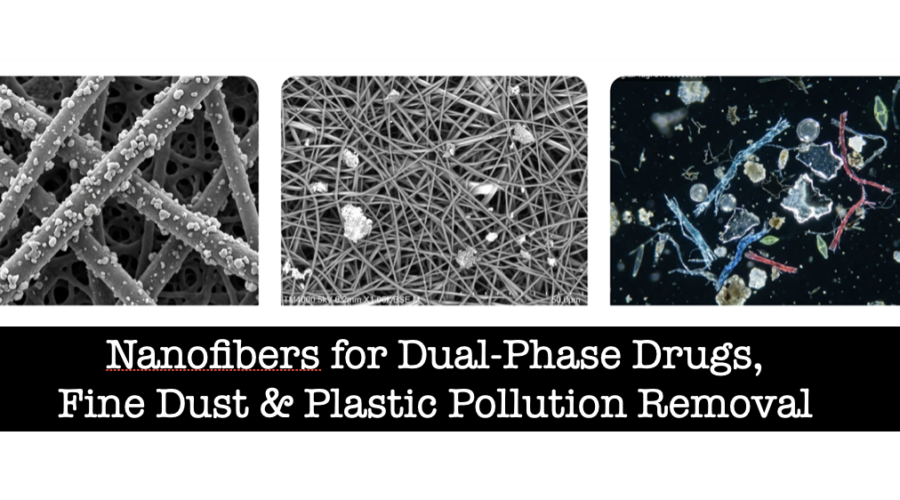
Nanofiber membranes can capture particles at sub‑micron scales while maintaining low resistance to airflow. This combination is valuable in air filtration systems, where efficiency must be balanced against energy consumption.
Acouspin positions its materials as capable of capturing fine particulate matter and even microplastics in water, responding to growing regulatory and environmental pressures.
The scale of the problem is large. In Europe, a vast majority of urban populations remain exposed to particulate levels above recommended thresholds, creating a persistent demand for improved filtration technologies.
Wound care and drug delivery
The medical case for nanofibers lies in their ability to mimic natural extracellular matrices and to host active substances.
Research from Helsinki suggests that ultrasound‑produced nanofibers could be used to create artificial skin capable of controlling moisture, protecting against infection and delivering drugs at controlled rates.
The ability to adjust fibre thickness and structure has direct implications for how cells interact with the material and how drugs are released.
In practical terms, this could enable wound dressings that deliver an initial burst of medication followed by sustained release, a long‑standing challenge in clinical treatment.
Energy and batteries
Battery technology is an emerging application. Nanofiber separators and coatings can improve safety, lifespan and energy density by providing controlled porosity and mechanical stability.
Acouspin targets lithium‑ion and next‑generation battery systems, positioning its materials as high‑porosity and dimensionally stable components.
Given the rapid growth of electric mobility and energy storage, even incremental improvements in battery performance can have significant market impact.
Composites and textiles
In composites, nanofiber layers can enhance mechanical properties such as toughness and resistance to delamination without adding significant weight.
In textiles, they can create breathable, functional membranes, including those that avoid environmentally problematic chemicals.
These are not headline‑grabbing applications, but they are commercially relevant ones. Incremental improvements in materials often translate directly into performance gains.
Fertile ground for deep tech
Acouspin’s story is not just about a specific technology. It is also about where that technology emerges.
Finland has spent the past two decades building an innovation ecosystem that is unusually favourable to deep tech ventures.
The country hosts more than 4,000 startups, employing tens of thousands of people and generating billions in revenue. Venture capital investment has reached around €1.5 billion annually in recent years, a significant figure relative to the size of the economy.
More importantly, the system is tightly interconnected. Universities, public agencies and private investors collaborate closely. Technology transfer organisations such as Helsinki Innovation Services play a central role in moving research from laboratories into commercial entities.
This model reflects a cultural emphasis on cooperation and trust, often cited as a defining feature of Nordic innovation systems. Public funding bodies provide not just capital but advisory support, influencing business models and reducing early‑stage risk.
The legacy of Nokia also looms large. The company’s decline in the consumer mobile market released a generation of engineers and entrepreneurs who seeded new ventures across sectors.
The result is an ecosystem that punches above its weight. It is particularly strong in areas such as AI, quantum computing and deep tech infrastructure, where scientific expertise is critical.
Acouspin fits squarely into this pattern. A university‑derived technology, supported by public funding, developed within a collaborative network and aiming to address global industrial challenges.
Hype, promise and the industrial gap
The rhetoric surrounding nanofibers is often expansive. Market estimates reach into the tens of billions. The range of applications is broad. The potential benefits are clear.
Yet the history of advanced materials is littered with technologies that struggled to scale.
The gap between laboratory success and industrial adoption can be wide. It involves not just engineering challenges but economic ones. Cost per unit, reliability, compatibility with existing manufacturing lines, regulatory approval, supply chain integration. Each of these can slow or derail commercialisation.
In the case of USES, several specific questions remain.
Throughput and cost
Can ultrasound‑enhanced systems achieve production rates that compete with established methods such as melt‑blowing or large‑scale electrospinning?
The available research suggests scalability, but also highlights challenges in maintaining uniformity at higher output levels.
Process stability
Industrial processes must operate continuously and reliably. Variability in fibre diameter or structure can be problematic, particularly in applications such as medical devices.
USES offers real‑time control, but also introduces new variables in the form of acoustic parameters.
Material compatibility
One of the technology’s advantages is its ability to process a wide range of materials, including aqueous solutions. This could reduce reliance on organic solvents and expand the range of possible applications.
However, each material system introduces its own challenges.
Market adoption
Even if the technology works, adoption depends on industry willingness to change existing processes.
Acouspin’s business model attempts to address this by lowering entry barriers. But industrial uptake often depends on more than cost. It requires demonstration of long‑term reliability and integration with existing supply chains.
The Nordic wager on deep tech
There is a broader story here about the strategic direction of Nordic economies.
Countries such as Finland are investing heavily in deep technologies that sit at the intersection of physics, materials science and computation. These are not quick wins. They require long development cycles and significant capital.
The rationale is partly necessity. Small economies cannot compete on scale. They compete on knowledge.
Deep tech offers a route to high‑value, defensible innovation. It also aligns with policy priorities in areas such as sustainability, healthcare and energy transition.
Acouspin’s focus on filtration, medical applications and energy systems places it squarely within these priorities.
At the same time, the Nordic model attempts to mitigate risk through collaboration. Universities, public agencies and private investors share both knowledge and financial exposure.
This does not eliminate the inherent uncertainty of deep tech. But it may improve the odds.
A quiet revolution or a niche tool?
So where does this leave Acouspin and ultrasound‑enhanced electrospinning?
The technology is scientifically credible. It is rooted in peer‑reviewed research spanning more than a decade. It addresses genuine limitations of existing methods. It offers a level of control that is difficult to achieve through conventional techniques.
The company itself reflects many of the strengths of the Finnish innovation ecosystem. Strong academic origins, interdisciplinary collaboration, and a pragmatic approach to commercialisation.
Yet the central question remains unresolved.
Will USES become a general‑purpose manufacturing platform, widely adopted across industries? Or will it remain a specialised tool, valuable in certain niches but unable to displace established technologies at scale?
The answer will depend on factors that extend beyond the laboratory.
It will depend on whether Acouspin can demonstrate consistent, high‑volume production under industrial conditions. Whether it can integrate its systems into existing manufacturing processes. Whether it can convince partners that the benefits outweigh the costs and risks of adoption.
And it will depend on timing. The demand for advanced materials is growing, driven by environmental regulation, healthcare needs and energy transition. If nanofiber production becomes a bottleneck, technologies that can scale efficiently may find their moment.
Shaping matter with sound
There is something almost poetic about the idea of shaping materials with sound.
Ultrasound‑enhanced electrospinning turns vibrations into structure. It uses invisible waves to create objects that themselves are nearly invisible. It represents a convergence of physics and engineering that is both abstract and practical.
Whether it becomes transformative is still an open question.
But in a laboratory in Helsinki, and now in the early stages of commercial deployment, the process is already real. Sound rises through liquid. A tiny jet forms. A fibre emerges. It drifts through air and settles into place, one strand among millions.
From such small beginnings, industries sometimes change.
Sources:
Acouspin – Ultrasound Nanofiber Technology
Scaling Up Ultrasound-enhanced Electrospinning
Finland’s 15 unicorns and $1.5B VC surge: How it became the Nordic deep tech hub — TFN
Ultrasound-enhanced electrospinning – Aalto-yliopiston tutkimusportaaliin