By reframing industry not as a burden but as an organising force, a new study of Southeast Finland reveals a paradox at the heart of the energy transition: the places that consume the most energy may also hold the key to using it most intelligently.
A region defined by appetite
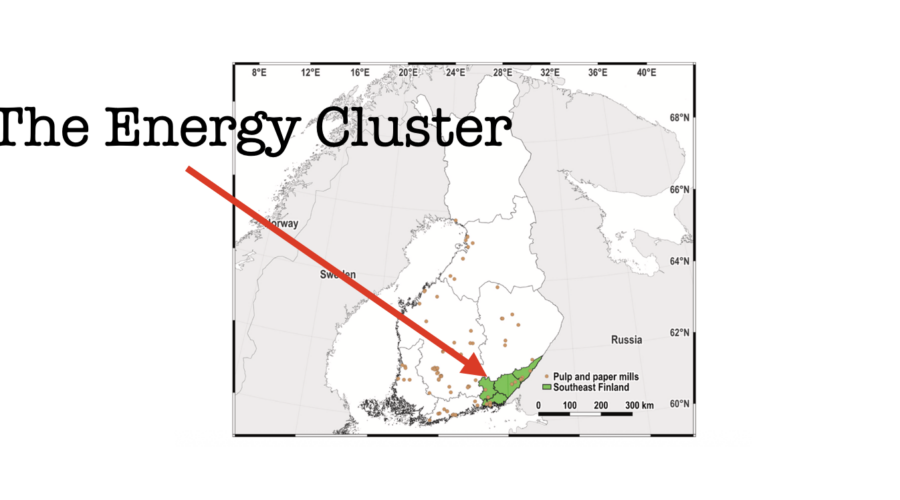
At first glance, Southeast Finland is an unlikely frontier of energy transformation. It is not a place of sprawling metropolitan demand or of sun-drenched photovoltaic optimism. It is a landscape shaped instead by timber, mills and smokestacks, by the slow, continuous churn of pulp and paper, and by a set of industrial processes that have historically required vast and uninterrupted flows of energy.
Here, industry is not simply a sector among others. It is the system. According to the study, pulp and paper, cement and steel together account for roughly 80 per cent of final energy demand in the region, an extreme concentration even by Nordic standards. The contrast with the national picture is striking. Across Finland as a whole, industry represents just under half of final energy use. In Southeast Finland, it dominates almost entirely.
This asymmetry is more than statistical. It is structural. It reframes the entire problem of decarbonisation. In many policy narratives, the transition to carbon neutrality is driven by electrified transport, improved building efficiency or distributed renewables. But in Southeast Finland, these shifts, while present, are almost incidental. They operate on the margins of a system whose centre of gravity is industrial production.
The study makes this point with quiet insistence: the future of the region’s energy system will be decided not in homes or vehicles, but inside a relatively small number of large industrial sites. “Ultimately,” the authors note, “regional energy transition success depends heavily on transforming a few large industrial sites”.
That framing introduces both clarity and unease. It simplifies the analytical problem, concentrating it around identifiable actors. Yet it also raises an uncomfortable question. What happens when those actors are not designed to be flexible, responsive or even particularly visible to consumers? What happens when the transition depends on infrastructures that were built for permanence?
The invisible mismatch
The study’s most compelling insight emerges from a quiet tension between two types of abundance. On one side lies carbon. Southeast Finland’s 16 pulp and paper mills collectively produce around 9 million tonnes of biogenic carbon dioxide each year, a figure that is both vast and underappreciated. This is not fossil carbon, but carbon generated from biomass, and therefore part of a renewable cycle. It is, in theory, an asset.
On the other side lies energy, or more precisely, renewable electricity. The region possesses significant solar photovoltaic potential, estimated at more than 53 gigawatts, but its wind resources are constrained by a technical and political obstacle: interference with defence radar systems. While this limitation is described as solvable, it remains unresolved in practice.
The result is a geographic mismatch. Carbon is plentiful where electricity is constrained. Electricity is cheapest and most abundant elsewhere, particularly in western Finland, where wind conditions are superior. This spatial dislocation becomes central when considering the emerging “power-to-X” economy, in which captured carbon dioxide is combined with green hydrogen to produce fuels, chemicals and materials.
The logic of cost optimisation leads to an almost counterintuitive conclusion. It is often cheaper to transport carbon to where electricity is abundant than to bring electricity to where carbon is produced. As the study observes, the most economical pathway involves exporting Southeast Finland’s captured CO₂ to wind-rich regions for processing.
The implication is stark. A region that could become a hub of synthetic fuels production instead risks being reduced to a supplier of raw carbon.
And yet, the story does not end there.
The price of staying local
One of the study’s most quietly radical findings concerns the cost of defying this optimisation logic. Policymakers often assume that forcing production to occur in less optimal locations imposes significant economic penalties. In this case, however, that assumption begins to unravel.
When the model enforces local production of e-fuels in Southeast Finland, requiring that the region’s carbon be processed within its own boundaries, the increase in cumulative system costs is only 1.7 per cent by 2050. Even more striking, maximising local renewable capacity raises costs by less than one per cent.
These are not negligible figures, but neither are they prohibitive. They suggest that the tension between efficiency and regional development may be less acute than commonly assumed. The choice to produce locally is not a purely economic one. It becomes a political and strategic decision, balancing cost against resilience, employment and territorial cohesion.
The study does not advocate explicitly for one pathway over another. But it makes clear that the trade-off exists, and that it is surprisingly modest. In an era increasingly defined by geopolitical uncertainty, that modesty carries weight.
The region itself sits at a sensitive border, shaped in recent years by the abrupt cessation of energy flows from Russia. Imports of electricity, natural gas and biomass have been disrupted, creating both scarcity and opportunity. In this context, the idea of localising energy production takes on an additional layer of meaning. It is not simply about efficiency, but about autonomy.
Electrification, quietly transformative
If carbon defines the region’s opportunity, electrification defines its transformation. Across the simulated scenarios, electricity use expands dramatically, reshaping not only how energy is generated but how it is consumed.
By 2050, electricity generation is projected to triple compared with 2020 levels, driven primarily by wind and solar. Heat, historically supplied by biomass combustion, becomes increasingly electrified. Electric boilers come to dominate, providing around 60 per cent of heat supply in the central scenario.
This shift may appear technical, but its implications are profound. It effectively decouples industrial heat from biomass, freeing up that resource for alternative uses, including high-value chemical production or carbon capture. It also transforms the role of the electricity system itself. No longer confined to powering appliances or lighting, it becomes the backbone of industrial processes.
The study highlights a further nuance. Despite their higher efficiency, heat pumps play a relatively limited role compared with resistive electric heaters. This is not due to a failure of technology, but to economics. Heat pumps are assumed to have significantly higher capital costs, and when electricity is sufficiently cheap, efficiency becomes less decisive.
Such findings complicate common assumptions about the transition. They suggest that technological superiority does not always translate into system-wide adoption. Cost structures, temporal dynamics and integration challenges all intervene.
Industry learns to move
Perhaps the most intriguing aspect of the study lies in its reimagining of industrial behaviour. Conventional models tend to treat heavy industry as inflexible, operating at constant output to maximise efficiency and stability. The processes involved, particularly in pulp and paper production, are indeed designed for continuity.
Yet the modelling suggests a different future. Under a system dominated by variable renewable energy, industrial plants could become active participants in balancing supply and demand. Pulp and paper mills, for example, are shown ramping production up and down in response to electricity availability, exploiting periods of surplus power.
This is not flexibility in the everyday sense. It requires significant infrastructural changes, including the addition of thermal energy storage and intermediate material buffers. It may also require oversizing certain production stages to allow for intermittent operation.
But the potential is real. The study indicates that industrial demand response could reduce peak electricity demand by as much as 30 per cent and lower system costs by up to 6 per cent, according to related research.
At a conceptual level, this represents a shift in identity. Industry ceases to be a passive consumer of energy and becomes a dynamic component of the energy system itself. It responds, adapts and, crucially, helps stabilise a grid increasingly dominated by variable sources.
The narrative is almost paradoxical. The very qualities that make heavy industry difficult to decarbonise, its scale, its intensity, its continuity, may also make it valuable as a source of flexibility.
A quiet decline of storage
In popular discourse, energy storage often occupies centre stage in discussions of renewable integration. Batteries, in particular, are presented as essential to smoothing variability and ensuring reliability.
Yet in Southeast Finland’s simulated future, storage plays a surprisingly minor role. The system relies instead on a combination of interregional electricity trade, flexible power-to-heat solutions and limited hydrogen buffering.
The levelized cost of storage remains small relative to total system costs, never exceeding a few percentage points. Excess electricity, when it occurs, is often curtailed or exported rather than stored.
This finding challenges a dominant narrative. It suggests that flexibility can be achieved through structural integration rather than through discrete storage technologies. Sector coupling, the linking of electricity, heat, transport and industry, becomes the primary mechanism for balancing variability.
It also underscores the importance of spatial dynamics. The ability to import electricity from other regions allows Southeast Finland to compensate for its local constraints, even as it exports other forms of energy or carbon.
A carbon hub in search of a grid
The notion of Southeast Finland as a “carbon hub” runs throughout the study. It is both a description and a possibility. The region’s pulp and paper mills generate a steady stream of biogenic CO₂, offering a feedstock for a wide range of synthetic products.
Yet the realisation of this potential depends on infrastructure. Capturing carbon is only the first step. It must then be transported, combined with hydrogen and processed into end products. Each stage introduces technical and economic challenges.
The study identifies grid capacity as a critical bottleneck. Importing the large volumes of electricity required for local e-fuel production would necessitate substantial expansion of transmission infrastructure. In one scenario, grid capacity nearly doubles compared with the baseline.
This raises questions about feasibility and timing. While Finland’s transmission system operator is investing in new lines, these developments take years, if not decades. In the meantime, decisions about where to locate processing facilities will shape the geography of the emerging energy system.
The tension between centralisation and decentralisation becomes palpable. Should production be concentrated in regions with the cheapest electricity, or distributed to align with carbon sources and industrial capacity? The answer, as the study suggests, may depend less on economics than on policy priorities.
Geopolitics as subtext
Although the study is primarily technical, a geopolitical narrative runs beneath its surface. The cessation of energy imports from Russia is not simply a historical detail. It forms part of the region’s structural condition.
The loss of imported electricity, natural gas and biomass has forced a reconfiguration of the energy system. It has also exposed vulnerabilities. Dependence on external suppliers carries risks, particularly in a volatile geopolitical environment.
In response, initiatives such as the proposed development of new transmission lines and defence-oriented energy programmes seek to align energy policy with national security objectives. The transition becomes not only an environmental imperative but a strategic one.
In this context, the modest cost of localising production takes on new significance. The additional expense may be justified not by immediate economic returns but by longer-term considerations of resilience and sovereignty.
The study does not dwell on these themes, but they are present nonetheless. They shape the interpretation of its results and hint at the broader forces driving energy transformation in Europe’s border regions.
The limits of modelling
No model is neutral, and the authors acknowledge several limitations in their approach. The transition pathways are based on techno-economic assumptions, including projected costs and carbon pricing. Changes in these parameters could alter the results.
More fundamentally, the model treats certain aspects of industrial behaviour as given. The ability of pulp and paper mills to operate flexibly, for instance, is assumed rather than demonstrated. In reality, such flexibility would require investment, experimentation and perhaps a rethinking of production processes.
The absence of hydrogen and carbon dioxide transport infrastructure within the model is another constraint. In practice, pipelines and other distribution systems could significantly alter the optimal configuration of production and trade.
Yet these limitations do not undermine the study’s central contribution. They highlight instead the complexity of the problem and the need for further research. If anything, they reinforce the sense that the energy transition is not a single pathway but a set of evolving possibilities.
A different kind of transition
The story that emerges from Southeast Finland is not one of technological breakthrough or sudden transformation. It is a story of recombination, of existing systems being reconfigured to meet new constraints and opportunities.
Industry remains central, but its role changes. Electricity becomes dominant, but not in isolation. Carbon, once an unwanted by-product, becomes a valuable resource. And geography, often treated as a backdrop, becomes a decisive factor.
Perhaps the most striking aspect of the study is its refusal to present the transition as a simple optimisation problem. Instead, it reveals a landscape of trade-offs, where economic efficiency, regional development, technological feasibility and geopolitical considerations intersect.
In this landscape, small differences in cost can have large implications. A 1.7 per cent increase in system costs becomes a lever for reshaping industrial geography. A constraint on wind power becomes a driver of solar deployment. A surplus of carbon becomes both an opportunity and a logistical challenge.
The narrative is not one of inevitability, but of choice.
The quiet radicalism of constraint
If there is a unifying theme in the study, it is the productive role of constraint. Limited wind power forces a greater reliance on solar. High industrial demand drives the search for flexibility. Geographic mismatch exposes new patterns of trade and cooperation.
In each case, what appears initially as a limitation becomes a source of innovation. The system adapts, recombines and, in doing so, reveals pathways that might otherwise have remained hidden.
This is perhaps the study’s most valuable contribution. It shifts the focus from abstract targets to concrete conditions. It asks not only what a carbon-neutral system should look like, but how it might emerge in a specific place, with its own history, infrastructure and constraints.
In Southeast Finland, the answer is neither simple nor singular. It is a negotiation between carbon and electricity, between industry and infrastructure, between cost and resilience.
And in that negotiation lies a broader lesson. The energy transition will not be uniform. It will unfold in different ways in different places, shaped by local realities as much as global imperatives.
In regions where industry dominates, the path will be particularly complex. But as this study suggests, it may also be unexpectedly fertile.
The future of energy, it seems, may well be written
in the places that consume the most of it.
Source: Dominance of industry in energy demand: Implications for the energy transition – ScienceDirect