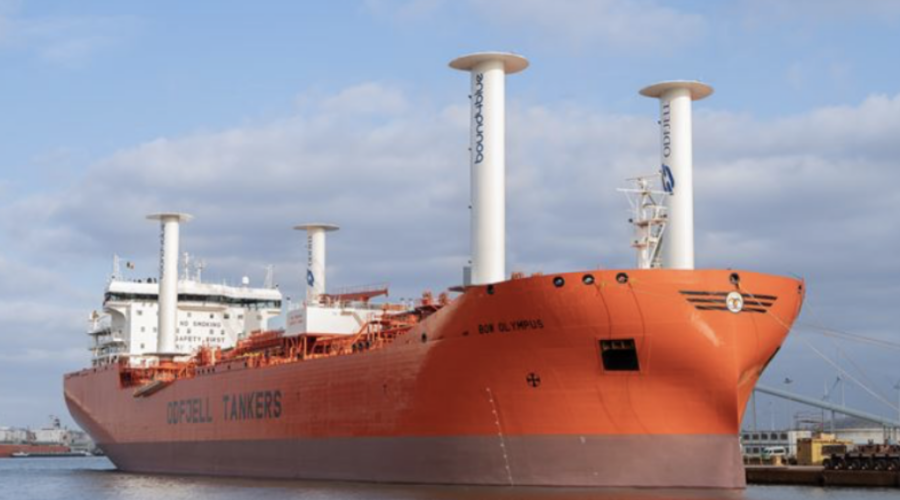
On Odfjell’s chemical tanker Bow Olympus, four modern suction sails and AI-enhanced weather routing are moving wind-assisted propulsion from promise to operational evidence. SINTEF’s July 2026 report matters because it shows a retrofit technology cutting fuel use now, while also exposing the harder questions of verification, training, maintenance and fleet-wide scalability.
The most important maritime decarbonisation story of the summer may not be a new fuel, a prototype engine or a port-side hydrogen hub. It is a chemical tanker already at sea. On 8 July 2026, SINTEF reported that Bow Olympus, part of the Norwegian Odfjell fleet, is saving about five tonnes of fuel per day through sail technology combined with AI-enhanced weather routing. The vessel normally consumes about 25 tonnes of fuel per day on ocean crossings, and under optimal conditions its sails can supply up to 40 percent of its energy demand. For a sector still searching for scalable zero-carbon fuels, this is not a laboratory claim. It is deployment evidence from commercial operation.
The significance is partly numerical, but mostly practical. International shipping remains a difficult climate problem because large ocean-going ships rely on dense, globally available fuels and operate across jurisdictions, ports, weather systems and cargo schedules. The International Maritime Organization’s 2023 greenhouse gas strategy targets net-zero emissions from international shipping by or around 2050, with indicative cuts of at least 20 percent by 2030 and at least 70 percent by 2040, compared with 2008. The European Union’s FuelEU Maritime regime, fully applied from 1 January 2025, sets progressively tighter limits on the greenhouse gas intensity of energy used by ships above 5,000 gross tonnes calling at European ports, beginning with a 2 percent reduction in 2025 and reaching 80 percent by 2050.
Bow Olympus is useful because it tests a decarbonisation option that does not wait for tomorrow’s fuel supply chain. Ammonia, methanol and hydrogen may still become central to deep-sea shipping, but each faces questions of production capacity, lifecycle emissions, safety, bunkering infrastructure and cost. Wind-assisted propulsion is different. As SINTEF notes, it can be installed on ships already in operation, reducing fuel consumption and emissions immediately. DNV similarly describes wind-assisted propulsion systems as technologies that generate aerodynamic forces to supplement vessel propulsion, with intelligent control and automation now making them suitable for ocean-going commercial ships without requiring extra crew.
The technology on Bow Olympus is not a romantic return to canvas, but a controlled aerodynamic system. The vessel uses four 22-metre suction sails, a modern form of wind-assisted propulsion in which airflow is manipulated to create a pressure difference and additional forward thrust. SINTEF’s associated reSail coverage explains that suction sails are related to wing sails, but use a fan to draw air at the rear of the wing, strengthening the pressure difference that helps propel the ship. That places Bow Olympus within a broader Nordic innovation ecosystem involving SINTEF, NTNU, Odfjell, Fugro Norway, HD Hyundai Europe R&D and bound4blue, aimed at understanding how wind systems behave in realistic marine conditions.
The AI element is crucial because wind power at sea is not simply a hardware question. A sail-equipped tanker must still arrive on time, protect cargo, avoid storms, comply with port windows and work within charter-party constraints. SINTEF reports that Bow Olympus uses advanced weather routing, with the route updated every 12 hours to exploit favourable winds, benefit from ocean currents and avoid hazardous weather while maintaining scheduled arrivals. Odfjell has separately reported that AI-based weather routing helped the vessel take advantage of prevailing wind conditions during transatlantic testing, where the company observed 15 to 20 percent energy savings in good but imperfect wind and up to 40 percent fuel-consumption reductions during parts of a voyage.
This is where the story shifts from clean-tech enthusiasm to validation. DNV says wind-assisted propulsion has already delivered fuel savings of 4.5 to 9 percent according to vessel owners and operators, with retrofit potential up to 25 percent and higher margins possible in newbuilds designed around sail systems. SINTEF’s Bow Olympus figure, five tonnes per day against normal ocean consumption of around 25 tonnes, indicates a roughly 20 percent daily fuel saving under the reported operating conditions. It is therefore within the upper range of current operational claims, but not outside the envelope suggested by classification and field data.
Yet the SINTEF report is valuable precisely because it does not treat the ship as an advertisement. Researchers Thor Albrektsen of SINTEF Ocean and Rolf Johan Bye of SINTEF Digital joined Bow Olympus on a voyage from Korea via Japan to China as part of the WAPS-IT project, which is examining the skills and training seafarers need for modern wind-assisted propulsion. Their work focuses on the human and operational side of deployment: how bridge teams monitor the system, how engineers and electricians maintain it, and how maritime education may need to change if sails become ordinary equipment rather than experimental add-ons.
The early finding is encouraging, but not trivial. SINTEF reports that operating the sails appears to require relatively little additional effort from navigators, with the sails running in automatic mode and bridge officers mainly monitoring weather, sail position, performance and system status. One short comment from the bridge captures the usability claim: crews can “switch them on and off with ease”. But the more important finding lies below deck. SINTEF says the greatest training need is in technical maintenance and system understanding, especially for electricians and engineers. This is a classic deployment lesson: the visible innovation is on deck, while the adoption bottleneck may be competence, diagnostics and integration.
Nordic innovation gives this case particular weight. Norway’s maritime cluster has long combined ship ownership, classification, offshore engineering, marine research and public research funding. WAPS-IT is owned by Seatrans Group and partly funded by the Research Council of Norway, while the reSail project is also partly financed by the Council and includes Norwegian research and industrial partners. Bow Olympus therefore functions less as a single ship story than as a floating instrument in a Nordic test architecture: one vessel producing operational evidence for training standards, aerodynamic modelling, weather routing and future ship design.
The scientific challenge is that wind at sea is more complicated than many simplified models assume. SINTEF’s reSail team has measured wind conditions on Bow Olympus using Fugro LiDAR before and after sail installation. The researchers found that wind varies more than expected, and that the ship and sail system affect the local wind field. In SINTEF’s account, simplified assumptions and simulations are not enough because they miss the complexity and variation in real wind conditions around large vessels. This is vital for validation. A sail’s performance is not only a matter of rated aerodynamic efficiency, but of placement, wake interaction, vessel motion, route, speed, weather and operational control.
That complexity leads to the investigative caveat. Bow Olympus is not proof that every tanker can save five tonnes a day, nor that wind-assist will deliver the same result on every route. DNV notes that operational cost uncertainty remains linked to weather, although weather-routing algorithms can improve outcomes. SINTEF’s own reSail work emphasises that reported fuel and emissions savings from ships with installed sails vary widely, and that proper knowledge of wind conditions, sail design, location, regulation and ship operation is needed to unlock the technology’s full potential.
There are also commercial and regulatory limits. Retrofitting requires deck space, unobstructed airflow, structural integration, class approval, maintenance capacity and compatibility with cargo operations. DNV highlights the need for reliable systems able to operate under varied conditions, and notes that classification work must address structural loads, control systems and safe integration. FuelEU Maritime and IMO policy create incentives for lower greenhouse gas intensity, but compliance value depends on robust measurement, reporting and verification. If wind propulsion is to avoid becoming another field of optimistic press releases, the industry needs transparent baselines, on-off testing, route-normalised performance data and independent verification.
That is why SINTEF’s framing is important. Bow Olympus is not presented as a paper story, but as a commercial ship being studied in operation. Its reported fuel savings are impressive, but the deeper finding is that wind-assisted propulsion is beginning to behave like deployable infrastructure: automated enough for bridge teams, demanding enough to require new technical training, and measurable enough to inform regulation and design. In SINTEF’s words, “data like these are essential” for future training programmes and low-emission ships.
The return of wind to shipping is therefore not nostalgic. It is computational, instrumented and hybrid. On Bow Olympus, sails do not replace the engine. They reduce its load. AI does not replace the crew. It expands the weather window in which wind can be harvested without sacrificing schedule reliability. Nordic maritime research does not claim that this solves deep-sea decarbonisation alone. It shows something more immediately useful: a retrofit pathway that can cut fuel burn while the industry argues over its future fuels.
If shipping’s climate transition is judged only by distant fuel revolutions, progress will look slow. If it is judged by tonnes of fuel not burned today, Bow Olympus becomes harder to ignore. Five tonnes per day is not the end of maritime decarbonisation. It is evidence that the transition has already started moving across the ocean, pushed by wind, steered by algorithms and tested by Nordic researchers on a working tanker.
References
- DNV. (2025). WAPS: Wind assisted propulsion systems. https://www.dnv.com/maritime/insights/topics/waps-wind-assisted-propulsion-systems/
- European Commission. (2026). Decarbonising maritime transport: FuelEU Maritime. https://transport.ec.europa.eu/transport-modes/maritime/decarbonising-maritime-transport-fueleu-maritime_en
- International Maritime Organization. (2026). IMO’s work to cut GHG emissions from ships. https://www.imo.org/en/mediacentre/hottopics/pages/cutting-ghg-emissions.aspx
- Norwegian SciTech News. (2026, May 27). Propelling the world’s giant ships into the future with new sail systems. https://norwegianscitechnews.com/2026/05/propelling-the-worlds-giant-ships-into-the-future-with-new-sail-systems/
- Odfjell. (2025, April 25). Odfjell completing first near carbon-neutral transatlantic voyage, saving five tons of fuel every day and improving GHG intensity by 85%. https://www.odfjell.com/about/our-stories/odfjell-completes-first-near-carbon-neutral-transatlantic-voyage-using-sails-and-biofuel-saving-five-tons-of-fuel-every-day-and-improving-ghg-intensity-by-85/
- SINTEF. (2026, July 8). Saving several tonnes of fuel per day with sails. https://www.sintef.no/en/latest-news/2026/saving-several-tonnes-of-fuel-per-day-with-sails/