Storm Vaia and the Bark Beetle’s Slow-Motion Sequel — and Whether Nordic Innovation Can Break the Cycle
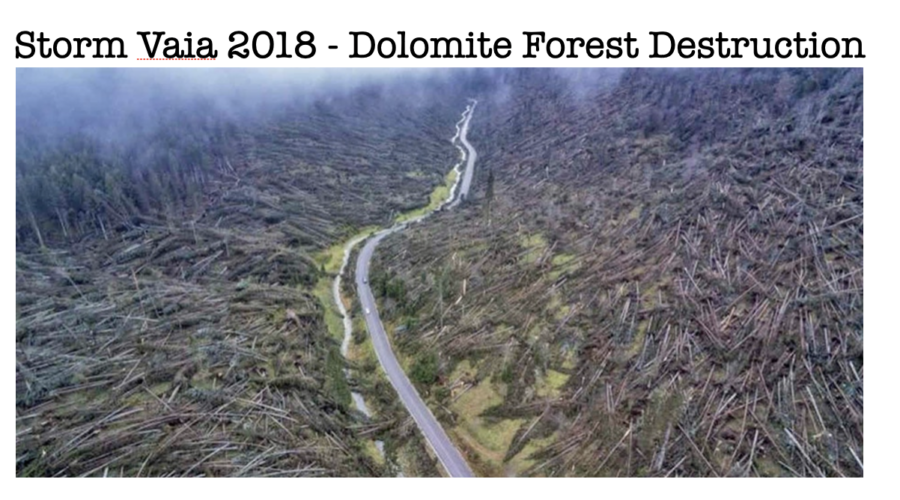
In October 2018, Storm Vaia tore through the eastern Italian Alps with sirocco winds gusting past 200 km/h, felling roughly 14 million trees — 8.5 million cubic meters of timber — across 42,500 hectares of Dolomite forest. It remains the most destructive event ever recorded in Italian forestry. Spruce stands, shallow-rooted and top-heavy, bore the brunt: 65% of the damaged area was spruce, uprooted wholesale. Within that footprint, 40% of the land saw near-total canopy loss. This was not a storm that thinned a forest. It erased one.
But Vaia’s real damage didn’t end when the wind died down. Roughly 10–20% of the fallen timber was never removed — left rotting in terrain too steep or remote for salvage logging. That deadwood became a breeding ground for Ips typographus, the European spruce bark beetle. By 2021, three growing seasons after the storm — precisely the lag researchers now recognize as typical for beetle outbreaks following windthrow — the Dolomites entered what foresters grimly call “the year of the bark beetle.” In Veneto alone, infestations have since claimed over 8 million additional trees, with some estimates suggesting cumulative beetle damage could eventually equal or exceed Vaia’s original toll.
This is the mechanism that should alarm anyone tracking climate-driven disturbance cascades: the storm and the infestation aren’t two separate disasters — they’re one continuous failure, climate change loading the gun and firing it twice. Warmer Mediterranean waters intensified Vaia itself; warmer, drier subsequent summers then supercharged beetle reproduction cycles on the wood the storm left behind.
The long-term ecological bill is still being tallied. Studies now show cleared areas exhibit no natural regrowth years on — Vaia’s windthrow didn’t just kill trees, it ripped up soil and depleted the seed banks forests need to regenerate. Combined with beetle-killed standing timber, some Dolomite valleys face a double disturbance with no self-repair mechanism.
Can Nordic Innovation Break the Cycle?
For Nordic readers, the Dolomites aren’t a cautionary tale from elsewhere — they’re a preview. Sweden and Finland sit on the same boreal spruce base, under the same warming trajectory, and the bark beetle is already moving. In Finland, damage areas have spread steadily northward since the 2010s, driven by the same combination of drought, heat and windthrow that primed the Alps. The question for the region’s research institutions isn’t whether the threat arrives, but whether detection can outrun it.
The most promising answer so far is early detection, and it’s a genuinely Nordic strength. At SLU in Umeå, researcher Langning Huo’s award-winning hyperspectral imaging method identifies a specific spectral band, G530, that picks up the physiochemical stress signature of an infested tree long before its crown visibly browns — lifting detection rates from 28% to 80% compared with conventional multispectral sensors. The ambition is to fold that capability into satellite and drone platforms for continent-wide monitoring.
Finland is running a parallel effort. The National Land Survey’s Finnish Geospatial Research Institute has built an AI-based drone photography method that outperforms the human eye at spotting early infestation, while Luke (the Natural Resources Institute Finland) and the University of Eastern Finland’s Sprucerisk project are combining open geospatial data with risk modelling to flag which stands are most exposed before beetles arrive. The EU-backed PREPARE project, initiated by Luke, is meanwhile building Finland’s formal contingency plan for a bark beetle outbreak on the scale already seen in Central Europe and Sweden.
None of this stops a storm. Windthrow events like Vaia remain, for now, unpreventable. But the Nordic research pipeline is squarely targeting the second half of the cascade — the multi-year window between fallen timber and full-blown infestation — where early intervention has the best chance of changing the outcome. Whether that pipeline can scale fast enough, and whether funding bodies like Business Finland and Vinnova back it at the pace the climate trajectory demands, will determine whether the Dolomites’ fate is a preview of the Nordics’ future, or a warning the region actually acted on in time.
Here is a link to a recent article written for Linkedin about the spruce beetle infestation seen by the writer during a six week hike in September 2026 in the Dolomites: https://lnkd.in/p/ddpbZRFy
Photo: Guide Dolomiti