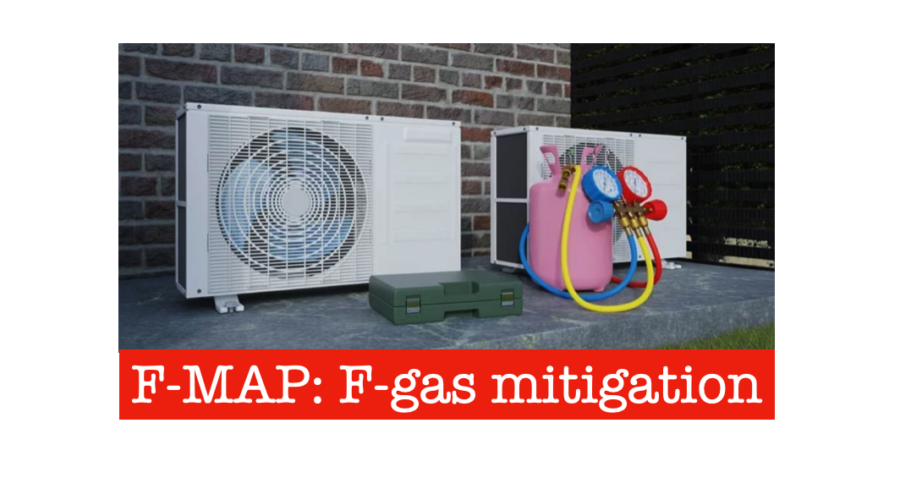
A €2.99 million European research project coordinated from Norway is developing an open-source model to help governments and industry compare the costs, emissions and infrastructure consequences of replacing fluorinated refrigerants.
A consortium led by SINTEF Energy Research has begun a three-year effort to model how refrigeration, air-conditioning and heat-pump systems could move away from fluorinated gases, or F-gases, without overlooking electricity demand, equipment costs or regional conditions.
The F-gas Mitigation Assessment and Pathways, or F-MAP, project started on 1 September 2026 and is scheduled to run until 31 August 2029. It receives €2,99 million from the EU’s Horizon Europe programme and brings together nine partners from Norway, Italy, France, North Macedonia, Ghana and South Korea.
Modelling costs, emissions and grid effects
The proposed tool will use linear optimisation to identify either the lowest-cost route to a specified emissions target or the largest emissions reduction achievable within a set budget. Built on SINTEF’s open-source EnergyModelsX framework, it is also intended to calculate how greater use of electrically powered cooling and heat pumps would affect electricity systems.
The project will assemble databases covering equipment, refrigerant leakage, costs and technical performance. Case studies in Italy, North Macedonia, Ghana and South Korea will test the model under contrasting climatic, economic and regulatory conditions.
For Norway and the wider Nordic refrigeration sector, the work builds on established expertise in natural refrigerants. Project leader Cecilia Gabrielii said many replacement technologies had been developed in Trondheim, while the outstanding need was a transparent method for comparing their cost, speed and emissions implications.
Alternatives bring different engineering risks
Candidate refrigerants include carbon dioxide, ammonia and hydrocarbons such as propane. Their direct climate impact is generally far below that of many hydrofluorocarbons, but selection remains application-specific: carbon-dioxide systems operate at high pressures, ammonia requires toxicity controls, and propane’s high flammability affects charge limits, installation and servicing.
The initiative arrives as Regulation (EU) 2024/573 tightens restrictions on F-gases and sets an EU phase-out of hydrofluorocarbon quotas by 2050. The regulation also strengthens leakage prevention, recovery and enforcement requirements.
However, F-MAP is presently a research programme, not a finished decision-support product. Its environmental benefit will depend on the quality of its data, successful validation and whether authorities and manufacturers ultimately use its findings.
Sources