European Alternatives to Major US Tech Platforms: 2026 Update Originally published May 7, 2025 By Nicholas Anderson
When we published the first version of this guide in May 2025, switching away from US tech was still a minority conviction. Eighteen months later it is government policy. On June 3, 2026 the European Commission unveiled a Tech Sovereignty Package covering chips, cloud, AI and open-source software, with measures to promote homegrown alternatives to Big Tech. The next day the European Parliament made France’s Qwant its default search engine in the browsers used across the institution, replacing Google.
The trigger was not only politics but a scare. After the US sanctioned officials of the International Criminal Court in The Hague, Microsoft cancelled an ICC official’s email account, as first reported by the Associated Press. The case fed European fears of a corporate “kill switch”: if your email, cloud and office tools sit under US jurisdiction, a decision in Washington can reach your inbox.
The children and data-protection concerns we raised in the original article have not gone away. Young people are still being hooked on apps built to capture attention, and the data of adults is still harvested ever more intrusively. Meaningful transparency and control through European regulation remains hard to achieve when the companies concerned have little interest in it.
So we are updating our series of factual guides to European and Nordic alternatives. forumNordic is a fully independent publication and receives no cash-backs from any of the companies named. Our listings are not recommendations about security or cost. The choice is entirely up to the consumer, though we have tried to make sure the names below are reasonable and safe alternatives.
forumNordic is open to other recommendations from readers. Please contact us at [editorial email address] with suggestions.
What has changed since May 2025
- Governments are switching, not just talking. France has announced that 2.5 million civil servants will stop using Zoom, Teams, Webex and GoToMeeting by 2027 in favour of the domestic Visio service. Germany’s federal digital ministry has mandated open document formats such as ODF for official documents, and the state of Schleswig-Holstein has reportedly moved about 80 percent of its government workplaces, some 30,000, to Linux, saving more than €15 million in licence fees. The Danish Ministry of Digital Affairs has said it is moving to Linux and LibreOffice, and the Austrian military has adopted open-source office software.
- Europe now has a sovereign office suite in the making. Euro-Office, launched in late March 2026 by a coalition including IONOS, Nextcloud, XWiki and OpenProject, offers editing of documents, spreadsheets and presentations with a tech preview and a first stable release planned for summer 2026. It is built on ONLYOFFICE code, which has triggered a licensing dispute (see below).
- Some names in our original list have changed. ONLYOFFICE discontinued its Workspace Cloud subscriptions in January 2026. Mastodon’s German non-profit lost its charitable status, founder Eugen Rochko stepped down as CEO in November 2025, and the project is moving to a new Belgian non-profit. Tutanota now trades as Tuta.
- Adoption still lags supply. Analysts note that Europe already has digital alternatives but lacks widespread adoption, and that some alternatives carry their own dependencies on US technology underneath. Choosing a European logo is not the same as being independent.
Alternatives to Facebook and Instagram
- Mastodon (Europe): Decentralised, open-source social network and part of the Fediverse. It was built and run from Germany and is now moving to a Belgian non-profit structure.
- Framasphere (France): Based on the Diaspora protocol, emphasising privacy and data ownership.
- Monnett (Luxembourg): A European Instagram alternative.
Alternatives to X (formerly Twitter)
- Mastodon (Europe): Twitter-like microblogging without centralised control.
- W Social (Sweden): A European-built X alternative.
- Pleroma: Lightweight, customisable microblogging server software in the Fediverse.
- Open Vibe (Czechia): A newer app that bridges users across open social networks.
Alternatives to YouTube and Reddit
- PeerTube (France): Decentralised video hosting, a YouTube alternative.
- Dailymotion (France): Established video platform.
- Lemmy: Open-source, federated Reddit alternative.
Alternatives to WhatsApp
- Threema (Switzerland): Privacy-focused messaging with end-to-end encryption.
- Element (UK): Built on the Matrix protocol, which European governments use for secure communication.
- Olvid (France): Private text messaging.
- Wire (Switzerland): Secure communication aimed at enterprises.
A caution: Signal, often recommended as the private option, is run by a US-based non-profit, so it does not solve the jurisdiction question.
Alternatives to Google
- Search: Qwant (France), now the default in the European Parliament’s browsers; Ecosia (Germany), which has started rolling out its own independent search results in Europe; Startpage (Netherlands); Mojeek (UK).
- Browser: Vivaldi (Norway).
- Email: Proton (Switzerland), Tuta, formerly Tutanota (Germany), Infomaniak (Switzerland).
- Docs: CryptPad (France), Collabora Online (UK/Germany), Euro-Office (European coalition).
- Maps: OpenStreetMap (open, community-run) and Organic Maps (Estonia).
- DNS: DNS4EU (Czechia), a privacy-compliant resolver that keeps name resolution inside the EU.
Alternatives to Microsoft 365
- LibreOffice (Germany): Free, open-source office suite, now being rolled out by several public bodies.
- Euro-Office, Collabora Online and openDesk (Germany): Enterprise-ready tools compatible with Microsoft formats; openDesk is a public-sector-oriented workplace suite.
- Nextcloud (Germany): Self-hosted file sharing and collaboration, including Nextcloud Talk for video calls.
- Office EU (Netherlands): A cloud-based suite from a Hague-based startup, hosted in Europe under EU jurisdiction. It is in early access, so treat it as one to watch.
- Video calls: Visio (France), Jitsi (France), Nextcloud Talk.
- A note on ONLYOFFICE (Latvia): It remains in our list for its software, but its cloud offering was wound down in January 2026, and it suspended its partnership with Nextcloud after accusing the Euro-Office project of licence violations. Euro-Office’s backers dispute that characterisation. Organisations that depend on it should check their set-up.
Alternatives to Amazon
- Retail: Greenweez (France), Fairmondo (Germany).
- Second-hand: Vinted (Lithuania), Back Market (France), Swappie (Finland).
- Books: Buch7 (Germany), Librelivre (France).
- Cloud: Nextcloud, Scaleway (France), Hetzner (Germany), OVHcloud (France), IONOS (Germany), Exoscale (Switzerland), plus Deutsche Telekom’s T Cloud Public.
New since our first edition: AI, VPNs and phones
- AI assistants and models: Mistral AI (France), Aleph Alpha (Germany), DeepL (Germany) for translation, Berget AI (Sweden), Tilde (Latvia) for Baltic and Eastern European languages. ChatGPT remains the leading chatbot in Europe, so this is the category where the gap is widest.
- VPN: Mullvad (Sweden), NordVPN (Lithuania), Nym (Switzerland).
- Phones: Fairphone (Netherlands), Jolla with Sailfish OS (Finland), Murena (France).
The Nordic angle
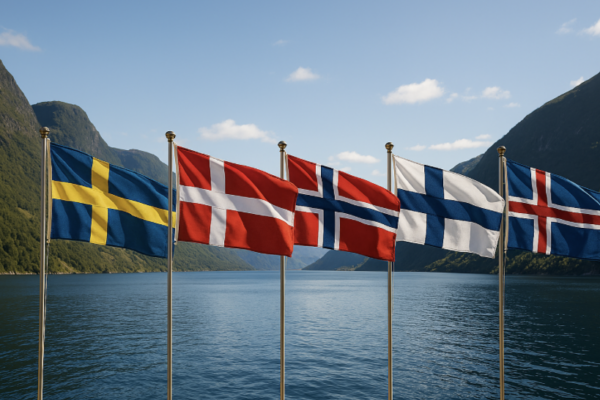
We promised Nordic alternatives in the original article and under-delivered, so here they are. The region is becoming a proving ground for sovereign public-sector IT, with Denmark and Sweden leading and the Danish government and the cities of Copenhagen and Aarhus trialling open-source software. Sweden’s government agencies have also been investigating an open standard for encrypted chat that would let different messaging apps talk to each other.
Public opinion is moving the same way. A survey published by Proton (itself a Swiss company named in this guide) found that Nordic respondents were more likely than other Europeans to want to switch to European tech services. In Finland, 57 percent said they want greater trust in how their personal data is processed.
- Vivaldi (Norway): Browser.
- Mullvad (Sweden): VPN.
- UpCloud (Finland), Evroc (Sweden), InfoPeak (Denmark): Cloud infrastructure; Evroc is building hyperscale capacity.
- Berget AI (Sweden): AI services.
- W Social (Sweden): Social network.
- Jolla (Finland): Sailfish OS phones and software.
- Swappie and Bought (Finland): Refurbished iPhones and iPads, and pre-loved clothing.
One warning from the Finnish side: Silo AI, once Europe’s largest private AI lab, is now part of AMD. Nordic champions do not always stay Nordic.
Our take
These platforms show that Europe can offer strong, privacy-respecting alternatives to dominant US tech. What it still lacks is scale, funding and users. Regulation and public procurement can open the door, but in the end it comes down to ordinary people and organisations actually making the switch, one inbox, one search engine and one office suite at a time. Backed by ethical frameworks and robust data protection law, the tools are there. The question for 2027 is whether we use them.
Sources and further reading
- EU Parliament replaces Google with Qwant (MediaNama, June 5, 2026) – medianama.com/2026/06/223-european-parliament-replaces-google-with-qwant-digital-sovereignty/
- European governments ditch US tech services over security fears (AP) – aol.com/news/european-governments-ditch-us-tech-085259632.html
- EU launches tech sovereignty initiative (AP, June 3, 2026) – abcnews.com/Business/wireStory/european-union-launches-tech-sovereignty-initiative-boost-chips-133553617
- Building a European digital stack (Tech.eu, updated November 2026) – tech.eu/2026/01/23/building-a-european-digital-stack-the-alternatives-to-us-big-tech-you-should-know/
- Europe builds Euro-Office (Tech.eu, March 27, 2026) – tech.eu/2026/03/27/europe-builds-microsoft-compatible-euro-office-to-reclaim-digital-sovereignty/
- What’s behind Europe’s efforts to ditch US software (TechCrunch, April 27, 2026) – techcrunch.com/2026/04/27/whats-behind-europes-efforts-to-ditch-u-s-software-in-favor-of-sovereign-tech/
- Mastodon CEO steps down as the social network restructures (TechCrunch, November 18, 2025) – techcrunch.com/2025/11/18/mastodon-ceo-steps-down-as-the-social-network-restructures
- Nordic survey on US tech (Proton) – proton.me/blog/nordic-alternative-us-tech-survey