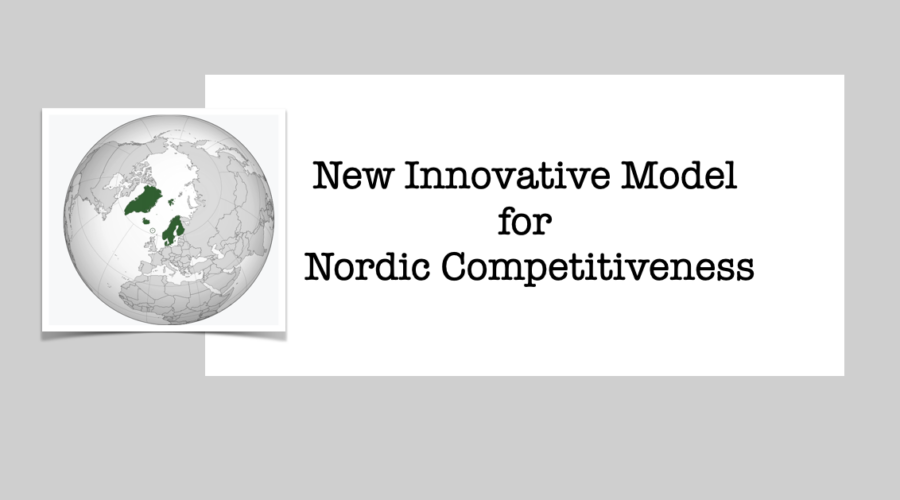
As Europe confronts slower growth, geopolitical uncertainty and intensifying global competition, a new Nordic initiative is seeking to answer a pressing question: can business, public institutions and policymakers work together more effectively to strengthen the region’s competitiveness?
Nordic Compass, launched in 2026, represents an unusual attempt to do exactly that. Describing itself as an industry-led alliance, the organisation brings together major Nordic corporations, foundations, public innovation bodies and selected advisory firms to develop practical initiatives in four strategic areas: capital markets, deep technology, defence and energy.
What makes Nordic Compass noteworthy is not simply its focus on competitiveness. Rather, it is the way the initiative has been assembled.
A Hybrid Approach to Strategy
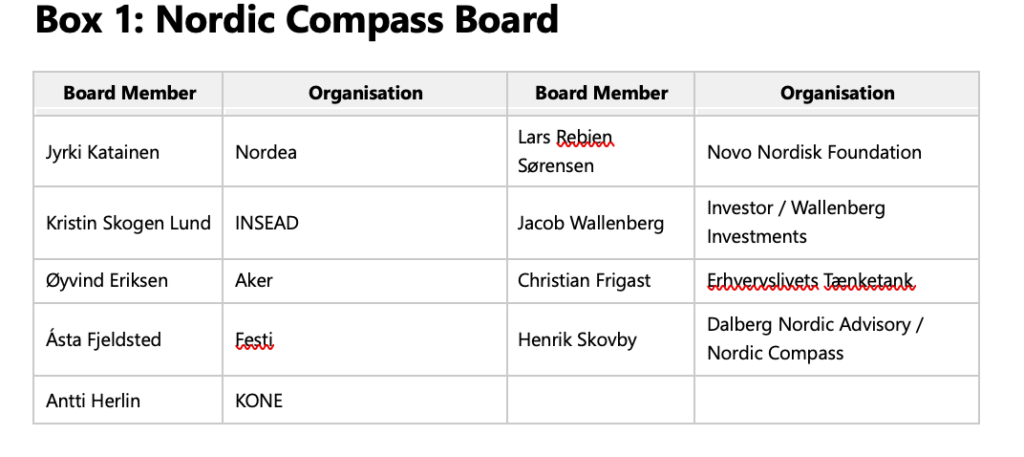
In most countries, economic strategy is developed either by governments, business lobby groups or academic experts acting largely independently. Nordic Compass seeks to combine all three worlds. The organisation is chaired by former Finnish Prime Minister Jyrki Katainen, who later served as Vice-President of the European Commission before joining Nordea. Alongside him sit some of the most influential figures in Nordic business, finance and philanthropy.
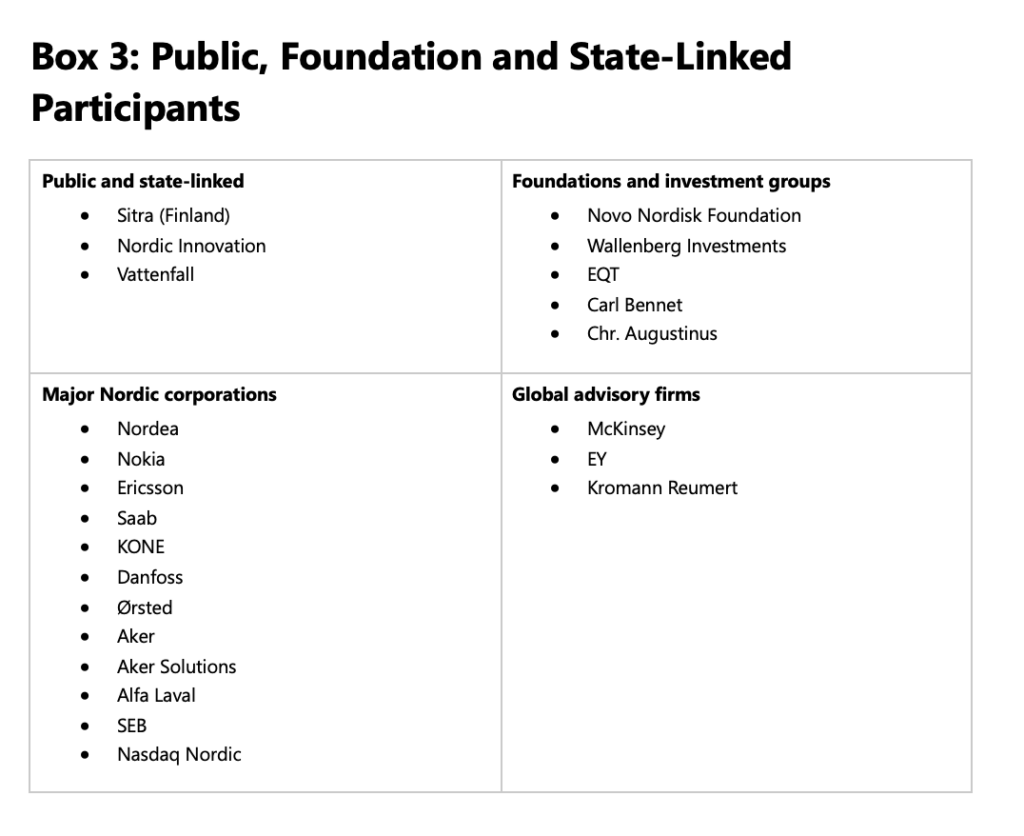
The alliance also combines private and public-sector participants. Among the partners is Sitra, Finland’s Innovation Fund, which operates under the supervision of the Finnish Parliament and has publicly confirmed that it is both a founding member and a funder of Nordic Compass. Nordic Innovation, funded through the Nordic Council of Ministers, also participates in the initiative. Meanwhile, Vattenfall, wholly owned by the Swedish state, appears among the listed partners.
This hybrid structure creates an interesting model. Rather than relying exclusively on government programmes or private-sector investment, Nordic Compass brings together organisations that span the boundary between public policy and private enterprise. The result is a platform that can potentially move ideas more rapidly from discussion into implementation.
Broad Industrial Representation
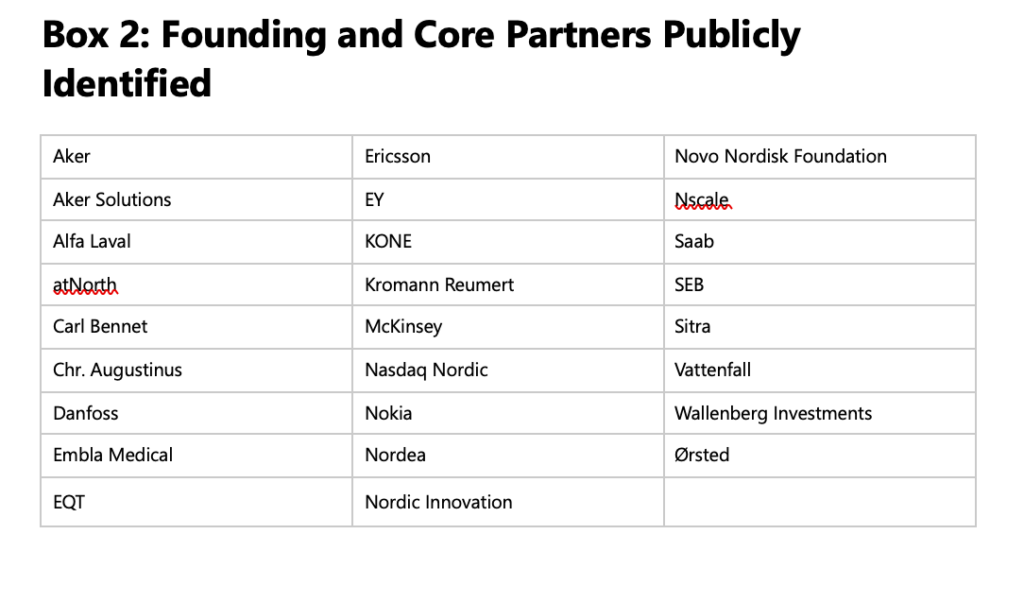
The initiative is also notable for the breadth of industrial representation involved. Companies associated with manufacturing, energy, telecommunications, defence, finance and investment are all represented. Partners include Nokia, Ericsson, Saab, Nordea, SEB, Danfoss, Ørsted, Vattenfall, Aker, Alfa Laval and Wallenberg Investments, among others.
Another distinctive feature is the participation of two of the world’s leading consulting organisations: McKinsey & Company and EY. Neither firm is Nordic, but both bring extensive international expertise in industrial transformation, competitiveness, innovation and organisational change. Their involvement suggests that Nordic Compass aims not merely to discuss Nordic cooperation, but to benchmark Nordic performance against global standards.
The Case for Nordic Coordination
The alliance has drawn inspiration from wider European discussions about competitiveness, including concerns that Europe is losing ground to both the United States and China in critical technologies, investment and industrial scale. Nordic Compass argues that the Nordic countries, while individually small, can achieve greater impact through coordinated action. Together, the five Nordic countries represent a population of around 28 million people and an economy comparable in size to some of the world’s largest national economies.
Open Questions on Funding
Questions nevertheless remain. The alliance has not publicly disclosed detailed information about its sources of funding, member contributions or budget. While Sitra openly identifies itself as a funder, the scale of contributions from private companies, foundations and other participants has not been published. Similarly, while public-sector organisations participate in the initiative, the extent of direct government financial support remains unclear.
An Experiment Worth Watching
Even so, Nordic Compass may prove significant as an experiment in public-private cooperation. By combining leading corporations, influential foundations, publicly funded innovation organisations and global advisory firms within a single framework, it offers a model that differs from traditional lobbying groups or government-led programmes.
Whether the alliance ultimately succeeds will depend on its ability to deliver tangible results. But its structure alone represents an innovative attempt to bridge the worlds of business, government and strategy at a time when the Nordic countries are searching for new ways to compete in an increasingly complex global economy.