Light-ion collisions at CERN strengthen the case that quark–gluon plasma can form in surprisingly small systems. Researchers in Copenhagen helped turn the unusual structure of neon into an experimental test, but “Little Big Bang” remains an explanatory metaphor rather than a technical description of what was observed.
In 2025, the Large Hadron Collider at CERN recorded collisions between oxygen-16 nuclei and between neon-20 nuclei at 5.36 teraelectronvolts per nucleon pair. These light-ion experiments occupy an important middle ground between collisions of individual protons and those involving heavy nuclei such as lead.
They also offer physicists a deliberately chosen geometric comparison. Nuclear-structure calculations describe neon-20 as substantially more deformed than oxygen-16, a contrast popularly likened to a bowling pin. The important point is not that the neon nucleus is a rigid miniature object. Rather, its quantum-mechanical distribution of protons and neutrons produces a distinctive initial geometry when two nuclei collide.
The first peer-reviewed results, published by the ALICE Collaboration in Physical Review Letters on 17 August 2026, report elliptic and triangular flow in both collision systems. Elliptic flow was stronger in the most central neon–neon collisions than in comparable oxygen–oxygen collisions, in agreement with hydrodynamic calculations incorporating the nuclei’s different structures.
The experiment underlies the University of Copenhagen announcement of 20 August 2026. Its headline, “Researchers create a Little Big Bang”, is effective popularisation, but not a technical description. The researchers did not reproduce the Big Bang or directly observe primordial matter. Instead, they measured particles emerging from tiny, exceptionally short-lived collision systems. The particles’ collective behaviour is consistent with the expansion of quark–gluon plasma, a state in which quarks and gluons are no longer confined inside protons and neutrons.
Turning nuclear shape into an experimental control
The Copenhagen contribution principally comes through the Niels Bohr Institute’s work within ALICE on anisotropic flow. You Zhou, identified by the university as a leader of the research, has investigated these directional particle patterns for more than a decade. His doctoral thesis examined how anisotropic flow responds to a collision’s initial geometry and fluctuations, precisely the relationship now being tested with oxygen and neon.
The measurement is necessarily indirect. A collision creates a minute region of extreme energy density that expands and cools almost immediately. Detectors record the final particles, not the plasma itself. Physicists then calculate flow coefficients describing whether more particles emerge in certain directions. If pressure within the system converts its initial spatial asymmetry into a corresponding asymmetry in particle motion, the final distribution retains information about both the expanding medium and the nuclei that created it.
Neon’s deformation makes this comparison especially useful. In 2025, Giuliano Giacalone and colleagues predicted that central neon–neon collisions should produce appreciably stronger elliptic flow than oxygen–oxygen collisions if hydrodynamic evolution transmits the starting geometry to the final particles. Comparing the two systems as a ratio also reduces some theoretical uncertainties that complicate interpretations of possible plasma formation in proton collisions.
The ALICE observations agree well with models constructed around this principle. An independent CMS Collaboration analysis, published on the same day, also found significant collective flow in both systems and evidence that the neon-to-oxygen differences are sensitive to intrinsic nuclear structure. Its hydrodynamic calculations qualitatively reproduced both the flow measurements and the ratios between the collision systems.
A separate CMS study found suppressed production of high-momentum charged particles in oxygen–oxygen collisions. Those results agreed better with models incorporating parton energy loss than with baseline calculations without such energy loss. Considered together, the flow and suppression measurements strengthen, without conclusively proving, the interpretation that quark–gluon-plasma-like matter can form in light-ion collisions.
A wider Nordic research network
Although Copenhagen supplied visible experimental leadership, the findings rest on a much wider international and Nordic research network. Physicists associated with the University of Helsinki, University of Jyväskylä and Helsinki Institute of Physics have contributed to ALICE research and to the modelling of collective flow, initial conditions and quark–gluon-plasma transport properties.
Finnish researchers have, for example, used Bayesian methods to estimate the plasma’s shear and bulk viscosities. That work also showed an important limitation: adding more sophisticated flow observables does not automatically eliminate uncertainty when the underlying dynamical model remains imperfect.
Copenhagen theses reveal how the required analytical expertise has developed. Vojtěch Pacík investigated multiparticle correlations and the unresolved origin of collective-looking behaviour in small collision systems. Emil Gorm Nielsen examined momentum-dependent flow fluctuations that can help test initial-state and hydrodynamic models. The theses did not predict the neon result directly, but they developed methods and questions central to its interpretation.
The critical qualification is that collective flow constitutes evidence for hydrodynamic behaviour, not a photograph of freely moving quarks. Calculated flow depends on nuclear-structure models, initial-state fluctuations and assumptions about whether such a small, rapidly evolving system can be described as a fluid. The ALICE measurements support geometry-driven hydrodynamic flow, while the CMS results provide an independent and broadly compatible test, but neither removes all model dependence.
The strongest defensible conclusion is therefore narrower than the “Little Big Bang” headline, but still significant: information about the structure of a light nucleus survives, in transformed form, in the motion of particles produced by its collision. Neon has become both a tool for testing primordial-like matter and an object whose quantum structure can be investigated through that matter.
References
ALICE Collaboration. (2024). The ALICE experiment: A journey through QCD. European Physical Journal C, 84(8), Article 813. https://doi.org/10.1140/epjc/s10052-024-12935-y [arxiv.org], [researchpo…elsinki.fi]
ALICE Collaboration. (2026). Evidence of nuclear geometry-driven anisotropic flow in O+O and Ne+Ne collisions at √sNN = 5.36 TeV. Physical Review Letters, 137(8), Article 082301. https://doi.org/10.1103/gymp-vp87 [journals.aps.org], [link.aps.org]
CMS Collaboration. (2026a). Observation of long-range collective flow in O+O and Ne+Ne collisions and implications for nuclear structure studies. Physical Review Letters, 137(8), Article 082302. https://doi.org/10.1103/26wx-tg6f [link.aps.org], [journals.aps.org]
CMS Collaboration. (2026b). Observation of suppressed charged-particle production in ultrarelativistic oxygen–oxygen collisions. Physical Review Letters, 136, Article 162301. https://doi.org/10.1103/89sf-9t1x [journals.aps.org]
Giacalone, G., Bally, B., Nijs, G., Shen, S., Duguet, T., Ebran, J.-P., Elhatisari, S., Frosini, M., Lähde, T. A., Lee, D., Lu, B.-N., Ma, Y.-Z., Meißner, U.-G., Noronha-Hostler, J., Plumberg, C., Rodríguez, T. R., Roth, R., van der Schee, W., & Somà, V. (2025). Exploiting ²⁰Ne isotopes for precision characterizations of collectivity in small systems. Physical Review Letters, 135(1), Article 012302. https://doi.org/10.1103/k8rb-jgvq [link.aps.org], [journals.aps.org]
Nielsen, E. G. (2020). Evidence of transverse momentum dependent flow angle and magnitude fluctuations at the LHC with ALICE [Master’s thesis, University of Copenhagen]. Niels Bohr Institute. https://nbi.ku.dk/english/theses/masters-theses/emil-gorm-nielsen/ [nbi.ku.dk]
Pacík, V. (2020). Investigation of azimuthal anisotropy using multi-particle correlations of identified hadrons at the LHC with ALICE detector [Doctoral thesis, University of Copenhagen]. Niels Bohr Institute. https://nbi.ku.dk/english/theses/phd-theses/vojtech-pacik/ [nbi.ku.dk], [alice-coll…eb.cern.ch]
Parkkila, J. E., Önnerstad, A., & Kim, D. J. (2021). Bayesian estimation of the specific shear and bulk viscosity of the quark-gluon plasma with additional flow harmonic observables. Physical Review C, 104(5), Article 054904. https://doi.org/10.1103/PhysRevC.104.054904 [converis.jyu.fi], [journals.aps.org]
University of Copenhagen. (2026, August 20). Researchers create a Little Big Bang: Bowling-pin-shaped nuclei shed new light on the Universe’s first moments. https://science.ku.dk/english/press/news/2026/researchers-create-a-little-big-bang-bowling-pin-shaped-nuclei-shed-new-light-on-the-universes-first-moments/ [science.ku.dk]
Zhou, Y. (2016). Anisotropic flow and flow fluctuations at the Large Hadron Collider [Doctoral thesis, Utrecht University]. CERN Document Server. https://cds.cern.ch/record/2127503 [cds.cern.ch]
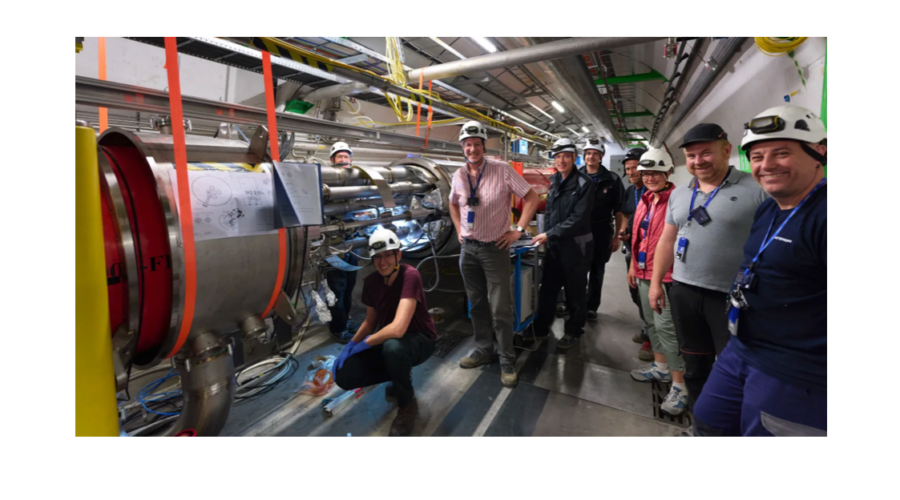
Photo: Cern