Somewhere in a SINTEF clean room in Norway, researchers are building a machine that does something your local water utility currently cannot: catch pesticide contamination while it’s still happening, instead of a day later, in a lab, with a printout nobody reads until the fish are already belly-up.
Right now, water-quality testing runs on a system designed for a calmer planet. Sample the river, bag it, drive it to a lab, wait. That workflow was fine when pollution moved at a bureaucratic pace. It is less fine when your pollution arrives via flash flood, landslide, or torrential rain — the kind of extreme weather that is becoming Northern Europe’s new normal, and that can flush pesticides out of soil and into rivers in the time it takes to fill out a sample-submission form.
Enter STARDUST — a genuinely excellent acronym for a project about detecting invisible things in water — which is trying to replace “drive it to the lab” with “measure it on the spot, in real time.” Elizaveta Vereshchagina, senior research scientist in SINTEF’s Department of Smart Sensors and Microtechnology, put the problem bluntly: today’s monitoring systems simply aren’t built to catch rapid variations, and that gap sits right at the intersection of environmental protection and public health.
The tech doing the actual detective work
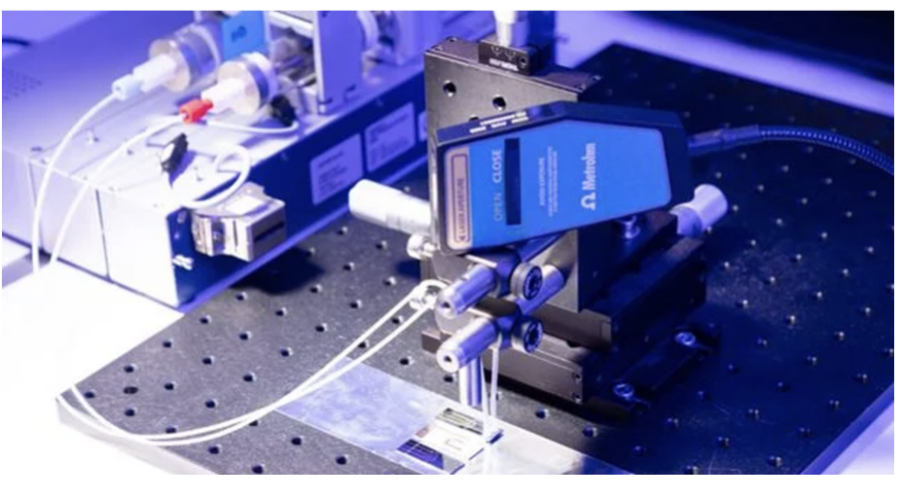
STARDUST’s weapon of choice has a name that sounds like a Bond villain’s laser: SERS, or Surface-Enhanced Raman Spectroscopy. In practice, it’s a technique that amplifies the faint light signals molecules give off, making pesticides that would otherwise hide in the analytical noise much easier to spot. SINTEF pairs SERS with microfluidics — samples flowing through channels thinner than a hair — to get fast, accurate readings without shipping anything anywhere.
Building the actual hardware requires the kind of fabrication vocabulary that sounds made up but isn’t: UV nanoimprint lithography, deep reactive etching, glass microstructuring, wafer bonding. SINTEF makes both the SERS substrates and the microfluidic components in-house, in clean rooms, at a precision level where “close enough” isn’t a category. Even so, project lead Karolina Milenko admits the team is still wrestling with a stubbornly hard problem: distinguishing between different pesticides at low concentrations, when background noise in the sample muddies the signal. Their fix is enlisting artificial intelligence to sharpen the sensitivity — which is either reassuring or slightly ominous, depending on your feelings about AI making judgment calls on your drinking water.
The citizen scientists chasing rainstorms
The most charmingly analog part of a very high-tech project: STARDUST can’t just wait around for extreme weather to happen near a lab. So it has recruited citizen scientists in Denmark and Ireland who go out and physically collect water samples during heavy rainfall — the exact moment when normal monitoring gives up. Some samples get tested locally as a reference; others get shipped to Oslo so the sensor tech can be validated against real-world chaos rather than tidy laboratory water.
It’s a nice bit of division of labor: humans brave the weather, chips do the chemistry.
The pitch: a landslide, a river, and a suitcase
Hans-Jørgen Albrechtsen, a professor at the Technical University of Denmark and STARDUST partner, offers the scenario that makes the whole project make sense: imagine a landslide hits a river high in a valley. It contaminates the water fast, and by the time anyone notices, the damage is already downstream — literally. Real-time sensing wouldn’t just document that disaster; it could flag it early enough to act before the water does serious harm.
The project’s actual ambition, stripped of the poetry, is refreshingly concrete: shrink all of this — the optics, the microfluidics, the AI — down from a research-grade lab setup into something the size of a rolling suitcase, portable enough to wheel to a riverbank, a groundwater well, or a lake and get an answer on the spot.
It’s not there yet. The consortium — spanning Norway, Romania, Poland, Ireland and Denmark, and drawing on nanotechnology, photonics, micro- and nanofabrication, materials science, machine learning and environmental chemistry — is still fighting signal noise and low-concentration detection limits. But for a field where the state of the art is still “bag it and drive it,” a suitcase that can smell pesticides in a puddle counts as science fiction getting genuinely close to arriving on time.