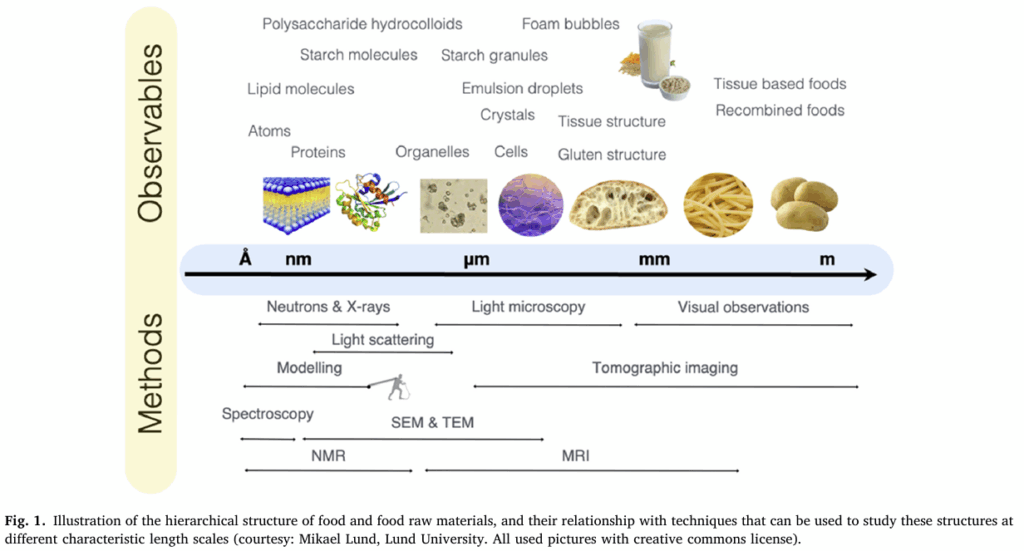
Food is more than just a mix of ingredients—it is a complex, hierarchical material where structure determines texture, taste, and even nutritional value. To design healthier and more sustainable foods, scientists need to understand how these structures form, evolve during processing, and break down during digestion. Traditional tools like light microscopy and rheology have provided valuable insights, but they often fall short when probing the nanoscale or capturing dynamic changes in real time.
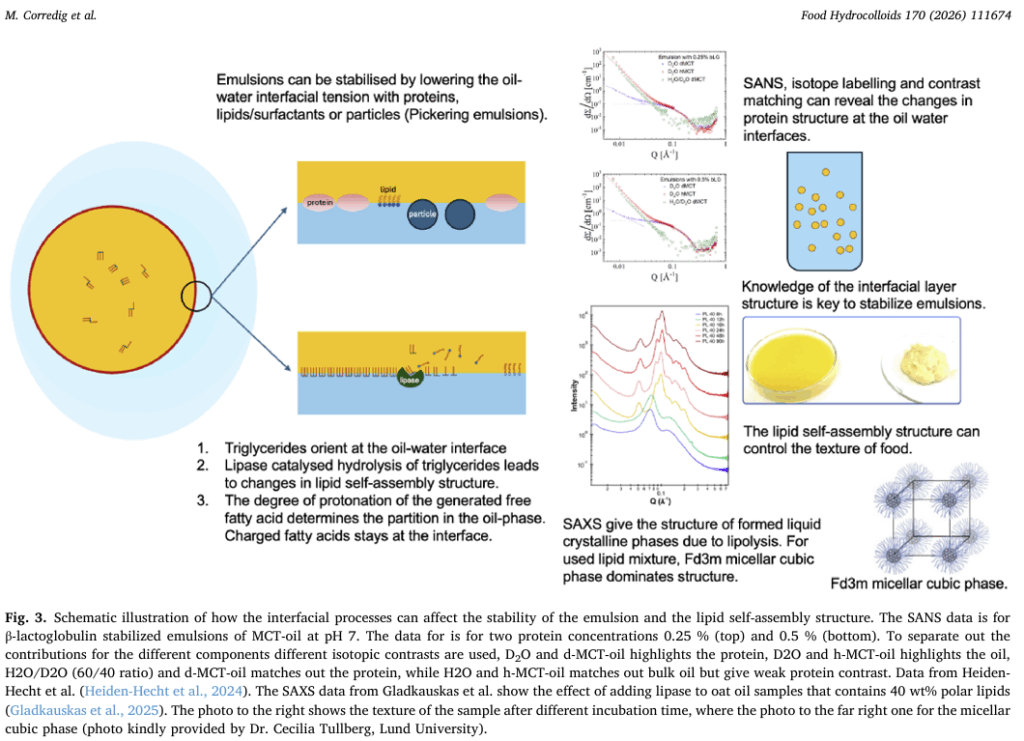
This is where X-ray and neutron techniques come into play. These advanced physical methods allow researchers to study food structures across multiple length scales—from atomic arrangements to macroscopic organization—with unprecedented resolution. X-rays interact with electron clouds, making them ideal for detecting heavy elements and crystalline structures, while neutrons interact with atomic nuclei and are particularly sensitive to light elements like hydrogen. This makes neutrons uniquely suited for studying water, proteins, and lipids in complex food matrices.
Why does this matter? Because food is dynamic. During cooking, extrusion, or digestion, structures continuously assemble and disassemble. For example, plant-based meat analogues rely on protein fibres formed under shear during extrusion—a process recently studied using simultaneous small-angle X-ray scattering (SAXS) and small-angle neutron scattering (SANS). Similarly, milk proteins and lipid droplets have been examined under gastric conditions to understand coagulation and nutrient release.
Beyond static imaging, these techniques enable in situ and in operando studies, meaning scientists can observe structural changes as they happen—during baking, fermentation, or even digestion. This capability is critical for moving beyond trial-and-error approaches toward predictive models of food behaviour. Coupled with computational modelling and AI-driven data analysis, X-ray and neutron methods are paving the way for a new era of structural food science, where foods are designed from first principles for optimal health, sustainability, and sensory appeal.
However, challenges remain. Access to large-scale facilities like synchrotrons and neutron sources is limited, and sample environments must mimic real-world conditions. Interdisciplinary collaboration—combining physics, chemistry, food science, and data science—is essential to fully exploit these tools.
Advanced X-ray and neutron techniques are revolutionizing food science by enabling detailed, real-time analysis of food structures across multiple scales. These methods provide insights into dynamic processes like cooking and digestion, supporting the design of healthier, sustainable foods. While challenges in accessibility and data interpretation remain, interdisciplinary approaches and AI-driven modelling promise a paradigm shift in how we understand and engineer food.
Key References
- Gilbert, E. P. (2019). Small-angle X-ray and neutron scattering in food colloids. Current Opinion in Colloid & Interface Science, 42, 55–72.
- Blazek, J., & Gilbert, E. P. (2011). Application of small-angle X-ray and neutron scattering techniques to the characterisation of starch structure: A review. Carbohydrate Polymers, 85, 281–293.
- Corredig, M., et al. (2026). Boosting structural food science using X-ray and neutron techniques. Food Hydrocolloids, 170, 111674.
- Ubbink, J., Burbidge, A., & Mezzenga, R. (2008). Food structure and functionality: A soft matter perspective. Soft Matter, 4(8), 1569–1581.
Source: Boosting structural food science using X-ray and neutron techniques