Desalination has always been an engineering of insistence. It applies pressure where resistance is maximal, forcing water through membranes that are designed to withhold salt, minerals, organisms, and doubt. The result is fresh water, but at a cost that has only ever been partly economic. Energy is consumed prodigiously; coastlines are industrialised; brine is returned to the sea in concentrated form; infrastructure announces itself in pipes, intakes, and exclusion zones. Desalination works, but it does so loudly.
For decades, the logic of the field has followed a single trajectory. Improve membranes. Improve pumps. Improve energy recovery. Each advance has been incremental, each efficiency gain contested and cumulative. The physical architecture of the system has remained untouched. Desalination plants are large, coastal, surface-bound machines that fight gravity and friction in equal measure. They are monuments to overcoming nature rather than collaborating with it.
The appearance, in Norway, of the world’s first subsea desalination plant suggests a different posture entirely. Rather than forcing seawater upward and inward, the system descends. It seeks depth, pressure, and darkness. It does not bring the ocean to the plant; it brings the plant to the ocean.
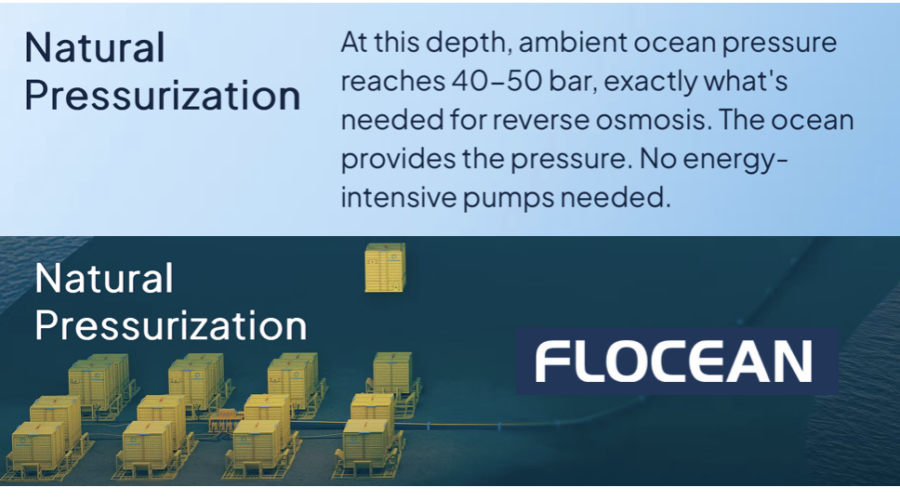
The company behind the project, Flocean, has developed a desalination architecture that is almost wilfully counterintuitive in its simplicity. At depths of several hundred metres, the surrounding water column exerts immense natural pressure. In conventional reverse osmosis plants, that pressure must be mechanically generated, consuming large amounts of electricity and subjecting equipment to continuous stress. Flocean’s system accepts the pressure as given. It situates reverse‑osmosis membranes on the seabed, allowing hydrostatic pressure to perform much of the work that pumps usually do.
This relocation changes nearly everything.
First, energy consumption drops. By exploiting ambient pressure, the system reduces the electrical load required to force water through membranes. Estimates suggest energy savings in the range of thirty to fifty percent compared with equivalent surface plants, depending on depth and configuration. In a sector where marginal efficiency gains are celebrated, this constitutes a step change.
Second, the environmental interface shifts. At depth, seawater is colder, darker, and more stable. Biological activity is lower; organic matter is sparse. The risk of biofouling declines, prolonging membrane life and reducing chemical cleaning. Brine discharge, rather than returning to sunlit coastal waters, disperses into deep ocean currents where salinity gradients dissipate more slowly and diffusely. The system becomes quieter, less intrusive, and harder to see, in both the literal and regulatory sense.
Third, infrastructure recedes. There is no coastal footprint in the conventional meaning of the term. No intake pipes cutting across beaches. No towers or tanks visible from shore. A subsea plant is connected by umbilicals rather than anchored in place by civil works. The visual politics of water provision alter accordingly.
Flocean’s choice of Norway as a proving ground is not incidental. The country’s offshore engineering culture, developed over decades of oil and gas extraction, has normalised the idea that complex, safety‑critical systems can live on the seabed for years with minimal human intervention. Remoteness, in this context, is not a liability but a design condition.
Sensors, redundancy, and maintenance by remotely operated vehicles are standard practices, not exotic solutions.
Yet it would be mistaken to read the subsea desalination plant as a simple transfer of offshore expertise to a new domain. Water, unlike hydrocarbons, is not extracted once and sold. It must be delivered continuously, reliably, and affordably. The tolerances for failure are not commercial but social. Municipal water systems are judged not by output alone but by trust, resilience, and political legitimacy.
This is where restraint becomes essential. Flocean has not positioned its system as a universal replacement for conventional desalination. Its early deployments are modest, described as demonstrators and pilots rather than definitive solutions. The technology is framed as modular and scalable, suitable for islands, industrial facilities, and drought‑prone regions where conventional infrastructure is impractical or contested.
The question is not whether the system works in principle, but whether it holds under time.
Subsea environments are unforgiving. Corrosion, biofilm formation, mechanical fatigue, and sensor drift are not hypothetical concerns but anticipated realities. Maintenance, though technically feasible, is slower and costlier than on land. Failures are harder to diagnose when the system is out of sight. The very qualities that make the plant attractive from an environmental and aesthetic standpoint complicate governance and accountability.
There is also a conceptual shift at play. Subsea desalination treats the ocean not as a resource to be drawn upon, but as a collaborator whose properties can be enlisted. Pressure, temperature, and depth become functional inputs rather than constraints. This resonates with a broader movement in engineering thought, one that seeks to exploit ambient conditions rather than override them. Passive buildings use climate; tidal turbines use flow; data centres use cold air. Flocean’s plant belongs to this lineage.
The implications for water geopolitics are not trivial. Desalination has long been associated with capital‑intensive states capable of absorbing its financial and ecological costs. If subsea systems can reduce energy demand and environmental resistance, they may widen the set of actors for whom desalination is politically viable. At the same time, moving infrastructure offshore diffuses responsibility. When a water plant is on land, citizens know where it is, who runs it, and whom to protest. When it lives on the seabed, those lines blur.
What makes the subsea desalination plant historically interesting is not simply that it is first, but that it revises an assumption that had calcified into dogma. For half a century, the future of desalination was imagined as more of the same: bigger plants, better membranes, cleaner energy. The architecture itself was not up for debate. By relocating the system vertically rather than optimising it laterally, Flocean has reopened that debate.
The plant does not announce itself. It does not tower on the horizon or glow at night. It operates below visibility, drawing quietly on a pressure field that has existed for geological time. Whether this marks the beginning of a new paradigm or a useful niche will depend on years of data rather than months of demonstration.
For now, the significance lies in the gesture. Desalination has always been about forcing water to change. The subsea plant begins by changing where desalination happens.
References
Elimelech, M., & Phillip, W. A. (2011). The future of seawater desalination: Energy, technology, and the environment. Science, 333(6043), 712–717. https://doi.org/10.1126/science.1200488
Gude, V. G. (2016). Desalination and sustainability: An appraisal and current perspective. Water Research, 89, 87–106. https://doi.org/10.1016/j.watres.2015.11.012
Interesting Engineering. (2025, December 31). Norway is launching the world’s first underwater desalination plant. https://interestingengineering.com/innovation/worlds-first-underwater-desalination-plant-launch-2026
Sharon, H., & Reddy, K. S. (2015). A review of solar energy driven desalination technologies. Renewable and Sustainable Energy Reviews, 41, 1080–1118. https://doi.org/10.1016/j.rser.2014.09.002
Tal, A. (2018). Addressing desalination’s environmental impacts: The Israeli experience. Water, 10(2), 197. https://doi.org/10.3390/w10020197