Carbon capture has long suffered from a credibility problem. The promise is grand, the timelines long, the assurances technical. Carbon dioxide, we are told, can be trapped, compressed, injected, and stored safely underground for centuries. Monitoring systems will watch over it; regulators will keep records; future generations will maintain the seals. The molecule will remain where we put it. That this requires faith, and institutional continuity on geological timescales, has never sat easily with the public imagination.
In Iceland, a radically different answer has emerged, one that replaces custody with chemistry. Instead of storing carbon dioxide and hoping it stays put, the process turns it into stone.
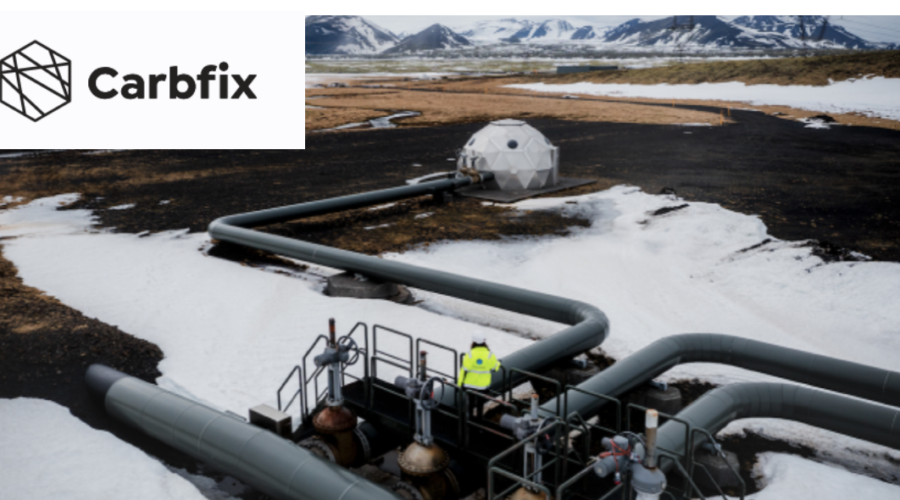
The idea is operational rather than rhetorical. Developed by the Icelandic company Carbfix, the method dissolves CO₂ in water and injects the resulting solution into basalt formations deep underground. There, under pressure and in the presence of calcium, magnesium, and iron, the carbon reacts to form stable carbonate minerals. Within a period measured not in centuries but in years, sometimes months, the gas becomes rock.
The transformation is irreversible in any meaningful sense. Once mineralised, the carbon is no longer mobile; it cannot leak, migrate, or accumulate. It becomes part of the geological record. The problem of storage is replaced with the fact of permanence.
This distinction has drawn attention from climate scientists weary of abstractions. Carbon capture has often been criticised not only for its costs and inefficiencies, but for what it asks society to trust. Geological storage schemes typically rely on cap rocks and pressure gradients to hold supercritical CO₂ in place. They assume containment rather than conversion. Carbfix’s approach dispenses with the assumption entirely. It alters the chemical identity of the carbon itself.
The last decade has seen the idea migrate from experiment to infrastructure. Early laboratory work demonstrated rapid mineralisation under controlled conditions. Pilot injections confirmed that basalt, abundant in Iceland due to its volcanic geology, was unusually well suited to the process. By the early 2020s, Carbfix was operating at industrial scale, injecting carbon dioxide emissions from geothermal power plants directly back into the ground from which their energy had been drawn.
The choice of Iceland was less happenstance than inevitability. The island is almost entirely basaltic, with porous formations that allow fluids to circulate. It also possesses an energy system dominated by geothermal and hydroelectric power, ensuring that the act of capturing and compressing carbon does not itself generate substantial emissions. Perhaps most importantly, Iceland has an institutional tolerance for infrastructure that inhabits geological time. Volcanic hazard, seismic risk, and deep uncertainty are familiar conditions rather than exceptional ones.
In this sense, Carbfix’s technology is local and general at once. It depends on specific geological conditions, yet points toward a broader reimagining of carbon removal. Basalt is not unique to Iceland; it is one of the most common rock types on Earth. Large formations exist across continental flood basalts, oceanic crust, and volcanic provinces worldwide. The chemistry is universal, even if the deployment is not.
The claim that carbon dioxide can be mineralised quickly was once met with scepticism. Mineral weathering was traditionally assumed to be slow, unfolding over thousands of years. The acceleration demonstrated by Carbfix relies on simple but decisive tweaks: dissolving the CO₂ before injection, increasing surface contact, and exploiting the reactive chemistry of fresh basalt. What nature does gradually, the process compresses.
Importantly, the system avoids one of the central political liabilities of carbon capture. It does not require the maintenance of pressure boundaries or the surveillance of subsurface plumes. Verification, though still necessary, is straightforward. Carbonate minerals are detectable; once formed, they remain. The risk profile shifts from leakage prevention to injection management.
This does not mean the technology is free of constraints. Water consumption is significant, though much of it can be recycled. Injection rates are bounded by geology and seismic safety. The process does not scale arbitrarily fast, nor does it absolve emitters of responsibility upstream. Mineralisation is an endpoint, not a substitute for decarbonisation.
Carbfix’s founders have generally resisted utopian framing. Their language is grounded, almost deliberately narrow. The technology, they argue, is one tool among many, suitable for specific contexts. It excels where concentrated CO₂ streams exist and where geology cooperates. It is not pitched as a solution for diffuse emissions, nor as a licence to continue business as usual.
This restraint reflects a learned caution. For years, climate technologies have oscillated between overpromising and retreat. Direct air capture facilities announce aspirational capacity figures that remain years from realisation. Bioenergy with carbon capture raises land use dilemmas that complicate its ethics. Against this background, turning CO₂ into stone has gained attention precisely because of its materiality. There is something disarmingly literal about the outcome.
The philosophical implications are subtle. Carbon capture has often been framed as deferred responsibility, an attempt to delay consequences without structural change. Mineralisation suggests a different metaphor. It treats carbon not as waste to be hidden, but as material to be transformed. The act is less like storage than burial in the oldest sense, incorporating human emissions into the metabolism of the planet.
This perspective resonates differently across disciplines. Geologists see continuity; carbon has been cycling between atmosphere, ocean, and rock for billions of years. Chemists see inevitability; carbonates are thermodynamically favoured under the right conditions. Climate scientists see risk reduction; permanence simplifies accounting. Social theorists, more cautiously, note that embedding climate solutions in geology also embeds them in the places and politics of extraction.
There is also a matter of scale. The quantities of CO₂ mineralised so far are modest compared with global emissions. Scaling the technology to gigatonnes would require a vast expansion of capture, transport, and injection infrastructure. The rocks may be patient, but societies are restless. Yet scale cuts both ways. Unlike many climate interventions, mineralisation becomes simpler, not riskier, as it grows. The more rock that reacts, the more stable the system becomes.
In recent years, Carbfix has attracted international partnerships, extending pilots to other volcanic regions and industrial contexts. Each site tests a boundary condition: different rock chemistries, different fluid dynamics, different regulatory environments. The results have been incremental, not spectacular, which may be part of their strength.
Turning CO₂ into stone does not offer redemption. It offers finality. In a field crowded with futures, scenarios, and pathways, that finality is almost radical. Climate policy has often been paralysed by the need to believe in endless management. Mineralisation proposes a different ideal: an intervention that ends rather than persists.
The stones beneath Iceland are older than any economy. In their slow, reactive patience lies a reminder that not all solutions must be agile or clever. Some can simply be permanent.
References
Alfredsson, H. A., Oelkers, E. H., Hardarsson, B. S., Franzson, H., Gunnlaugsson, E., & Gislason, S. R. (2013). The geology and water chemistry of the Hellisheiði geothermal field, SW Iceland. Geothermics, 45, 92–102. https://doi.org/10.1016/j.geothermics.2012.10.005
Gislason, S. R., Wolff-Boenisch, D., Stefánsson, A., Oelkers, E. H., Gunnlaugsson, E., Sigurdardóttir, H., … Matter, J. M. (2010). Mineral sequestration of carbon dioxide in basalt: A pre-injection overview of the CarbFix project. International Journal of Greenhouse Gas Control, 4(3), 537–545. https://doi.org/10.1016/j.ijggc.2009.11.013
Matter, J. M., Stute, M., Halliday, A. N., Mesfin, K., Snæbjörnsdóttir, S. Ó., Gislason, S. R., … Oelkers, E. H. (2016). Rapid carbon mineralization for permanent disposal of anthropogenic carbon dioxide emissions. Science, 352(6291), 1312–1314. https://doi.org/10.1126/science.aad8132
Snæbjörnsdóttir, S. Ó., Oelkers, E. H., & Gislason, S. R. (2020). Carbon dioxide storage through mineral carbonation. Nature Reviews Earth & Environment, 1, 90–102. https://doi.org/10.1038/s43017-019-0011-8
Tal, A., & Gordon, J. (2021). The politics of negative emissions: Carbon removal and the future of climate policy. Energy Research & Social Science, 72, 101862. https://doi.org/10.1016/j.erss.2020.101862