There is a deceptively simple promise behind QF Products, the University of Copenhagen project listed by Spin-outs Denmark in 2024: “Bringing the world’s highest quality 2D nanomechanical resonator to the real world.” The claim is not marketing fluff in the usual start-up sense. It points to a precise scientific lineage at the Niels Bohr Institute, where researchers have spent years learning how to make ultra-thin silicon nitride membranes vibrate with extraordinarily low loss. The commercial vehicle appears publicly as QFactory ApS, a Copenhagen company founded in 2023, with Eric Christopher Langman as CEO and Albert Schliesser as co-founder and chief scientific officer.
The product idea is small enough to sit on a chip, but it belongs to a much larger industrial story. If quantum technology is to move beyond laboratory demonstration, it needs components that are stable, reproducible, manufacturable and useful before the arrival of full-scale quantum computers. QFactory’s bet is that nanomechanical resonators can become one of those enabling components: a family of “quantum drums” for force sensing, optomechanics, electromechanics and, eventually, quantum memory. Its website says the company designs and fabricates resonators for applications requiring “ultra-low loss and small mass”, using techniques developed in the Quantum Optomechanics group at the Niels Bohr Institute.
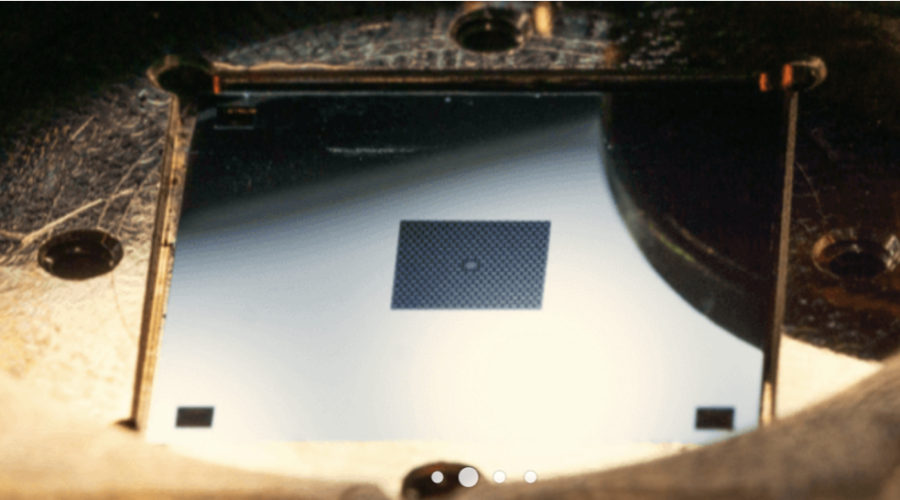
The physics begins with a membrane. Not a metaphorical one, but a real dielectric film, often silicon nitride, stretched under tensile stress. A defined part of the film vibrates out of plane at ultrasound frequencies. Around it is a patterned structure that acts as a phononic crystal. Just as an electronic bandgap controls the movement of electrons in a semiconductor, a phononic bandgap can prevent mechanical vibrations at certain frequencies from escaping. The Niels Bohr Institute describes the effect as a way to “trap a mechanical resonance within the phononic crystal”, producing a compact quantum system with built-in environmental isolation.
The key invention is soft clamping. In ordinary mechanical resonators, energy leaks into supports, defects, surfaces and the surrounding structure. In the Copenhagen design tradition, the vibrational mode is engineered so that bending losses are strongly suppressed. In patent language, the resonator element and clamping structure are configured so elastic waves penetrate evanescently into the clamping structure “in a manner such as to minimize bending throughout the entire resonator device”. The granted US patent, assigned to the University of Copenhagen, lists Albert Schliesser, Yeghishe Tsaturyan, Eugene Simon Polzik and Andreas Barg as inventors and was filed internationally in 2017.
That same year, the underlying scientific breakthrough appeared in Nature Nanotechnology. The paper, “Ultracoherent nanomechanical resonators via soft clamping and dissipation dilution”, reported that soft phononic clamping diluted intrinsic material dissipation by five orders of magnitude and enabled a record room-temperature frequency-quality-factor product. In later work, Niels Bohr Institute researchers and collaborators refined the platform, studying nonlinear damping, photonic-crystal mirror membranes and related device geometries for cavity quantum optomechanics.
For a non-specialist audience, the significance lies in the quality factor, Q. A high-Q mechanical resonator rings for a long time after being excited, like a glass that keeps singing after being tapped. In sensing, long coherence and low thermal noise can translate into the ability to detect weaker forces, smaller masses or subtler pressure changes. QFactory says its soft-clamped designs suppress mechanical loss by about two orders of magnitude compared with conventional membrane resonators, giving an edge wherever high-quality factor, low thermal noise, high force sensitivity or long quantum coherence matters.
This is why the first commercial beachhead is not necessarily a quantum computer. Spin-outs Denmark says the project will develop a vacuum pressure sensor intended to “significantly outperform current industry standard technology”, while Innovation District Copenhagen reports that QFactory’s first product is a mechanical quantum-scale sensor “100,000 times more sensitive than any competing technology”. The same article says the company eventually hopes to provide pressure gauges for the microprocessor industry, atomic-scale 3D scanners for life sciences and memory devices for quantum computers.
The order matters. Vacuum sensing is a hard, unglamorous market, but it is also one where performance counts. Semiconductor manufacturing, quantum experiments, surface science and advanced microscopy all depend on controlled vacuum environments. A resonator whose motion is exquisitely sensitive to gas damping could, in principle, become a pressure gauge with very high resolution. For QFactory, the opportunity is not merely to sell a scientific curiosity. It is to translate a fragile laboratory capability into a calibrated, packaged, repeatable instrument.
The company’s public positioning remains early-stage. QFactory’s products page advertises “Quantum Drums”, including standard resonators with a central pad inside a phononic crystal and custom geometries with ultra-low mass, large area, double defects, metal functionalisation and guaranteed Q-factor. That wording suggests a company still close to research users, selling specialised components and adapting designs to customer needs rather than shipping commodity sensors at scale. Innovation District Copenhagen also noted in December 2024 that QFactory’s main customers were then other universities using the devices for research.
The business structure is correspondingly lean. Public company data list QFactory ApS under CVR number 44133482, established in June 2023, with its purpose given as development and sale of hardware, software and related activities. Danish company databases record Eric Christopher Langman as managing director. Proff reported 2024 gross profit of DKK 541,000 and annual profit of DKK 351,000, while Riskpilot lists one employee and describes the company as operating in manufacture of other special-purpose machinery. Such figures should be read cautiously, as early spin-outs often book grant income, prototype sales or project revenue before they resemble conventional product companies.
The innovation system around the company is almost as revealing as the technology. Spin-outs Denmark supports junior researchers who want to turn research results into companies, offering one-year funding of up to DKK 600,000 plus bench fee and overhead, alongside entrepreneurial training, mentoring and university business-development support. QF Products entered the programme in 2024, placing it within a national effort to make Danish research more commercially productive without forcing scientists prematurely into venture-capital logic.
A second institutional experiment came from the University of Copenhagen itself. In December 2024, Innovation District Copenhagen reported that the university had introduced a standard “quantum express licence” to simplify commercialisation for quantum researchers, with QFactory as the first company to launch under it. The article says companies pay nothing to the university for the first five years and the university supports the patent application process. Langman is quoted as saying: “We experienced the licensing negotiations as fast, simple and fair.”.
For policy readers, this is more than administrative detail. Universities often celebrate spin-outs, but their intellectual-property procedures can be slow, costly and opaque, particularly for first-time founders. A standardised express licence is an attempt to reduce transactional friction in a field where timing is critical and global competition is growing. David Dreyer Lassen, prorector for research and innovation at the University of Copenhagen, framed it as an obligation to “remove as many obstacles as possible” for researchers willing to build businesses from university science.
The other significant signal came in March 2026, when BioInnovation Institute announced that eleven companies had joined its Venture Lab programme, including start-ups in health, planetary health and quantum. BII says Venture Lab is a 12-month programme that provides business acceleration, scientific and team development, a founder-friendly convertible loan of EUR 500,000, approximately DKK 4 million, plus access to labs and offices in Copenhagen. Although the BII release as opened here does not show the full list down to QFactory in the visible snippet, related coverage and a quantum company directory identify QFactory as the only quantum-technology company in that cohort.
What is striking is how little this resembles the popular image of quantum commercialisation. There is no obvious billion-qubit roadmap, no claim to break encryption, no promise of instant quantum advantage. Instead, QFactory sits in the quieter but potentially more durable category of quantum-adjacent hardware: components whose performance emerged from quantum science, but whose first markets may be classical sensing, industrial metrology and research instrumentation. This is often where deep tech becomes real, not through a single world-changing platform, but through specialised devices that solve specific measurement bottlenecks.
Still, the commercial questions are severe. Can these resonators be fabricated with sufficient yield and uniformity? Can their performance survive packaging, shipping, calibration and use outside expert laboratories? Can a start-up support demanding industrial customers while still improving the science? Can pressure sensing provide enough revenue before more speculative applications, such as quantum memories or atomic-scale scanning systems, mature? The public sources show promise and institutional backing, but they do not yet prove industrial adoption at scale.
The scientific questions are equally important. Ultra-high Q is not a single number that automatically translates across applications. A device optimised for optomechanical experiments may not be ideal for contaminated industrial environments, fast readout electronics or rugged pressure gauges. Nonlinear damping, mode coupling and thermal effects are not merely academic details. The 2021 Physical Review Letters paper involving Langman and Schliesser explicitly investigated nonlinear dissipation in dissipation-diluted resonators, noting its relevance for device design and for diagnosing performance.
That is why QFactory’s most valuable asset may not be a single membrane design, but the accumulated design grammar of the Niels Bohr Institute’s optomechanics programme. The group has explored low-mass designs for sensing, metal-functionalised membranes for electromechanics, multiple resonators on the same membrane and topological concepts for mechanical modes. This suggests a platform technology with several branching paths, although each branch will require different engineering, customers and proof points.
Albert Schliesser’s own public quote captures the cultural hinge. “As physicists we are here to find out stuff,” he told Innovation District Copenhagen. “Often deeply fundamental stuff, but I personally like the idea that our ideas turn out to also be useful in the real world.” That sentence could stand as a manifesto for Denmark’s quantum innovation challenge. The country has world-class quantum science. The question is whether it can build the translational machinery to let that science become companies, products and industrial advantage.
QFactory is therefore a test case worth watching. If it succeeds, it will not be because it used the word quantum, but because it turned a delicate physical insight into an instrument people can buy, trust and integrate. The tiny drum at the heart of the company may never become famous outside specialist circles. But in the deep-tech economy, some of the most consequential innovations are not those that make the loudest noise. They are the ones that keep ringing, almost without loss, long after the first tap.
References
- BioInnovation Institute. (2026, March 10). Eleven new companies join BII’s Venture Lab program. https://bii.dk/community/news/eleven-new-companies-join-biis-venture-lab-program/ [bii.dk]
- Catalini, L., Rossi, M., Langman, E. C., & Schliesser, A. (2021). Modeling and observation of nonlinear damping in dissipation-diluted nanomechanical resonators. Physical Review Letters, 126(17), 174101. https://doi.org/10.1103/PhysRevLett.126.174101 [journals.aps.org]
- Enzian, G., Wang, Z., Simonsen, A., Mathiassen, J., Vibel, T., Tsaturyan, Y., Tagantsev, A., Schliesser, A., & Polzik, E. S. (2023). Phononically shielded photonic-crystal mirror membranes for cavity quantum optomechanics. Optics Express, 31(8), 13040. https://doi.org/10.1364/OE.484369 [curis.ku.dk]
- Innovation District Copenhagen. (2024, December 18). New express-deal to pave way for more quantum-start-ups from University of Copenhagen. https://innovationdistrictcopenhagen.dk/new-express-deal-to-pave-way-for-more-quantum-start-ups-from-university-of-copenhagen/ [innovation…enhagen.dk]
- Niels Bohr Institute, University of Copenhagen. (n.d.). Ultracoherent mechanical devices. https://nbi.ku.dk/english/research/quantum-optics-and-photonics/quantum-optomechanics/ultracoherent-mechanical-devices/ [nbi.ku.dk]
- QFactory. (n.d.). About. https://qfactory.dk/about [qfactory.dk]
- QFactory. (n.d.). Products. https://qfactory.dk/products [qfactory.dk]
- QFactory. (n.d.). Technology. https://qfactory.dk/technology [qfactory.dk]
- Schliesser, A., Tsaturyan, Y., Polzik, E. S., & Barg, A. (2022). Mechanical resonator device. U.S. Patent No. 11,486,756. University of Copenhagen. [patents.justia.com], [patentimag…leapis.com]
- Spin-outs Denmark. (n.d.). QF Products. https://spinouts.dk/project/qf-products/ [spinouts.dk]
- Spin-outs Denmark. (n.d.). Programme. https://spinouts.dk/program/ [spinouts.dk]
- Tsaturyan, Y., Barg, A., Polzik, E. S., & Schliesser, A. (2017). Ultracoherent nanomechanical resonators via soft clamping and dissipation dilution. Nature Nanotechnology, 12, 776-783. https://doi.org/10.1038/nnano.2017.101 [nature.com]