In a wind-swept field outside Lund, a machine is learning how to see. Not through lenses or mirrors, but through atomic silence. The European Spallation Source, frequently described as a “giant microscope”, is less an instrument than an epistemic shift: a redefinition of what counts as visibility in science, and of who can afford to produce it.
This article examines the development of that “microscope” and its emerging uses, placing equal emphasis on technical architecture and the political economy that made it possible. The ESS is not only a scientific tool. It is also a statement about Europe’s future in high-cost, high-impact research.
Reinventing the microscope
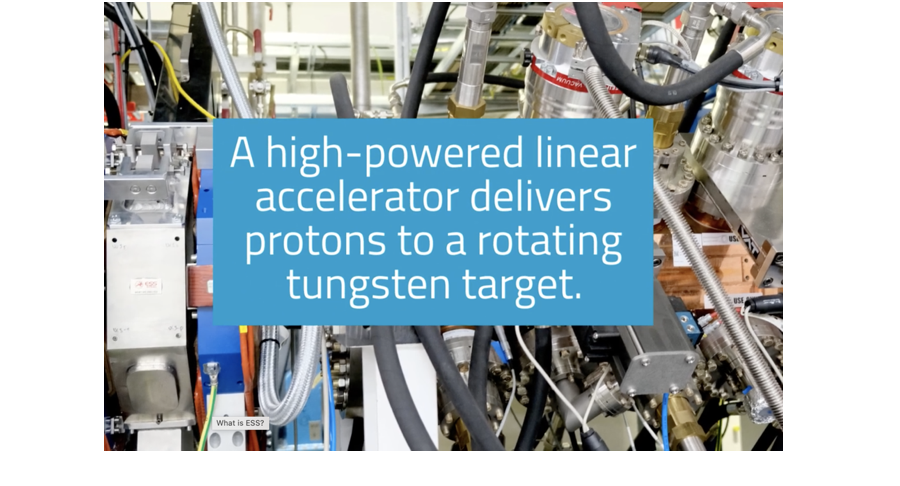
The ESS does not observe light. It manufactures neutrons. At its core is a linear accelerator that propels protons to roughly 96 percent of the speed of light before colliding them with a rotating tungsten target. This collision, known as spallation, releases cascades of neutrons which are then moderated, slowed and guided into beamlines for experimental use.
The shift from photon-based observation to neutron-based probing is not incremental. It is ontological. Neutrons carry no electrical charge and interact with atomic nuclei rather than electron clouds, allowing them to penetrate materials deeply without damaging them.
This produces a different category of image. Where optical microscopes map surfaces and X-rays privilege heavier elements, neutron scattering reveals hydrogen, magnetic structures and internal dynamics. It makes visible what is otherwise structurally invisible: diffusion pathways in batteries, water transport in biological tissues, and spin behaviour in quantum materials.
In this sense, ESS is not just more powerful. It sees different truths.
The engineering of invisibility
The technological ambition of ESS lies in intensity. The facility is designed to produce neutron beams up to twenty times more powerful than comparable sources, dramatically increasing resolution and experimental throughput.
Achieving this required solving multiple engineering constraints simultaneously:
- Beam generation: a superconducting linear accelerator extending roughly 600 metres delivers high-energy protons with extreme precision
- Target design: a rotating tungsten wheel disperses heat and stress from repeated impacts
- Cryogenics: superconducting cavities operate at temperatures close to two kelvins, requiring complex helium cooling infrastructure
- Moderation: liquid hydrogen slows neutrons to usable energies while preserving intensity
- Beam transport: neutron optics guide particles that cannot be steered electromagnetically
Each component addresses a paradox: neutrons are ideal probes precisely because they are difficult to control. As one researcher notes, out of millions of generated neutrons, only a fraction are successfully guided to experimental targets.
The microscope, then, is built around loss. Its power lies in managing dispersion, recovering order from statistical chaos.
The first proton beam
On 16 May 2025, engineers at ESS achieved a critical milestone. A proton beam travelled more than 540 metres through the accelerator, reaching the beam dump at full design energy.
This was not merely a test. It was the first demonstration that the machine could function as an integrated system, from ion source to terminus. Years of distributed engineering across European laboratories converged into a single trajectory.
Inside the control room, technicians reportedly celebrated with subdued relief. The moment marked a transition from construction to activation. The microscope had not yet produced neutrons, but it had learned to aim.
The next step, beam-on-target, will initiate neutron production and effectively switch the facility from engineering project to scientific instrument.
The political economy
ESS is often described as a 3-billion-euro microscope in Swedish media. The phrase captures both its scale and its ambiguity. It is a research tool, but also one of the largest scientific investments in Scandinavia. Its funding model reflects a broader European strategy: distributed cost, shared ownership and in-kind contributions. Thirteen countries contribute components, expertise and capital, embedding the facility within a transnational infrastructure network.
For Sweden, hosting ESS is both opportunity and burden. Government support has required repeated financial injections, including additional funding to ensure completion and operation within revised timelines.
This raises structural questions:
- Does concentrating resources in a single mega-facility crowd out smaller-scale research?
- Can national funding models sustain infrastructure whose benefits are globally distributed?
- How does Europe compete with state-backed scientific investment in the United States and China?
ESS sits at the intersection of these tensions. It is both a scientific instrument and a geopolitical wager on collaborative scale.
The future uses
The promise of ESS lies in what neutron scattering enables. Its future applications cluster into several domains:
1. Energy systems
Neutron techniques can trace ion movement in batteries and hydrogen storage materials, offering pathways to more efficient energy storage and conversion systems.
2. Life sciences and medicine
Because neutrons are sensitive to hydrogen, they can map water distribution and drug interactions within biological systems. This enables detailed studies of protein folding, membrane transport and pharmaceutical absorption.
3. Sustainable materials
From recyclable plastics to lightweight composites, neutron imaging allows researchers to study internal structures during real-time stress and chemical change, supporting circular economy design.
4. Quantum and magnetic systems
Neutrons interact with magnetic moments, making them uniquely suited to probing spin dynamics in quantum materials, an essential frontier for computing and sensing technologies.
5. Industrial diagnostics
The ability to analyse internal defects non-destructively has implications for engineering, from turbine blades to infrastructure components.
Across these domains, the defining feature is not just resolution but dynamics. ESS enables the study of processes over time, capturing motion at atomic scales.
The invisible workforce
Behind the physics lies a less visible system. Thousands of engineers, technicians and scientists across Europe have contributed to ESS through in-kind deliveries.
Their work is fragmented across institutions but unified in the machine. Components built in different countries are integrated into a single operational logic, turning the facility into a physical expression of European scientific cooperation.
Yet this model carries risks. Integration delays, technological mismatches and coordination costs have contributed to schedule shifts and budget pressures.
The microscope is not only complex. It is socially distributed.
Seeing as power
ESS represents a transformation in how science observes the world. It replaces illumination with interaction, optics with particle physics, and individual laboratories with continental infrastructures. But its deeper significance lies elsewhere.
To build a machine capable of seeing at this level requires not only technical expertise but political alignment, long-term funding and institutional trust. The microscope becomes a measure of collective capacity.
The question is no longer whether we can see deeper into matter. It is whether we can sustain the systems required to do so.
When the first neutrons emerge in Lund, they will not simply probe materials. They will test the proposition that large-scale, cooperative science remains viable in an era of fragmentation.
References
European Spallation Source. (n.d.). About ESS. https://ess.eu/about
European Spallation Source. (n.d.). Explore ESS. https://ess.eu/explore
European Spallation Source. (n.d.). Science using neutrons. https://ess.eu/science-using-neutrons
Lund University. (n.d.). ESS research infrastructure. https://www.lunduniversity.lu.se/research-and-innovation/research-infrastructures/ess
SVT Nyheter. (2025, May 16). Milstolpe för ESS i Lund – här är historiska protonstrålen. https://www.svt.se/nyheter/lokalt/skane/milstolpe-for-ess-i-lund-har-ar-historiska-protonstralen
European Commission / ESS ERIC. (Various). Project and infrastructure materials
Uppsala University. (2026). European Spallation Source research infrastructure
Swedish Government. (2022, November 3). Funding support for ESS
Zhang, C., & Gao, M. (2025). Spallation neutron sources and multidisciplinary applications
Picture: Lund University