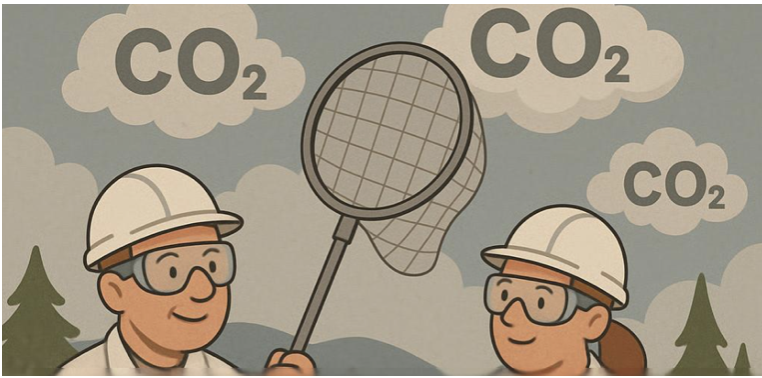
Professor Timo Repo and Zahra Eshaghi Gorjin at the University of Helsinki are advancing the materials chemistry that underpins practical direct air capture (DAC). Their work does not claim to have invented DAC; rather, it focuses on the capture chemistry—the molecular systems that bind CO₂ from very dilute air and release it again with low energy input. Repo’s group is internationally known for nitrogen‑based organic bases, superbases, and reversible CO₂ chemistry. Gorjin, a researcher in the group, has concentrated on deep eutectic solvents (DES) that host powerful CO₂‑binding molecules while resisting moisture and remaining recyclable.
What they developed
Repo and Gorjin demonstrated that extremely strong CO₂‑binding bases such as tetrabutyl‑nitrogen (TBN) can be embedded in DES to produce a liquid absorbent with several desirable properties. The resulting system shows high CO₂ uptake, robust performance in humid air, low regeneration temperature (around 70 °C), and recyclability over many cycles. Embedding reactive bases in DES effectively “tames” their reactivity toward water and stabilizes them for repeated absorption/desorption cycles. This approach addresses a central materials challenge for DAC: how to combine strong CO₂ affinity with moisture tolerance and low energy demand for regeneration.
How this fits into DAC history
DAC began as a concept for removing CO₂ directly from ambient air and has progressed through prototype machines to commercial pilots. Early conceptual work and engineering demonstrations established the feasibility of capturing CO₂ from air. The current phase emphasizes advanced materials that reduce energy and cost. Repo and Gorjin sit squarely in that materials‑innovation phase: they supply the chemical “filter” that could make future DAC systems cheaper and more energy efficient.
Comparison with Climeworks and Carbon Engineering
| Feature | Repo & Gorjin (DES + superbase) | Climeworks | Carbon Engineering |
|---|---|---|---|
| Capture material | Liquid superbase in DES | Solid amine‑coated filters | Aqueous KOH scrubbing |
| Humidity tolerance | Very high | High; sometimes needs dehumidification | Moderate |
| Regeneration energy | Low (~70 °C) | Moderate (~100 °C) | Very high (calcination ~900 °C) |
| Scale readiness | Lab / pilot | Commercial plants | Pilot / commercial plans |
Repo and Gorjin’s liquid chemistry promises lower thermal energy for regeneration and superior performance in wet air compared with many solid amine systems. Climeworks has demonstrated modular, commercial DAC using solid sorbents and established operational experience. Carbon Engineering uses liquid alkaline scrubbing that can produce concentrated CO₂ but requires high‑temperature processing for regeneration. The Helsinki chemistry is promising on energy and moisture metrics but remains at lab or early pilot scale; industrial players have the advantage in demonstrated system integration and scale.
Path to industrialization and outlook
To move from laboratory promise to industrial deployment, the DES‑superbase approach needs scale‑up of chemical production, durability testing over thousands of cycles, pilot‑plant integration, regulatory and safety assessment, and a full techno‑economic analysis. Finland’s strengths in green chemistry, process engineering, and access to renewable heat make it a plausible location for pilot development. If the materials prove durable and cost‑effective at scale, they could reduce the operational energy and cost of DAC modules and complement existing solid and liquid capture technologies.
Conclusion
Repo and Gorjin contribute a materials‑first solution to a central DAC problem: how to bind CO₂ strongly yet release it with little heat and in the presence of moisture. Their DES‑based liquid absorbents are a promising step toward lower‑energy, moisture‑tolerant DAC. The work is an example of how fundamental chemistry can feed into engineering and industry, but commercialization will require rigorous scale‑up, long‑term testing, and system integration before it can rival or augment the established approaches used by companies such as Climeworks and Carbon Engineering.