Ammonia has long been viewed as one of the most promising carbon-free fuels for industry and power generation. It contains no carbon, is relatively easy to store and transport, and already benefits from a global production and distribution network. Yet one major obstacle has held it back: burning ammonia typically produces harmful nitrogen emissions and greenhouse gases. [New burner…ia problem | Word]
Researchers at SINTEF Energy Research and Siemens Energy now report a significant advance that could change this. In a study published in Applications in Energy and Combustion Science, the partners demonstrated the first gas turbine burner specifically designed for pure, uncracked ammonia operating at pressures of up to 10 bar, conditions relevant to commercial gas turbines. Earlier experiments with pure ammonia had reached only around 4-5 bar. [New burner…ia problem | Word]
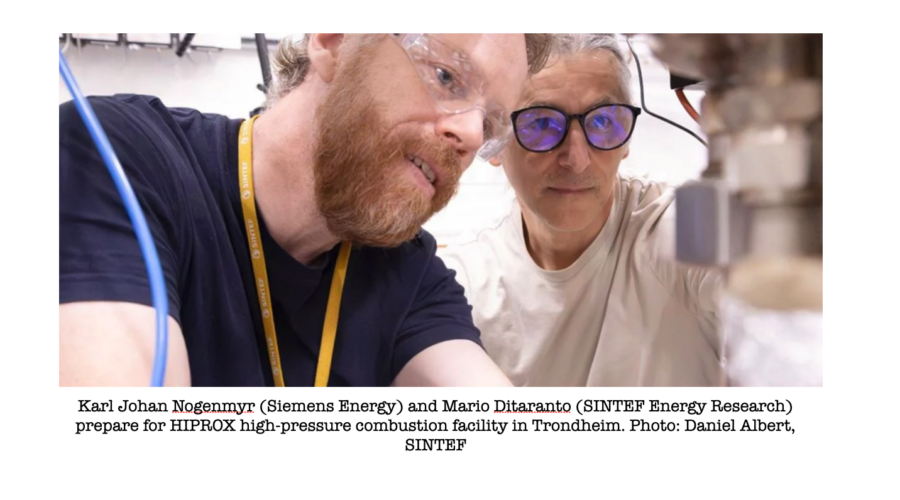
Tests at SINTEF’s HIPROX high-pressure combustion facility in Trondheim showed that the burner operated stably across a wide range of conditions. At its optimum operating point, emissions were remarkably low: 47 parts per million of nitrogen oxides (NOx), around 1 part per million of nitrous oxide (N₂O), and no measurable unburned ammonia. Most of the fuel’s nitrogen was converted into harmless nitrogen gas rather than pollutants. [New burner…ia problem | Word]
The breakthrough draws on a technique long used in coal-fired power stations. Fuel is burned in two stages, with limited air initially encouraging nitrogen to form harmless nitrogen gas before the remaining air completes combustion. The researchers also found that keeping burner walls relatively hot helps minimise unwanted emissions. [New burner…ia problem | Word]
Another practical advantage is that the system can start on natural gas and switch to ammonia without producing hydrogen cyanide, a toxic by-product observed in some alternative designs. [New burner…ia problem | Word]
For the emerging ammonia economy, this is more than a laboratory success. It represents a tangible step towards using carbon-free ammonia as a practical fuel for large-scale power generation and industrial energy systems.