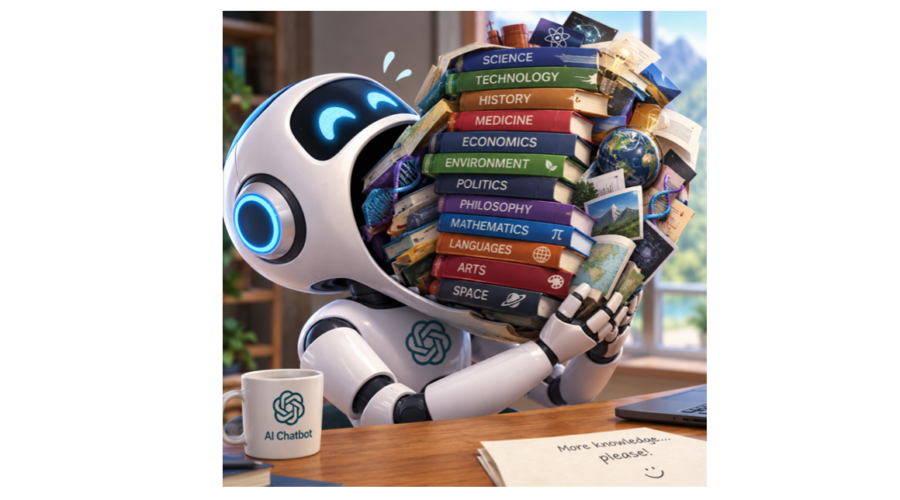
A major Nordic study indicates that language models produce a less diverse range of factual claims than a Google-search baseline. But its warning of “knowledge collapse” identifies a possible future risk, not evidence that public knowledge is already shrinking.
When people consult an AI chatbot, they receive a synthesis rather than a landscape of links. Research led by the University of Copenhagen suggests that this convenience may come with an epistemic cost.
The researchers tested 27 language-model systems on 155 general and country-related topics. For every topic, they used 200 information-seeking prompt templates selected from the IssueBench collection. Approximately 1.7 million responses were decomposed into 70 million claims, which were then grouped according to semantic equivalence.
The study defines “epistemic diversity” as variation in the claims that models produce. It found that every tested system generated a less diverse distribution of claims than its search baseline. Even GPT-5, the most diverse model in the comparison, was at least 18.7 per cent less diverse. Retrieval-augmented generation improved diversity, while larger models were unexpectedly less diverse than smaller ones.
The comparison, however, was not with everything an ordinary user might encounter during an open-ended search. The baseline comprised up to 40 Google results for each topic, gathered in the United States on 1 January 2026 by entering the topic as the query. The experiment consequently compares bodies of text produced under controlled conditions, not complete experiences of searching and using an AI service.
This distinction limits what can be concluded. The study measured diversity, not factual accuracy, relevance or learning. A varied collection can contain errors, while a relatively uniform answer can still be correct. Nor did the researchers follow people to establish what they remembered or believed after using a chatbot.
The expression “knowledge collapse” therefore requires care. In the paper, it denotes the risk that dependence on homogeneous model outputs could reduce access to less prominent knowledge over time. The study did not find that such a collapse is already under way. On the contrary, epistemic diversity generally increased across successive model generations, although the improvement was uneven and did not appear in every model family.
The Nordic provenance is significant. First author Dustin Wright, formerly a postdoctoral researcher at the University of Copenhagen, is now an assistant professor at Aalborg University. Senior author Isabelle Augenstein is a professor at Copenhagen’s Department of Computer Science. Researchers from three American universities also contributed, and the paper was accepted for EMNLP 2026.
Independent research lends qualified support to the central concern. An analysis of 234,839 human–ChatGPT conversations found that 79 per cent of user inputs were not readily answerable through conventional search. This suggests that generative AI broadens the kinds of requests people make. Yet for comparable searchable questions, Google results covered a wider semantic space than ChatGPT answers across most topics. The diversity of an AI response was also associated with the diversity of the user’s next question, although the observational design cannot prove that the AI response caused the change.
A peer-reviewed PNAS Nexus study supplies evidence closer to learning itself. Across seven experiments involving 10,462 participants, Shiri Melumad and Jin Ho Yun found that participants learning from LLM syntheses reported shallower knowledge and subsequently produced advice that was sparser, less original and less likely to be adopted than advice produced after using conventional web links. Some experiments held the core information constant, strengthening the case that presentation and active synthesis matter.
The Copenhagen research applies to tested models, not automatically to every branded service. ChatGPT and Gemini are mentioned in the university communication, but complete versions of Microsoft Copilot and Perplexity were not evaluated. Their search integration, citations and interface design could alter what users encounter.
The finding is thus narrower, but more useful, than its dramatic label. AI can expand the questions people are able to ask while still compressing the range of claims returned for an individual topic. For journalists, students and researchers, a polished chatbot answer should be treated as a starting point, not the boundaries of the available knowledge.
References
Melumad, S., & Yun, J. H. (2025). Experimental evidence of the effects of large language models versus web search on depth of learning. PNAS Nexus, 4(10), pgaf316. https://doi.org/10.1093/pnasnexus/pgaf316 [academic.oup.com], [sooth.fyi]
University of Copenhagen. (2026, September 26). AI chatbots give us a narrow slice of knowledge: Researchers warn of “knowledge collapse”. https://news.ku.dk/all_news/2026/09/ai-chatbots-give-us-a-narrow-slice-of-knowledge-researchers-warn-of-knowledge-collapse/ [news.ku.dk]
Wright, D., Masud, S., Christensen, P. E., Moore, J., Yadav, S., Antoniak, M., Park, C. Y., & Augenstein, I. (2026). What and whose knowledge? Measuring epistemic diversity in large language models [Paper accepted for EMNLP 2026]. arXiv. https://doi.org/10.48550/arXiv.2510.04226
Yu, Y., Li, Y., Suri, S., & Counts, S. (2026). From searchable to non-searchable: Generative AI and information diversity in online information seeking. In Extended abstracts of the 2026 CHI Conference on Human Factors in Computing Systems. Association for Computing Machinery. https://doi.org/10.1145/3772363.3798802