The new UnloQ project is a useful corrective to one of quantum computing’s most persistent myths: that industry only needs to wait for bigger machines. The Finnish bet is that value may arrive earlier, if researchers can make noisy quantum computers usable enough for real industrial problems.
Finland’s latest quantum computing project begins with a sober admission. Quantum computers may one day help with materials, optimisation, artificial intelligence, finance, energy systems and logistics, but today’s machines remain fragile. Their qubits are disturbed by heat, electromagnetic interference, imperfect control pulses and measurement errors. In practical terms, the promise of quantum computing is still filtered through noise. That is the problem the new UnloQ project, led by VTT with the University of Helsinki and the University of Jyväskylä, has chosen to tackle directly.
The project’s full name, Unlocking Quantum Computing Benefits, is revealing. It does not present the next qubit milestone as the central breakthrough. Instead, it asks which industrial problems are worth attempting on imperfect machines, and how software, algorithms and adoption pathways can be designed around current limitations. Business Finland has awarded €8 million to the five-year project under its Rise to the Challenge programme, according to VTT.
That framing is important, because quantum computing has often been sold through a distant horizon: fault-tolerant machines, large-scale error correction and transformative advantage over classical computers. The near-term reality is messier. A major review of quantum error mitigation notes that for quantum computers to solve real-world problems, researchers must address noise, while full fault tolerance is a longer-term answer and near-term NISQ machines require mitigation rather than complete removal of errors.
UnloQ is therefore innovative less because it invents an entirely new category of quantum technology than because it shifts the innovation target. The novelty lies in treating noise not only as a physics problem, but as a software, workflow and industrial adoption problem. The University of Jyväskylä’s project description says UnloQ will combine quantum computing and high-performance computing into hybrid workflows, develop software and algorithms for noisy quantum devices, and identify high-impact application areas and pilot candidates.
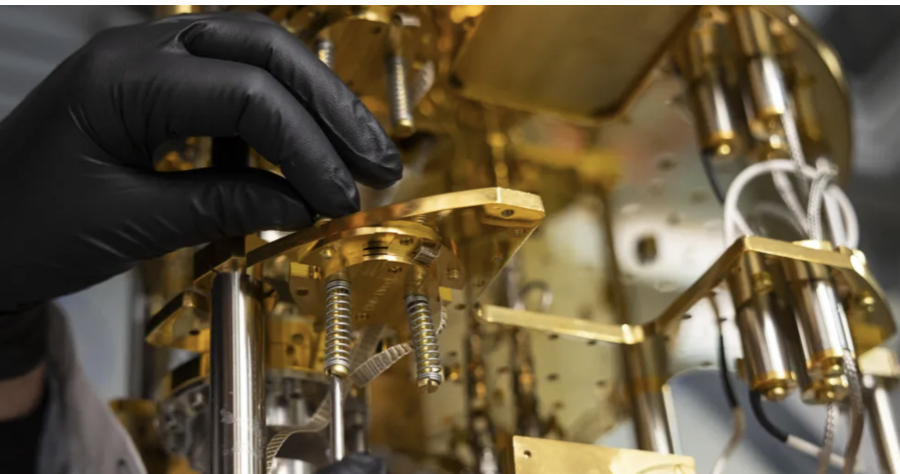
This is a significant move for Finland’s quantum ecosystem. VTT and IQM launched Europe’s first 50-qubit superconducting quantum computer in March 2025, making it available for research and business use through VTT’s quantum computing service. The machine followed a phased Finnish programme that began with a 5-qubit system in 2021, moved to 20 qubits in 2023 and then reached 50 qubits.
But qubit count alone does not create commercial value. The 50-qubit VTT Q50 system is integrated with the LUMI supercomputer, enabling hybrid computation in which parts of a problem are handled classically and parts quantum mechanically. LUMI’s own description of the integration points to precisely the areas UnloQ now wants to push further: hybrid algorithms, error mitigation techniques and compilers that take the characteristics of quantum computers into account.
The project’s central insight is that firms cannot build quantum capability by passively waiting. “The benefits of quantum computing will not be discovered simply by waiting for more advanced machines,” VTT quotes consortium lead Maaria Nuutinen as saying. Her point is both technical and industrial: companies need to learn which problems are genuinely quantum-suitable before the hardware becomes mature enough for routine deployment.
The emphasis on noise also brings Finland into line with the wider European policy debate. The European Commission’s Quantum Europe Strategy, adopted on 2 July 2025, says Europe has made progress in quantum technology but is lagging in turning innovation capabilities into market opportunities, while also facing fragmented strategies and roadmaps across member states. The Commission wants Europe to become a global quantum leader by 2030 through research, infrastructure, start-up growth, supply chains, dual-use technologies and skills.
Finland’s own Quantum Technology Strategy 2025-2035 sets a similarly ambitious national frame. It argues that quantum technologies could enable major advances in computing, measurement and communications, and that Finland could become one of the leading countries in both quantum technologies and their applications. The strategy calls for a strong quantum computing environment, infrastructure for device development, skills, long-term RDI funding, company growth support and international cooperation.
Seen in that context, UnloQ appears to be a bridge between two parts of the Finnish story that do not automatically connect: hardware prestige and industrial value. Finland has already demonstrated that it can build serious superconducting quantum machines with IQM and VTT. The harder question is whether Finnish companies, researchers and software developers can turn access to those machines into repeatable advantage before competitors elsewhere do the same.
The project’s choice of partners is designed around that gap. VTT acts as coordinator and industrial bridge-builder. The University of Helsinki contributes algorithm and software engineering expertise. The University of Jyväskylä brings theoretical work in quantum information, including noise and imprecision. VTT says software and algorithm development will be carried out “down to the pulse level”, close to the physical operation of the hardware.
That pulse-level detail is important. In ordinary computing, most industrial users never think about electrical behaviour inside a processor. In quantum computing, the boundary between hardware and software is still porous. The way a quantum operation is physically driven can affect whether a computation survives long enough to produce useful results. Noise-aware algorithms and resource-efficient software are therefore not decorative add-ons. They may be the difference between a demonstration and a tool.
There is, however, a risk of overclaiming. The source material does not prove that UnloQ has already produced a commercially valuable quantum application. It describes a funded research and adoption effort, not a demonstrated industrial breakthrough. Its innovation is prospective and infrastructural: building methods, pilots and organisational models for early use of noisy quantum devices. That is meaningful, but it should not be confused with evidence that quantum computing is already outperforming classical methods in Finnish industry.
The most credible promise is therefore practical learning. If UnloQ can identify which optimisation, simulation or machine-learning tasks are genuinely worth testing on quantum hardware, and which are better left to classical or high-performance computing, it will offer industry something valuable even before quantum advantage is routine: a disciplined map of opportunity and non-opportunity. That kind of negative knowledge is often underappreciated in technology policy, but it can prevent wasteful pilots and inflated expectations.
For policy-makers, the project also offers a lesson in timing. Waiting for perfect machines may leave companies unprepared when more capable quantum computers arrive. Moving too early, without clear use cases or noise-aware methods, risks burning money and credibility. UnloQ tries to occupy the middle ground: early enough to build competence, cautious enough to recognise the present limits of the technology.
That makes the project an instructive example of second-stage quantum innovation. The first stage was building the machine. The second is learning how to use a machine that still makes mistakes. In quantum computing, that may be where the real industrial race begins.
References
VTT Technical Research Centre of Finland. (2026, June 3). UnloQ project accelerates the benefits of quantum computing for industry. https://www.vttresearch.com/en/project_news/unloq-project-accelerates-benefits-quantum-computing-industry
Cai, Z., Babbush, R., Benjamin, S. C., Endo, S., Huggins, W. J., Li, Y., McClean, J. R., & O’Brien, T. E. (2023). Quantum error mitigation. arXiv. https://arxiv.org/abs/2210.00921
European Commission. (2025, July 2). Quantum Europe Strategy. https://digital-strategy.ec.europa.eu/en/library/quantum-europe-strategy
LUMI. (2025, March 4). Europe’s first 50-qubit superconducting quantum computer connected to LUMI. https://lumi-supercomputer.eu/vttq50-connected-to-lumi/
Ministry of Economic Affairs and Employment of Finland. (2025). Finland’s Quantum Technology Strategy 2025-2035: A new engine of growth and builder for a sustainable future. https://julkaisut.valtioneuvosto.fi/bitstreams/d58ab039-a9c7-47dd-a816-58718208a18e/download
University of Jyväskylä. (2026). UnloQ: Unlocking quantum computing benefits. https://converis.jyu.fi/converis/portal/detail/Project/285770609?lang=en_GB
VTT Technical Research Centre of Finland. (2025, March 4). VTT and IQM launch first 50-qubit quantum computer developed in Europe. https://www.vttresearch.com/en/news-and-ideas/vtt-and-iqm-launch-first-50-qubit-quantum-computer-developed-europe