In a sector crowded with glossy videos of orange arms throwing sparks, the most interesting advances often hide in cell architecture, fixture logic, and the mundane choreography of pallets, jigs and software. Jucat (an integrator from Seinäjoki) has been refining precisely these seams of the welding value chain since 2001. Their proposition is not simply “more robots”, but tightly‑engineered, high‑availability welding systems where positioners, logistics and sensing stack neatly into predictable throughput.
This deep‑tech profile looks under Jucat’s hood: how its cells are put together, what is proprietary versus partnered, and why laser welding has become a timely pivot. The lens is squarely on Jucat; context is implied rather than comparative. Sources include the company’s English and Finnish pages, partner technical papers, and credible regional coverage (Finnish material translated where needed).
Jucat’s Architecture‑First View
Ask Jucat what it sells and the answer is not a catalogue of SKUs, but a systemic approach to productive welding. The company’s public materials emphasise an “advanced, optimised design and production process” that commits to the productivity targets defined at project kick‑off. In practice that means concept engineering, robotic stations, workpiece positioners, welding and assembly jigs, programming, operator training, and long‑tail lifecycle support, all under one envelope.
The Finnish‑language company page is more explicit: Jucat aims to keep strategic partners “close to the core” and to “deploy new innovations constantly” so customers receive state‑of‑the‑art solutions. This reads less like marketing puff and more like a discipline: only a small number of integrators in the Nordics maintain a house style that blends concept planning (layout, takt, upstream/downstream buffers) with fixture ergonomics and automation safety as tightly as this.
Workpiece Control
The spine of Jucat’s philosophy is the workpiece positioner (their own JCP/JCK/JCL families) which aims to bring the weld seam into the most forgiving attitude every time, reducing cycle time variance and improving bead quality. The company markets these as innovative, but the more useful claim is operational: swift, safe moves into optimal weld posture with knock‑on gains in quality and takt. For manual teams, positioners are presented as a route to “better quality” as well.
In case work, Jucat points to mobilised positioners removing production bottlenecks, effectively decoupling station‑bound fixtures from a fixed line and relieving layout constraints that often trap throughput. That is a classic lean remedy; it is notable to see an integrator productise it for heavy weldments.
Multi‑Robot FMS
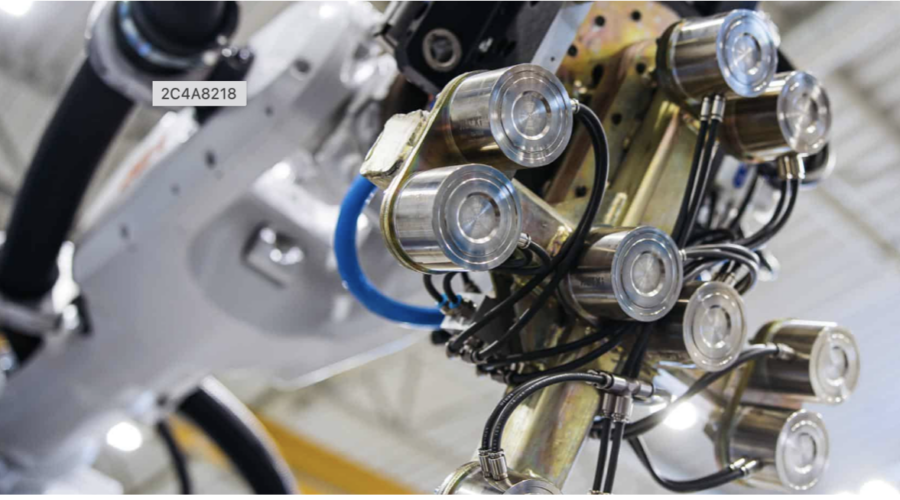
Jucat’s ABB partner deck (from ALIHANKINTA 2020) is a rare, technical glimpse of how the company thinks about fully automated multi‑robot FMS cells for welded products. The document lays out an end‑to‑end cell where material pallets and product pallets move via FMS conveyors, with separation of duties between handling robots (ABB IRB 6700) and welding robots (ABB IRB 2600/4600). The stack includes machine vision, RFID identification, automatic torch/tool changes, and laser seam finding/tracking, with RobotStudio underpinning offline programming and cell validation. The pitch is blunt: “manufacture without a human hand touching the process at all”.
That language can be over‑promised in automation brochures; however, the module list; RFID for pallet/fixture identity, laser tracking for seam variability, and tool/torch change routines baked into the PLC/robot supervisor, suggests a mature recipe for high mix/low touch welding where changeovers are software‑defined rather than wrench‑defined.
Twenty‑Fold Speed Gains, With Caveats
Jucat’s news feed flags a pivot: the “laser welding cell era” with throughput cited as up to 20× faster than predecessor processes. As ever, “up to” depends on thickness, joint design, shielding, and fit‑up discipline; but as an integrator signal it is important, laser welding is no longer boutique. It is entering standard offering territory in Nordic cell design.
The company couples this with educational content, explainers on TIG/MIG/MAG/spot/laser differences, automation benefits, feature round‑ups, and productivity tactics, a sign they are onboarding customers who may need a process migration path from conventional GMAW to laser, rather than green‑field lines.
Although the website itself is coy about named references, regional coverage fills in: Jucat describes itself as a welding‑automation specialist supplying the vehicle industry, with systems contributing to tractor ROPS cabins, forestry harvester heads, tram rolling stock and bogies, and thin‑sheet door lines. Named customers include ABB, MSK Group, Ponsse, Prima Power, Valmet, Valtra and Wärtsilä, a credible cross‑section of Finnish heavy industry and beyond.
The Wärtsilä relationship in particular has real texture. In 2020, Yle reported a significant robot cell order for the Smart Technology Hub in Vaasa, including a robot cell with rotation equipment for a new washing system serving engine blocks and large components. While not a welding cell, it shows the same handling and process‑integration competence applied to harsh, heavy, and wet environments, useful DNA when you graduate to welding bogies or heavy frames.
Partnering to Go Deeper, Not Broader
Jucat has been an ABB Value Provider for robotics since 2019, using ABB hardware across its portfolio. The partner deck documents not just robot models but portal gantries for large envelopes, plasma welding/cutting/marking, and laser search/tracking, indicating the company’s comfort with multi‑process cells where welding is one of several operations in a gated sequence. The payload spans are serious: 1,500 kg to 75,000 kg for handling solutions, putting Jucat solidly in heavy fabrication territory.
That hardware conservatism, one robot vendor, deep integration, is often a design accelerant. It reduces points of friction in controller interoperability, simplifies safety‑PLC homogeneity, and lets the integrator invest in fixture intelligence rather than jigsawing brands for brochure completeness. The company’s own copy underscores that its “technologically advanced, modern facilities” in Seinäjoki support European deployments with a partner network for service.
Execution Culture
A recurring phrase in Jucat’s material is the guarantee that solutions meet productivity goals set at project start. Integrators don’t make such claims lightly: they’re an implicit SLA on takt and OEE. To deliver it, Jucat leans on thorough concept planning; layout, positioner selection, and fixture logic that allows ergonomic loading while the robot welds. The Finnish page connects this to “planned quality and productive processes”, in other words, front‑loading engineering so downstream production is boring on purpose.
The company’s values (profitable growth, long‑term client value, motivated personnel, long‑term partners) are standard Nordic fare. What’s more telling is the workshop discipline implied by their claims: training, post‑deployment customer support to “utilise full capacity”, and a bias for incremental production development after go‑live. In welding, where the fastest way to lose money is to leave the cell alone after installation, that stance matters.
Growth Vector -> Exports First, Defence Emerging
An interview published by the Seinäjoki development agency paints a commercially candid picture. CEO Jukka Rintala targets doubling revenue in a few years with growth from exports, citing Germany and Sweden as the current hotspots; export share sits at 20–30%, with the aim to flip to a majority. The piece notes multi‑million‑euro welding line deliveries (MSK Cabins, 2023) and names projects reaching as far as Algeria and Japan. It also flags defence industry demand as an emerging lane. This is a useful read because it calibrates ambition with the integrator reality: 5–10 significant orders per year can move the needle if your unit economics are right.
A separate public record anchors the basics: founded 2001, HQ Seinäjoki, leadership by Jukka Rintala, with product focus on robotic welding, handling equipment and production automation. The firm also received the Seinäjoki Technology Award in 2022, a local but telling recognition of its regional impact.
Three forces make Jucat an integrator to watch:
- The shift to laser welding in production cells is accelerating. Integrators that already treat seam‑finding, pallet ID, and offline programming as table stakes will scale laser faster (and safer). Jucat’s own materials point to exactly these features.
- High‑mix Nordic fabrication punishes brittle cells. Jucat’s positioner‑centric logic and FMS conveyors with software changeovers directly address mix without sacrificing availability.
- Export discipline: a small number of large cells per year, fits the capital cycles of European industry in 2026. The company’s public targets, markets, and reference sectors suggest a grounded plan rather than a vanity sprint.
If there is a caveat, it is visibility: Jucat’s website is conservative in hard metrics (OEE deltas, cycle times by product family, ppm defects, consumable burn rates). For buyers, this is where reference calls and acceptance tests will do the talking. For now, the available record shows an integrator that has matured the boring essentials of welding automation, and that is often what separates the market‑ready from the merely flashy.
Sources
- Jucat: “Next generation of welding automation” https://jucat.fi/
- ABB Value Provider deck (PDF): FMS cell details, robots used, vision/RFID/laser tracking, payload ranges. https://new.abb.com/docs/librariesprovider52/tapahtumat/jucat.pdf?sfvrsn=1f051d17_2
- Into Seinäjoki feature (FI): CEO interview on export strategy, customer sectors, 2023 MSK Cabins deal, defence entry. https://intoseinajoki.fi/uutiset/jucat-kaasuttaa-viennilla-kasvuun/
- Yle (FI): Wärtsilä order for a robotics cell in Smart Technology Hub (Vaasa), with handling/rotation equipment. https://yle.fi/a/3-11643566