In April 2026, Tromsø became a meeting ground for a distinctive kind of academic exchange, as researchers from across Europe gathered to explore how the humanities can reshape the way knowledge is produced and communicated. The event, hosted by The Arctic University of Norway, formed part of a week-long programme designed to challenge traditional academic boundaries and address large-scale societal issues through interdisciplinary thinking.
At the heart of the initiative was a central question: to what extent are today’s global challenges rooted in human experience, shaped by culture, history, and language? Rather than treating issues such as environmental change or social transformation as purely technical problems, the programme encouraged participants to consider them as deeply embedded in meaning and interpretation.
The gathering was organised as a Blended Intensive Programme, bringing together researchers from seven countries under the auspices of UiT’s Centre for Arctic Humanities, in collaboration with international academic networks. The format emphasised direct engagement and exchange, creating a space where scholars from different disciplines were required not only to present their perspectives but also to negotiate and rethink them in dialogue with others.
Activities extended well beyond traditional seminars. Participants engaged in hands-on sessions with Sámi cultural collections, explored historical maps, and took part in storytelling workshops. A day at sea in Balsfjord added another dimension, as researchers examined marine life through both scientific categorisation and creative interpretation. These exercises aimed to demonstrate how knowledge can be generated through sensory, narrative, and artistic practices as much as through data and analysis.
Visits to exhibitions also played a crucial role. Displays such as Living with the Ocean and Queering Polar History encouraged participants to reflect on how narratives shape understanding of the Arctic and its histories. By integrating perspectives from indigenous culture, gender studies, and environmental humanities, the programme highlighted how complex realities can be interpreted in multiple ways depending on the frameworks applied.
The initiative was coordinated by Associate Professor Lilli Mittner, who argued that the humanities hold a vital role in transforming the modern university. According to her, disciplines such as literature, history, and cultural studies do more than critique established knowledge systems. They actively create new forms of understanding through interpretation, storytelling, and imagination.
Mittner emphasised that creativity should not be seen as an optional addition to academic work, but as a fundamental component of it. In her view, the future relevance of universities depends on their ability to engage with complexity and uncertainty, something that requires not only technical expertise but also interpretative insight.
A key outcome of the programme was the recognition that collaboration between the sciences and the humanities can transform the very questions being asked. Rather than simply translating scientific findings into accessible language, humanistic approaches can reframe research agendas, opening new avenues for inquiry. This shift, participants suggested, is essential for addressing challenges that are simultaneously environmental, cultural, and social.
The Tromsø gathering ultimately pointed towards a broader rethinking of academic practice. By foregrounding co-creativity and interdisciplinary engagement, it proposed a model of scholarship that is less about isolated expertise and more about collective exploration. In doing so, it underscored the potential of the humanities not only to interpret the world, but also to shape how it is understood and navigated in the future.
Reference
UiT The Arctic University of Norway. (2026, April 24). Facing the future with critical imagination.
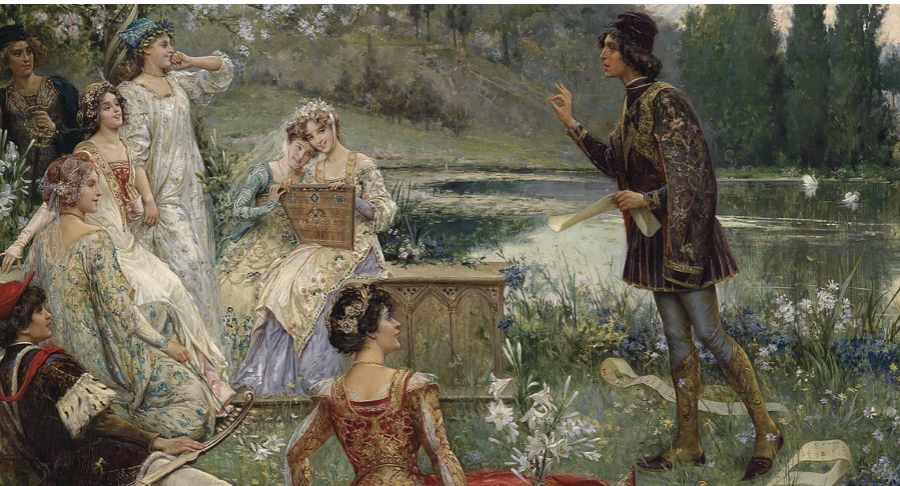
Photo of part of painting of the Decameron called of the Narration – Giovanni Boccaccio