The electrification of road transport has been underwritten by a simple certainty: charging infrastructure follows the vehicle. Ships, however, have remained stubbornly tethered to a different logic. Their “filling stations” are ports; fixed, distant, and often inconvenient. This asymmetry has long constrained the electrification of maritime operations, particularly offshore, where vessels can spend weeks servicing wind farms or oil installations far from land.
Now, a convergence of Nordic engineering, offshore wind expansion, and advances in wireless power transfer has begun to dissolve that constraint. At the centre of this shift lies a deceptively simple idea: charge ships where they already are.
The Ocean Charger project, led by the Norwegian shipbuilder Vard in collaboration with SINTEF, NORCE, and a wide industrial consortium, represents one of the most ambitious attempts to operationalise this concept. Its solution is neither a cable nor a conventional plug, but a magnetic interface capable of transferring megawatts of power across open water.
What emerges is not merely a new technology, but the early blueprint of a distributed offshore energy system.
Corrosion, Motion, and Distance
At sea, engineering problems rarely arise in isolation. Any attempt to electrify offshore vessels must contend simultaneously with mechanical instability, corrosive saltwater, and the economics of distance.
Traditional charging relies on rigid, metal-to-metal connections. These work on land because vehicles remain stationary, alignment is precise, and environmental exposure is limited. At sea, these conditions collapse. Waves and wind continually shift both vessel and infrastructure, introducing stress into connectors and increasing the risk of electrical arcing or failure.
Saltwater compounds the issue. It accelerates corrosion, degrades insulation, and raises maintenance costs. As Håvard Vollset Lien, head of the Ocean Charger project at Vard, observes, conventional connections suffer from “mechanical wear and tear, corrosion and demanding maintenance,” making them both costly and unreliable offshore.
The consequence is not merely technical but systemic. Electric vessels serving offshore wind farms must often return to port simply to recharge, journeys that can consume a significant portion of their battery capacity.
This creates a paradox: zero-emission ships may burn energy, and time, just to remain operational.
From Plug to Field
The Ocean Charger project resolves this paradox by abandoning the physical connector altogether.
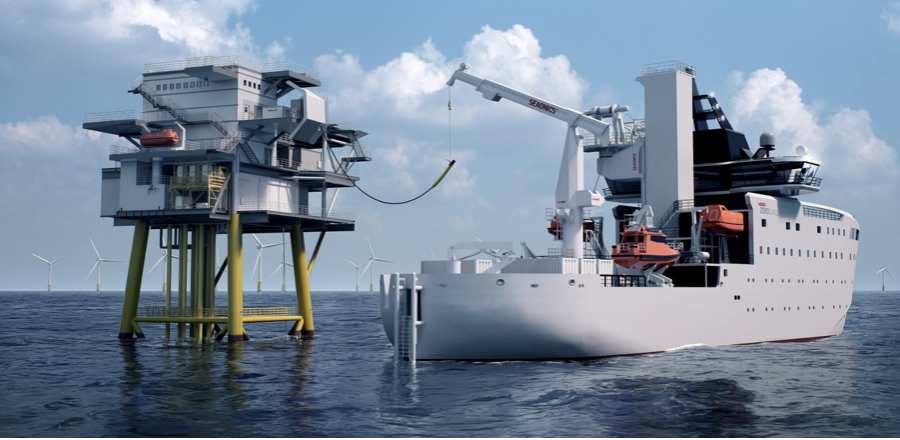
Instead, it uses inductive power transfer (IPT), a technology more commonly associated with wireless phone charging but here scaled to industrial proportions. Power is transmitted via oscillating magnetic fields between two coils, one embedded in the charging station (for example, on a wind turbine), the other mounted on the vessel.
The implications are substantial:
- No exposed metal contacts, eliminating corrosion risks
- Tolerance to misalignment, enabling operation in moving seas
- Reduced mechanical wear, lowering maintenance requirements
Engineers describe the user experience as analogous to “putting a cup in a cup holder,” requiring minimal precision during connection.
Behind this apparent simplicity lies a complex energy chain. High-voltage electrical power, potentially sourced directly from offshore wind turbines, is converted into high-frequency currents, transmitted magnetically, and then rectified back into usable onboard electricity.
This is not merely wireless charging; it is high-power electromagnetic coupling operating at multi-megawatt scales.
From Buses to Ships
The intellectual lineage of Ocean Charger extends into terrestrial transport systems, particularly inductive charging for heavy-duty vehicles.
Research into high-power IPT systems for buses and trucks has shown that wireless charging can achieve efficiencies above 90% while delivering power levels in the hundreds of kilowatts, with scalable architectures reaching even higher outputs.
Crucially, these systems rely on:
- Optimised coil geometry and electromagnetic materials
- High-frequency power electronics
- Thermal and control system integration
Such design principles are now being translated to maritime contexts, albeit with far greater power demands and environmental complexity.
Prototype offshore systems have already demonstrated megawatt-level transfer capacity, with projected targets around 5–6 MW, sufficient to recharge large service vessels within a few hours.
In effect, the maritime sector is leapfrogging directly into the high-power regime of inductive charging.
The Ocean Charger Project
Technological feasibility, however, is only one dimension. The Ocean Charger project explicitly addresses the broader maritime value chain.
According to NORCE, the initiative aims to develop, simulate, and test a full-scale system enabling zero-emission vessel operations at offshore wind farms, while also examining business models, standardisation, and alternative energy transfer methods.
This reflects a wider strategic shift:
- Offshore wind farms are not just energy generation sites, but energy hubs
- Vessels become mobile energy consumers within a distributed grid
- Charging infrastructure evolves from port-based to networked offshore nodes
The project consortium includes energy companies, shipbuilders, battery manufacturers, and research institutions, underlining the systemic nature of the transition.
In this sense, Ocean Charger is as much about industrial coordination as technological innovation.
Economic and Operational Implications
The economic logic of offshore charging is compelling.
First, it reduces non-productive transit. A vessel that can recharge on-site avoids long return journeys to port, increasing operational uptime.
Second, it allows for smaller battery systems. Frequent “top-up” charging, rather than deep discharge cycles, extends battery life and reduces capital expenditure.
Third, it reshapes cost structures. Electricity sourced directly from offshore wind turbines is typically cheaper than marine fuels, while reduced mechanical wear lowers maintenance costs.
Moreover, inductive systems enable opportunity charging, a model already explored in electric bus networks, where vehicles recharge intermittently rather than in single long sessions.
Applied offshore, this could transform vessel operation into a continuous energy balancing process rather than a periodic refuelling cycle.
Environmental and Strategic Significance
The broader significance of offshore charging lies in its potential to decarbonise an often-overlooked segment of the energy transition: the vessels that build and maintain renewable infrastructure itself.
Offshore wind is among the fastest-growing energy sectors globally, but its maritime logistics chain remains emissions-intensive.
By enabling zero-emission operations within wind farms, Ocean Charger closes a critical loop: renewable energy powering its own maintenance ecosystem.
Strategically, the technology also positions Norway, and the wider Nordic region, as a leader in integrated maritime electrification, combining expertise in shipbuilding, offshore engineering, and energy systems.
Toward an Offshore Charging Network
The long-term vision extends beyond individual projects.
Developers envisage a coastal and offshore charging network, where vessels can recharge at multiple points across their operational routes; on wind turbines, substations, or dedicated charging platforms.
Such a network would mirror the evolution of electric vehicle infrastructure on land, but with added complexity:
- Integration with fluctuating renewable generation
- Standardisation across vessel types and operators
- Regulatory frameworks for offshore energy transfer
The success of Ocean Charger may therefore hinge less on technical proof-of-concept, already demonstrated, than on the creation of interoperable standards and viable business models.
Infrastructure Without Ports
The history of maritime transport is, in many ways, a history of ports: fixed points anchoring movement across fluid space. Offshore charging challenges that logic.
By decoupling energy transfer from physical infrastructure, inductive charging systems redefine where and how ships can operate. The sea itself becomes an extension of the grid.
What emerges is a new spatial paradigm: infrastructure without ports, charging without cables, and mobility without return journeys.
If realised at scale, this paradigm will not only accelerate maritime decarbonisation, it will fundamentally reshape the relationship between energy and movement at sea.
References
- NORCE Research. (2025). Ocean Charger – Maritime value chain for offshore wind with offshore energy transfer. [norceresearch.no]
- Tunstad, H. (2026, April 27). A new “plug and play solution” enables offshore charging for electric ships at sea. Norwegian SciTech News. [norwegians…chnews.com]
- Uko, E. (2026, May 5). Wireless offshore chargers let electric ships recharge at sea. New Atlas. [newatlas.com]
- Cranworth, N. (2026, May 6). Norwegian breakthrough enables offshore electric ship charging. Maritime Technology Review. [maritimete…review.com]
- EcoPortal. (2026). Wireless charging system for electric ships. [ecoportal.net]
- AJOT. (2024). Norway’s Vard develops Ocean Charger. [ajot.com]
- Gagadget. (2026). Norwegian project can charge electric ships at sea. [gagadget.com]
- Chalmers University. (2021). Modular inductive power transfer for high-power vehicle charging. [research.chalmers.se]
- U.S. Department of Energy / ORNL. (2019). High-power inductive charging system development. [energy.gov]
- Energy Solutions. (2025). Wireless charging for electric buses: ROI analysis. [energy-solutions.co]
- Photo: Charging at Sea
- Norway Is Rewiring the Physics and Economics of Maritime Electrification
- The electrification of road transport has been underwritten by a simple certainty: charging infrastructure follows the vehicle. Ships, however, have remained stubbornly tethered to a different logic. Their “filling stations” are ports; fixed, distant, and often inconvenient. This asymmetry has long constrained the electrification of maritime operations, particularly offshore, where vessels can spend weeks servicing wind farms or oil installations far from land.
- Now, a convergence of Nordic engineering, offshore wind expansion, and advances in wireless power transfer has begun to dissolve that constraint. At the centre of this shift lies a deceptively simple idea: charge ships where they already are.
- The Ocean Charger project, led by the Norwegian shipbuilder Vard in collaboration with SINTEF, NORCE, and a wide industrial consortium, represents one of the most ambitious attempts to operationalise this concept. Its solution is neither a cable nor a conventional plug, but a magnetic interface capable of transferring megawatts of power across open water.
- What emerges is not merely a new technology, but the early blueprint of a distributed offshore energy system.
- Corrosion, Motion, and Distance
- At sea, engineering problems rarely arise in isolation. Any attempt to electrify offshore vessels must contend simultaneously with mechanical instability, corrosive saltwater, and the economics of distance.
- Traditional charging relies on rigid, metal-to-metal connections. These work on land because vehicles remain stationary, alignment is precise, and environmental exposure is limited. At sea, these conditions collapse. Waves and wind continually shift both vessel and infrastructure, introducing stress into connectors and increasing the risk of electrical arcing or failure.
- Saltwater compounds the issue. It accelerates corrosion, degrades insulation, and raises maintenance costs. As Håvard Vollset Lien, head of the Ocean Charger project at Vard, observes, conventional connections suffer from “mechanical wear and tear, corrosion and demanding maintenance,” making them both costly and unreliable offshore.
- The consequence is not merely technical but systemic. Electric vessels serving offshore wind farms must often return to port simply to recharge, journeys that can consume a significant portion of their battery capacity.
- This creates a paradox: zero-emission ships may burn energy, and time, just to remain operational.
- From Plug to Field
- The Ocean Charger project resolves this paradox by abandoning the physical connector altogether.
- Instead, it uses inductive power transfer (IPT), a technology more commonly associated with wireless phone charging but here scaled to industrial proportions. Power is transmitted via oscillating magnetic fields between two coils, one embedded in the charging station (for example, on a wind turbine), the other mounted on the vessel.
- The implications are substantial:
- No exposed metal contacts, eliminating corrosion risks
- Tolerance to misalignment, enabling operation in moving seas
- Reduced mechanical wear, lowering maintenance requirements
- Engineers describe the user experience as analogous to “putting a cup in a cup holder,” requiring minimal precision during connection.
- Behind this apparent simplicity lies a complex energy chain. High-voltage electrical power, potentially sourced directly from offshore wind turbines, is converted into high-frequency currents, transmitted magnetically, and then rectified back into usable onboard electricity.
- This is not merely wireless charging; it is high-power electromagnetic coupling operating at multi-megawatt scales.
- From Buses to Ships
- The intellectual lineage of Ocean Charger extends into terrestrial transport systems, particularly inductive charging for heavy-duty vehicles.
- Research into high-power IPT systems for buses and trucks has shown that wireless charging can achieve efficiencies above 90% while delivering power levels in the hundreds of kilowatts, with scalable architectures reaching even higher outputs.
- Crucially, these systems rely on:
- Optimised coil geometry and electromagnetic materials
- High-frequency power electronics
- Thermal and control system integration
- Such design principles are now being translated to maritime contexts, albeit with far greater power demands and environmental complexity.
- Prototype offshore systems have already demonstrated megawatt-level transfer capacity, with projected targets around 5–6 MW, sufficient to recharge large service vessels within a few hours.
- In effect, the maritime sector is leapfrogging directly into the high-power regime of inductive charging.
- The Ocean Charger Project
- Technological feasibility, however, is only one dimension. The Ocean Charger project explicitly addresses the broader maritime value chain.
- According to NORCE, the initiative aims to develop, simulate, and test a full-scale system enabling zero-emission vessel operations at offshore wind farms, while also examining business models, standardisation, and alternative energy transfer methods.
- This reflects a wider strategic shift:
- Offshore wind farms are not just energy generation sites, but energy hubs
- Vessels become mobile energy consumers within a distributed grid
- Charging infrastructure evolves from port-based to networked offshore nodes
- The project consortium includes energy companies, shipbuilders, battery manufacturers, and research institutions, underlining the systemic nature of the transition.
- In this sense, Ocean Charger is as much about industrial coordination as technological innovation.
- Economic and Operational Implications
- The economic logic of offshore charging is compelling.
- First, it reduces non-productive transit. A vessel that can recharge on-site avoids long return journeys to port, increasing operational uptime.
- Second, it allows for smaller battery systems. Frequent “top-up” charging, rather than deep discharge cycles, extends battery life and reduces capital expenditure.
- Third, it reshapes cost structures. Electricity sourced directly from offshore wind turbines is typically cheaper than marine fuels, while reduced mechanical wear lowers maintenance costs.
- Moreover, inductive systems enable opportunity charging, a model already explored in electric bus networks, where vehicles recharge intermittently rather than in single long sessions.
- Applied offshore, this could transform vessel operation into a continuous energy balancing process rather than a periodic refuelling cycle.
- Environmental and Strategic Significance
- The broader significance of offshore charging lies in its potential to decarbonise an often-overlooked segment of the energy transition: the vessels that build and maintain renewable infrastructure itself.
- Offshore wind is among the fastest-growing energy sectors globally, but its maritime logistics chain remains emissions-intensive.
- By enabling zero-emission operations within wind farms, Ocean Charger closes a critical loop: renewable energy powering its own maintenance ecosystem.
- Strategically, the technology also positions Norway, and the wider Nordic region, as a leader in integrated maritime electrification, combining expertise in shipbuilding, offshore engineering, and energy systems.
- Toward an Offshore Charging Network
- The long-term vision extends beyond individual projects.
- Developers envisage a coastal and offshore charging network, where vessels can recharge at multiple points across their operational routes; on wind turbines, substations, or dedicated charging platforms.
- Such a network would mirror the evolution of electric vehicle infrastructure on land, but with added complexity:
- Integration with fluctuating renewable generation
- Standardisation across vessel types and operators
- Regulatory frameworks for offshore energy transfer
- The success of Ocean Charger may therefore hinge less on technical proof-of-concept, already demonstrated, than on the creation of interoperable standards and viable business models.
- Infrastructure Without Ports
- The history of maritime transport is, in many ways, a history of ports: fixed points anchoring movement across fluid space. Offshore charging challenges that logic.
- By decoupling energy transfer from physical infrastructure, inductive charging systems redefine where and how ships can operate. The sea itself becomes an extension of the grid.
- What emerges is a new spatial paradigm: infrastructure without ports, charging without cables, and mobility without return journeys.
- If realised at scale, this paradigm will not only accelerate maritime decarbonisation, it will fundamentally reshape the relationship between energy and movement at sea.
- References
- NORCE Research. (2025). Ocean Charger – Maritime value chain for offshore wind with offshore energy transfer. [norceresearch.no]
- Tunstad, H. (2026, April 27). A new “plug and play solution” enables offshore charging for electric ships at sea. Norwegian SciTech News. [norwegians…chnews.com]
- Uko, E. (2026, May 5). Wireless offshore chargers let electric ships recharge at sea. New Atlas. [newatlas.com]
- Cranworth, N. (2026, May 6). Norwegian breakthrough enables offshore electric ship charging. Maritime Technology Review. [maritimete…review.com]
- EcoPortal. (2026). Wireless charging system for electric ships. [ecoportal.net]
- AJOT. (2024). Norway’s Vard develops Ocean Charger. [ajot.com]
- Gagadget. (2026). Norwegian project can charge electric ships at sea. [gagadget.com]
- Chalmers University. (2021). Modular inductive power transfer for high-power vehicle charging. [research.chalmers.se]
- U.S. Department of Energy / ORNL. (2019). High-power inductive charging system development. [energy.gov]
- Energy Solutions. (2025). Wireless charging for electric buses: ROI analysis. [energy-solutions.co]
Photo: Vard