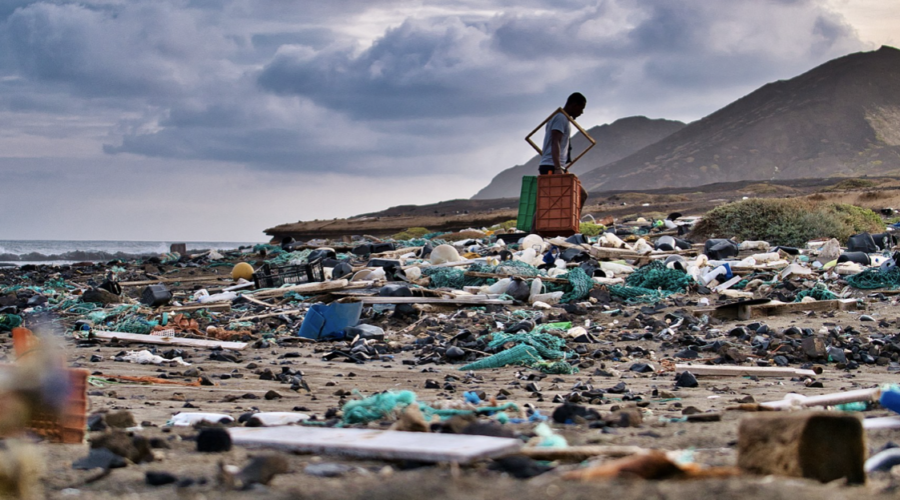
On a global scale, the problem is almost invisible. A single diaper, sealed in its pastel‑coloured wrapping, seems harmless enough. Yet multiplied by the 170 billion produced each year, the picture changes. The world’s infants generate nearly 40 million tons of diaper waste annually, a slow‑moving tide of material that resists decay. At the centre of each diaper lies a substance that most people never see: a fine, crystalline polymer that swells into a gel when wet. These superabsorbent polymers, or SAPs, are made from fossil fuels and linger in landfills and waterways as microplastics. They are the last non‑biodegradable component in an otherwise increasingly sustainable product category. And they are everywhere.
In recent years, the environmental cost of SAPs has become harder to ignore. Wastewater treatment plants report rising levels of polymer fragments. Agricultural soils, treated with water‑retention products that rely on similar materials, accumulate residues that do not break down. Regulators in Europe have begun to scrutinize microplastics with new urgency. Yet the global hygiene and agriculture industries have struggled to find a replacement that matches the performance of fossil‑based SAPs at industrial scale.
It is into this landscape that a small Finnish company, Elea & Lili, has stepped with a claim that sounds almost improbable: a cellulose‑based superabsorbent that is biodegradable, microplastic‑free, and capable of matching the performance of conventional polymers. The company, a spinout from VTT Technical Research Centre of Finland, raised 2.5 million euros in seed funding to industrialize the material, known as Cellulose Super Absorbent, or CSA. The technology and intellectual property behind it were transferred from VTT after more than a decade of biomaterials research.
A Nordic lineage of cellulose science
Finland’s relationship with cellulose is long and intimate. The country’s forests have shaped its economy, its research institutions, and its industrial identity. VTT, founded in 1942, has spent decades exploring the possibilities of cellulose beyond paper and packaging. In recent years, its researchers have turned toward advanced biomaterials: nanocellulose, cellulose films, and chemically modified fibres with properties once thought exclusive to synthetic polymers.
The development of cellulose‑based superabsorbents fits naturally into this lineage. Scientific literature from the past two decades documents a growing interest in modifying cellulose to absorb large quantities of water. Researchers have experimented with crosslinking methods, chemical substitutions, and composite structures that allow cellulose to swell without dissolving. These studies, published across Europe, Asia, and North America, show that cellulose can be engineered into hydrogels with impressive absorbency. But they also reveal the challenges: achieving high performance without compromising biodegradability and doing so at a scale suitable for global industries.
Patents filed in Finland and elsewhere describe various approaches to cellulose‑based absorbents, from chemically modified fibres to crosslinked networks designed to mimic the swelling behaviour of SAPs. These documents provide a sense of the scientific landscape in which Elea & Lili operates, though none of them can be directly tied to the company without explicit public confirmation. They illustrate the complexity of the problem and the diversity of solutions researchers have attempted.
What is publicly known about CSA
Elea & Lili’s CSA material is described as a cellulose‑based alternative to fossil‑derived SAPs, designed to replace them in diapers and agricultural products without reducing performance. It is biodegradable and microplastic‑free, addressing the environmental concerns that have made SAPs a target for regulators and sustainability advocates. The company’s first commercial applications focus on disposable diapers and agricultural water‑retention products, two markets that together represent enormous global demand.
Public sources do not disclose the chemistry behind CSA, the production process, or the specific performance metrics. This is typical for early‑stage deep‑tech companies, especially those emerging from research institutions. The absence of detail does not diminish the significance of the claim, but it does require careful interpretation. What can be said with certainty is that the company positions CSA as a drop‑in replacement for SAPs, compatible with existing manufacturing infrastructure. This is a crucial point. Many sustainable materials fail not because they lack scientific merit, but because they require manufacturers to retool their production lines.
The scale of the challenge
Replacing SAPs is not a trivial task. The global diaper industry alone depends on materials that can absorb many times their weight in liquid, retain it under pressure, and do so consistently across billions of units. Agricultural water‑retention products face similar demands, often under harsher conditions. Any alternative must match or exceed the performance of fossil‑based SAPs while offering clear environmental benefits.
The Nordic region has become a hub for such innovations, driven by strong research institutions, supportive public funding, and a cultural emphasis on sustainability. Finland, Sweden, and Norway have all invested heavily in biomaterials research, seeking to leverage their forest resources in new ways. Elea & Lili’s emergence fits within this broader trend, reflecting a regional commitment to developing materials that align with environmental goals without sacrificing industrial viability.
The future implications
If CSA performs as claimed, the implications are significant. For the hygiene industry, it could mean the first fully biodegradable diaper, eliminating the last persistent plastic component. For agriculture, it could offer a soil‑friendly alternative to water‑retention polymers that currently contribute to microplastic accumulation. For regulators, it could provide a viable pathway to reducing microplastic pollution without disrupting essential industries.
More broadly, CSA represents a shift in how cellulose is understood. No longer confined to traditional roles, cellulose is becoming a platform for advanced materials with properties once reserved for synthetic polymers. This shift has the potential to reshape supply chains, reduce dependence on fossil fuels, and position the Nordic region as a leader in sustainable materials.
What remains unknown
The public record leaves important questions unanswered. The chemistry of CSA, the scalability of its production, the results of lifecycle analyses, and the details of its performance remain undisclosed. These gaps are not unusual, but they matter. As the company moves toward commercialization, transparency will become increasingly important for investors, regulators, and consumers.
For now, Elea & Lili stands at the intersection of scientific promise and industrial ambition. Its success will depend not only on the strength of its technology, but on its ability to navigate the complex landscape of global supply chains, regulatory frameworks, and market expectations.
The world’s diaper problem will not be solved overnight.
But in a laboratory in Finland, a material made from trees may offer a glimpse of a future where even the most ubiquitous products leave no trace behind.