Follow‑up to Forum Nordic’s coverage of Europe’s “drone wall” and the new geometry of lower‑airspace security.
DroneFactory as a Capability
Europe’s scramble to harden the lowest layer of its airspace (where quadcopters, FPVs, and loitering munitions fly) has accelerated from concept to procurement in less than two years. At the centre of this shift is not just counter‑UAS software, sensors, and effectors, but an emerging industrial doctrine: fieldable manufacturing. Sensofusion’s Tactical Drone Factory (hereafter, DroneFactory) proposes a starkly different answer to the stockpiling problem: don’t warehouse drones, warehouse the ability to build them, forward and on demand. The Helsinki‑based firm claims a single ISO‑container can produce ~50 interceptor drones per day, switching designs by swapping digital plans, an approach that could compress kill‑chain adaptation cycles from months to days.
This analysis dissects DroneFactory as a capability platform, and situates it within the EU’s “drone wall,” Nordic border security, and the global counter‑UAS industry. We look at logistics, C2 and EW interoperability, supply‑chain resilience, regulatory friction, and adversary adaptation, drawing on public sources and recent EU and industry moves.
The Obsolescence Trap
In rapidly evolving drone warfare, static inventories age in months. Platforms optimized for last quarter’s threat profile can underperform against new RF signatures, flight envelopes, or autonomous behaviours. Sensofusion frames DroneFactory as a response to this “obsolescence trap,” emphasizing additive manufacturing, on‑board spares, and design‑plan swapping to push the production system itself to the edge.
The logic is reinforced by Europe’s 2025–2026 operational experience: UAS incursions forcing costly, reactive air defence and periodic disruptions of airports and bases across the Nordics and EU. Policymakers have treated these as a hybrid‑threat wake‑up call, catalysing the EU’s drone/counter‑drone Action Plan and an accelerated “drone wall” agenda.
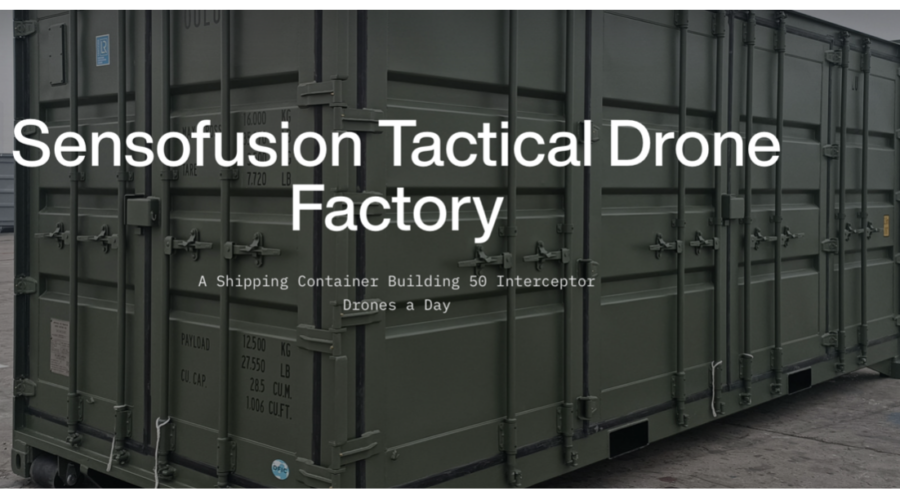
Sensofusion’s press materials and trade coverage describe a 20‑foot ISO container equipped with industrial 3D printers (carbon‑plastic airframes), electronics assembly, materials and spares, and a manned QC station. The claimed throughput is ~50 interceptor drones/day under continuous operations by a small team; reconfiguration requires only an updated design file. It’s pitched as STANAG‑compatible and truck/airlift deployable.
Key points to parse:
- Factory, not product: DroneFactory is agnostic to the specific interceptor; it’s a production platform for whatever modular designs the operator authorizes and certifies. That makes it more akin to a mobile foundry in Europe’s drone‑wall supply chain than a single weapon system.
- Supply‑chain scope: The container can print airframes and assemble electronics, but it still depends on inputs (motors, ESCs, radios, EW payloads, batteries, propellers). The practical constraint is therefore assured parts and cells, not just print speed. (Sensofusion’s public materials highlight onboard inventories but do not disclose BOM burn rates.).
- Software‑defined production: The competitive edge is IP mobility (CAD, flight software, and EW integration recipes) plus the ability to update designs as adversaries iterate. This maps directly onto EU priorities for rapid industrial ramp‑up and civil‑military synergies in counter‑drone tech.
The EU’s Drone Wall: From Slogan to Systems Engineering
Policy Architecture and Timelines
By late 2025, a mix of UAS incursions and NATO air intercepts had hardened political consensus for a multi‑layered “drone wall” on Europe’s eastern and northern frontiers. The European Commission’s Action Plan on Drone and Counter‑Drone Security sketches concrete steps: scaling production, 5G‑assisted detection, single‑air‑picture integration, and a 2026 Drone Security Package including a “EU‑trusted” label and a counter‑drone centre of excellence.
Parallel reporting traces the political momentum: defence ministers’ summits, industry signalling by Saab, Rheinmetall, and BAE, and operational incidents from Denmark to Poland. Think‑tank and trade analyses depict the “drone wall” as a continent‑wide response integrating detection, EW, and kinetic layers, where cost curves and update cycles matter more than exquisite one‑off interceptors.
Where a Portable Factory Fits
DroneFactory aligns with at least three pillars of the EU plan:
- Rapid ramp‑up and sovereign capacity: Forward‑deployed production reduces shipment latency and de‑risks warehousing against technology obsolescence. It potentially supports the Drone and Counter‑Drone Industrial Forum aim to scale European solutions.
- Layered defence economics: Low‑cost, attritable interceptors are essential to economically match adversary swarm tactics, a recurrent lesson from Ukraine and Middle East theatres. A containerized plant that prints airframes and assembles electronics depresses unit cost and speeds iteration.
- Border‑security flexibility: Along Nordic and Baltic borders, terrain and infrastructure are uneven; modular factories can follow risk, co‑locating near C2 nodes, radar/5G detection grids, or logistic hubs, then redeploying as threat axes shift.
Throughput, Changeover, and the “Design‑to‑Field” Loop
Sensofusion’s claimed ~50/day output depends on airframe print time, post‑processing, and electronics assembly cadence. Additive manufacturing helps where airframe variants must morph quickly (e.g., swapping sensor nacelles, arm structures, or interceptor payload mounts). The governing constraint will be electronics integration (RF front‑ends, EW payloads, secure radios) and battery availability, not print speed.
The changeover advantage (loading a new design plan) becomes strategically meaningful only if doctrine and certification keep pace. EU/NATO users will need pre‑approved design families and fast safety cases for new airframes, plus software assurance for flight control and interceptor logic, especially when soft‑kill EW and hard‑kill intercept profiles change. (This mirrors the EU’s call for standardization and live testing, including 5G‑radar use and single‑air display integration.)
C2, EW, and the RF Commons
Counter‑drone operations live in a crowded RF spectrum. A March 2026 announcement by Bittium and Sensofusion highlights successful coexistence testing, showing that RF jamming and anti‑jamming tactical comms can operate side by side without degrading each other’s performance. That matters if DroneFactory‑made interceptors carry EW payloads or operate amid Airfence‑style detection/mitigation and must respect blue‑force comms.
The Airfence ecosystem itself (passive RF detection, AI‑driven signal analysis, soft‑kill countermeasures, and operator geolocation) remains a core Sensofusion pillar. It is already fielded with governmental customers across Europe, North America, the Middle East, and Asia, providing the sensor‑to‑effector glue that DroneFactory‑built interceptors would plug into.
Mobility, Survivability, and Signature
An ISO container is easy to ship, hide in civilian‑looking logistics flows, and reposition. But it’s also a fixed point when operating, vulnerable to ISR and long‑range fires. Hardening measures (EMCON discipline, decoys, rapid teardown, and distributed production cells) will be critical. Europe’s defence press has emphasized the operationalization of the drone wall on an aggressive schedule, implying field testing will stress these survivability details.
Sovereignty, Sanctions Hygiene, and Export Controls
The EU’s Action Plan previews risk assessments to avoid high‑risk suppliers and create an “EU‑trusted” label, reflecting a deeper sovereignty theme across the drone wall. Sensofusion’s footprint (Finland‑based, NATO interoperable, with public statements restricting sanctioned entities) positions DroneFactory within that European‑engineered narrative, which European defence finance analysts have underscored as strategically important.
Procurement and Financing Signals
Open‑source finance profiles indicate Sensofusion completed Series B rounds in 2024 and January 2026, suggesting capital availability to scale production and partnerships, though headcounts and revenue figures vary by source and are partially gated. Regardless, venture‑backed C‑UAS firms are being pulled into sovereign programs at speed as the market swells.
Multiple market surveys project double‑digit growth in the global C‑UAS space through 2030, emphasizing integrated, affordable systems and EW/kinetic mix. For policymakers, the salient insight is less the exact TAM figure than the directional surge in demand, and the premium on interoperable, updateable solutions, the niche where a factory‑as‑a‑platform could differentiate.
Who Else Could Field “Capability Factories”?
While containerized assembly is not unique in defence, forward‑deployed drone production is still emergent. Global competitors in C‑UAS (DroneShield, Dedrone, Rheinmetall, Thales, Northrop Grumman) focus on sensors, effectors, and integration; few publicly market a mobile drone‑manufacturing platform. Trade directories and industry reports catalogue over 550 companies in C‑UAS, but production‑platform offerings remain limited and nascent in the public domain. That represents both a first‑mover advantage and a target for fast followers.
The Northern Frontier
The Nordics have tasted the operational nuisance of low‑altitude intrusions, from Copenhagen airport closures to sightings over bases and coastal infrastructure, framed by analysts as grey‑zone probes. As Finland, Sweden, and Norway integrate deeper with NATO and EU defence projects, modular production nodes co‑sited with detection layers (including 5G‑assisted sensing) could shorten the detect‑decide‑deploy loop for interceptors.
Local press has highlighted Finland’s role and Sensofusion’s capabilities (operator geolocation, long‑range detection claims, early U.S. Marine Corps work), suggesting national ecosystem readiness to pilot such platforms along the eastern border and Gulf of Finland approaches.
Procurement Mechanics on the Eastern Flank
The Eastern Flank Watch initiative (announced Helsinki, Dec 2025) indicates Finland‑Poland co‑leadership of border hardening, an environment primed for pilot deployments of industrial innovations that improve resilience and tempo. In that integrated air picture, DroneFactory would not displace existing procurement streams (radars, C2, EW) but feed them with attritable interceptors that update as threat signatures evolve.
Risks, Frictions, and the Adversary Vote
The Battery and Motor Bottleneck
Even with on‑board spares, battery chemistry and motor supply are the tactical choke points. Cell quality, cold‑weather performance, and safe storage impose space‑and‑weight penalties that can erode nominal throughput. Trusted‑supplier sourcing (already on the EU’s radar) must be squared with scale and price to maintain affordability against swarms.
Certification and Safety Cases
A factory that can change designs with a file push raises airworthiness and safety questions for interceptors, especially over civilian‑adjacent border regions. The EU’s 2026 Drone Security Package, the “EU‑trusted” label, and a counter‑drone centre of excellence are precisely the institutional tools to standardize accelerated certification, but they must be designed with fieldable manufacturing in mind.
Spectrum Conflicts and Blue‑on‑Blue Risk
C‑UAS operations frequently involve RF jamming, spoofing, or takeover, all of which can degrade tactical comms if poorly coordinated. The Bittium–Sensofusion interoperability tests are a positive indicator, but multi‑vendor deployments across borders and agencies will demand joint trials and doctrine.
Adversary Adaptation
The enemy gets a vote. Expect RF agility, autonomy (GNSS‑denied navigation), decoy swarms, and low‑RCS profiles to blunt passive RF detection and classic jamming. The value proposition of DroneFactory, then, is not a frozen design, but the cadence at which it can push new airframes and payloads into the fight, so long as data from the front (Nordic patrols, Eastern flank incidents) flows back into design updates. Think of it as coupling intelligence cycles to manufacturing cycles.
Next 12–24 Months
- Pilot deployments of containerized production on EU borders or training areas; indicators might appear in EU testing calls and national procurement notices aligned to the Action Plan.
- Interoperability frameworks: Formal CONOPS and TTPs for operating Airfence‑class detection + interceptors + tactical comms without RF fratricide; watch for joint flight tests publicized via Nordic MODs or vendors.
- Industrial partnerships: Whether European primes (e.g., Saab, Rheinmetall) move to license or bundle forward‑manufacturing modules, signalling mainstreaming beyond niche pilots.
- Supply‑chain localization: EU‑trusted labelling and supplier diversification to derisk cells, motors, RF modules; monitor the Industrial Forum output for concrete roadmaps.
- Adversary counter‑adaptations: Any reporting on autonomous penetration tactics or 5G counter‑surveillance measures that stress existing detection layers (EU’s 5G‑as‑radar experiments will be a bellwether).
DroneFactory is less a product story than an industrial‑tempo story. If Europe’s “drone wall” is to be more than a procurement slogan, it must out‑iterate a learning adversary at the cheapest layer of air defence. Containerized, software‑defined manufacturing could make that possible if the EU couples it to standards, interoperability, and trusted supply.
For Nordic readers and policymakers, the opportunity is to test this concept where the requirement is clearest: distributed border sectors with harsh climates and civilian‑adjacent risk envelopes that demand rapid, certified, and affordable counter‑UAS effects. The strategic prize is agility, the capacity to change faster than the threat.
Methodology & Source Notes
This article integrates vendor announcements, EU policy documents, think‑tank and trade analyses, financial databases, and industry directories. All claims grounded in public materials are referenced below.
References
- ASDNews. (2026, March 9). Bittium and Sensofusion collaborate to develop interoperability in tactical communications and anti-drone systems. https://www.asdnews.com/news/defense/2026/03/09/bittium-sensofusion-collaborate-develop-interoperability-tactical-communications-antidrone-systems [asdnews.com]
- Chatham House. (2025, October 1). A ‘Drone Wall’ is needed for Europe to defend against a new threat. https://www.chathamhouse.org/2025/10/drone-wall-needed-europe-defend-against-new-threat[chathamhouse.org]
- CNBC. (2025, October 2). Defense giants welcome Europe’s push to build a drone wall. https://www.cnbc.com/2025/10/02/defense-bae-saab-and-rheinmetall-welcome-europes-drone-wall-plans.html[cnbc.com]
- European Commission. (n.d.). Action Plan on Drone and Counter Drone Security. Retrieved March 16, 2026, from https://digital-strategy.ec.europa.eu/en/policies/drone-security [digital-st….europa.eu]
- European Security & Defence. (2026, March 13). Europe’s Drone Wall – Ready, EDDI, Go! https://euro-sd.com/2026/03/articles/exclusive/49854/europes-drone-wall-ready-eddi-go/ [euro-sd.com]
- MarketsandMarkets. (2025, October). Counter‑Unmanned Aircraft System (C‑UAS) Market—Global Forecast to 2030. https://www.marketsandmarkets.com/Market-Reports/counter-cuas-systems-market-4197284.html[marketsand…arkets.com]
- PitchBook. (2026). Sensofusion: Company profile—Valuation, funding & investors. https://pitchbook.com/profiles/company/343063-72 [pitchbook.com]
- sUAS News. (2026, March 15). Sensofusion Tactical Drone Factory: A shipping container that builds 50 interceptor drones a day. https://www.suasnews.com/2026/03/sensofusion-tactical-drone-factory-a-shipping-container-that-builds-50-interceptor-drones-a-day/ [suasnews.com]
- Unmanned Airspace. (2026, March 11). The 2026 global counter UAS industry directory is now available. https://www.unmannedairspace.info/counter-uas-industry-directory/ [unmannedai…space.info]
- The Business Research Company. (2026, March). Counter‑Unmanned Aircraft Systems (UAS) Market Report. https://www.thebusinessresearchcompany.com/report/counter-unmanned-aircraft-systems-uas-global-market-report [thebusines…ompany.com]
- Yrittäjät (Federation of Finnish Enterprises). (2025, September 19). Finnish company could play big role in building drone wall. https://www.yrittajat.fi/en/news/finnish-company-could-play-big-role-in-building-drone-wall/ [yrittajat.fi]
- Defence Finance Monitor (LinkedIn post). (2026, January 15). Sensofusion closes counter‑drone gap with European engineered solution. https://www.linkedin.com/posts/defence-finance-monitor_sensofusion-oy-strategic-analysis-of-c-uas-activity-7416485374782423040-xTFv [linkedin.com]
- Modern Diplomacy. (2025, October 16). EU unveils ‘Fortress Europe’ plan to counter drones, secure borders. https://moderndiplomacy.eu/2025/10/16/eu-unveils-fortress-europe-plan-to-counter-drones-secure-borders/[moderndiplomacy.eu]
- Sensofusion. (n.d.). Airfence—Advanced anti‑drone system. Retrieved March 16, 2026, from https://sensofusion.com/ [sensofusion.com]
- Access Newswire. (2026, March 13). Sensofusion Tactical Drone Factory: A shipping container that builds 50 interceptor drones a day. https://www.accessnewswire.com/newsroom/en/aerospace-and-defense/sensofusion-tactical-drone-factory-a-shipping-container-that-builds-50-interc-1147434 [accessnewswire.com]
- Defense Update. (2025, October 12). Europe’s “Drone Wall”. https://defense-update.com/20251012_europes-drone-wall.html [defense-update.com]