Far above the Arctic Circle, in places few people ever visit, lie some of the world’s northernmost peatlands, vast, water‑logged carbon stores built slowly over millennia. They look simple: mosses, sedges, dwarfed shrubs, ice, wind. Yet these ecosystems are among the most complex climate regulators on the planet. They lock away extraordinary amounts of carbon, regulate hydrological cycles, cool regional climates, and buffer against runaway warming.
A major new set of findings from NIBIO (Norwegian Institute of Bioeconomy Research) has now revealed something both intuitive and startling: increasing water levels can lower emissions from Arctic peatlands. The research, conducted at the world’s northernmost peatland, demonstrates that the relationship between water, soil, microbes and carbon release is more dynamic than previously understood. These insights could reshape climate‑mitigation models for high‑latitude ecosystems and influence land‑management strategies across the Nordic region.
Earth’s climate vaults
Peatlands cover only about 3% of the global land surface, but store roughly twice as much carbon as all the world’s forests combined. Their defining feature is water. When soils stay saturated, organic matter decomposes slowly, locking carbon underground. When peat dries, even briefly, it becomes an emissions source, sometimes releasing centuries of stored CO₂ and methane in a matter of days.
This precarious balance makes Arctic peatlands acutely sensitive to temperature rise, permafrost thaw, changing precipitation, and hydrological disturbances such as drainage or infrastructure development. The Arctic is warming at nearly four times the global rate, amplifying the risk.
It is in this context that the new NIBIO findings have drawn international attention: they show that controlling water levels may be one of the most powerful levers for stabilizing carbon storage in northern peat systems.
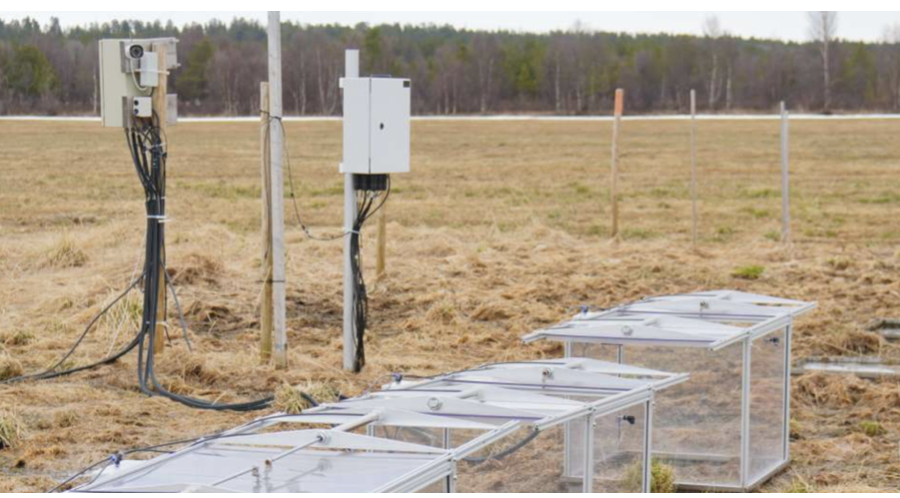
The NIBIO team monitored emissions across the northernmost peatland studied to date, examining how varying water table heights influence greenhouse gas release. Their headline conclusion is both simple and profound: “More water, lower emissions.”
Higher water tables were associated with:
- Reduced CO₂ emissions
- Stabilization of organic‑matter decomposition
- Lower overall carbon losses
Why does this happen? In saturated conditions, microbial decomposition becomes oxygen‑limited. This dramatically reduces aerobic breakdown of organic matter, a process that would otherwise release large quantities of CO₂.
The findings also align with emerging European peatland research demonstrating that rewetting degraded peatlands can transform them from major emitters back into net carbon sinks. But the Arctic adds complexity: temperature thresholds, permafrost dynamics, and seasonal hydrology interact in ways that temperate peatlands do not.
What makes NIBIO’s study significant is that it delivers direct field evidence from the high Arctic itself, something scientists have long speculated about but rarely measured at this granularity and latitude.
Peatland scientists often refer to hydrology as the master variable, controlling almost everything that happens within the system:
1. Carbon sequestration and release
A high water table slows decay, maintaining carbon in long‑term storage. A low water table exposes peat to oxygen, accelerating oxidation and carbon loss.
2. Vegetation composition
Moisture determines which plants dominate, mosses that build peat, sedges that ventilate soils, or shrubs that accelerate decomposition.
3. Permafrost stability
Water distribution impacts freeze‑thaw dynamics and the structural integrity of permafrost layers.
4. Microbial communities
Hydrological changes reorganize microbial assemblages, altering the balance between CO₂‑producing and methane‑producing organisms.
The NIBIO findings reinforce the idea that water management, not just temperature, could be a crucial factor in Arctic climate resilience.
Methane vs CO₂
One of the long‑standing debates in peatland science is the methane paradox:
When peatlands are wetter, methane emissions typically rise, because methane‑producing microbes thrive in oxygen‑poor soils. Methane is a potent greenhouse gas, so scientists question whether rewetting truly reduces overall climate impact.
But in many Arctic systems, including those in the NIBIO study:
- Methane increases were relatively small
- Carbon dioxide reductions were large and meaningful
- Net radiative forcing favoured rewetting
This suggests that not all peatlands behave the same, and Arctic peatlands may respond more favourably to hydrological restoration than previously assumed.
Climate implications
1. A new lever in Nordic climate mitigation
Scandinavian nations, including Norway, Sweden and Finland, have been evaluating land‑use strategies that reduce emissions from peat agricultural fields. But Arctic peatlands, previously considered too remote or too sensitive to manage, may now enter the policy conversation.
If hydrology adjustments can reduce emissions, even selectively, these landscapes become active climate‑policy assets rather than passive risks.
2. Integrating hydrology into national GHG accounts
Land‑use emissions are notoriously difficult to quantify. Norway already reports emissions from agriculture, forestry, and land degradation. Incorporating peatland hydrology metrics could provide more precise assessments and more accurate projections for 2030 and 2050 climate targets.
3. Rising urgency due to Arctic warming
Because the Arctic is warming faster than the rest of the planet, the risks of peat drying, permafrost thaw and carbon loss are accelerating. The NIBIO findings suggest that hydrological buffering may prevent tipping points in vulnerable northern landscapes.
Threats to Arctic peatlands
1. Permafrost thaw
Thawing destabilizes peat layers, triggers collapse features and exposes deep carbon to decomposition.
2. Changing precipitation patterns
Arctic regions are projected to experience more rainfall but also more evaporation, making water balance unpredictable.
3. Infrastructure development
Roads, pipelines and energy installations can disrupt natural water flows dramatically.
4. Wildfire risk
Once extremely rare in the high Arctic, fires are becoming more common as peat dries.
With these threats rising, managing hydrology is increasingly seen not as interference, but as damage control.
How hydrological management could work
While large‑scale engineering in the Arctic is neither feasible nor desirable, several subtle, low‑impact interventions could improve hydrological resilience:
- Blocking old drainage channels
Even minor legacy ditches can drastically lower water tables. - Restoring natural flow paths
Reconnecting bogs with upstream wetlands slows drainage. - Re‑vegetation using Sphagnum moss species
Mosses help retain water and initiate peat‑forming processes. - Reducing disturbance from infrastructure
Rerouting roads or managing culvert placements can reestablish natural saturation patterns.
These approaches mirror successful interventions in northern Finland and Sweden, where selective peatland rewetting has significantly reduced emissions.
The NIBIO findings strengthen the case for evidence‑based hydrological restoration in Norway’s Arctic peat landscapes.
The political and economic dimensions
1. A cost‑effective climate tool
Restoring hydrology is far cheaper than high‑tech mitigation projects. For governments under pressure to deliver rapid, cost‑efficient emissions reductions, peatlands represent a high‑leverage opportunity.
2. Indigenous and local considerations
Peatlands are integral to Sámi reindeer‑herding landscapes. Any interventions must respect ecological dynamics that support grazing, migration and cultural heritage.
3. Research investment alignment
These findings align with broader Norwegian funding initiatives focused on societal security, climate resilience and environmental preparedness, including Research Council calls for climate‑smart land management and Arctic environmental monitoring.
What remains unknown
Despite the promising findings, significant uncertainties remain:
- How will permafrost dynamics interact with hydrological restoration?
- What are the long‑term methane trajectories under wetter conditions?
- Can peatlands be rewetted selectively to maximize CO₂ reduction while minimizing methane increases?
- How do wildfire risks change under different water regimes?
- What are the crossover thresholds, where hydrological benefits diminish or reverse?
The NIBIO team’s field measurements provide the strongest current basis for exploring these questions. But long‑term monitoring, especially through the 2030s, will be essential.
The Arctic is often described as a sentinel of global climate change. Its landscapes respond quickly, visibly and sometimes catastrophically. Peatlands are among the most sensitive of these systems, capable of swinging from carbon sinks to carbon sources with small hydrological shifts.
The new NIBIO findings provide a hopeful message: we can influence this trajectory.
By maintaining or restoring higher water tables, it may be possible to slow carbon loss, stabilize peat structures, and prevent dangerous feedback loops.
This reframes Arctic peatlands not merely as vulnerable ecosystems but as active components of climate mitigation strategy, if managed with care, respect and scientific rigor.
As policymakers, researchers and Nordic climate strategists absorb these findings, the question becomes clear:
Will the Arctic’s water be allowed to protect its carbon, or will changing hydrology accelerate the release of a climate time‑bomb?